


1 INTRODUCTION: COVID‐19 AND OLDER PEOPLE
Several months prior to the COVID‐19 crisis, before the first infections had been reported in Belgium, it had become clear that severe acute respiratory syndrome coronavirus 2 (SARS‐CoV‐2) causes a higher mortality rate amongst older people (Chen, Li et al., 2020; Chen, Zhao, et al., 2020; Guan, et al., 2020; Mueller, 2020; Zhou et al., 2020). It is no surprise that the combination of age and multimorbidity makes older adults living in close contact in nursing homes highly vulnerable to COVID‐19 infections (Chen, Li, et al., 2020; Chen, Zhao, et al., 2020; Guan, et al., 2020; Stall et al., 2020). It became clear that the pandemic would hit nursing homes harder than hospitals (Thornton, 2020; ECDC Public Health Emergency Team, D. K., 2020; Graham et al., 2020 ; Zimmerman et al., 2020; O’Hanlons et al., 2020). Most nursing homes in Belgium proved unprepared for the crisis. Moreover, this crisis exposed a long‐standing shortcoming in the country’s healthcare organisation, and specifically in the area of integrated care for older people. The collaboration between nursing homes and hospitals mainly focused on admission and discharge planning (e.g., efficient communication and accurate medical information and care plans). While these aspects are essential for optimal continuity of care, quality of life and prevention of early readmission (Zurlo & Zuliani, 2018), they were insufficient in the face of the current crisis. The COVID‐19 pandemic has shown that, in addition to the focus on transitional care, more efforts are needed regarding the exchange of expertise and continuous bilateral interaction between both levels and focus of care. Such knowledge exchange would create a learning environment that could offer permanent, high‐quality integrated care to patients and residents (LaMantia et al., 2010). Such initiatives should be taken proactively in order to avoid future disasters. A case study from Belgium is used to illustrate this point.
2 CASE STUDY: A COLLABORATION BETWEEN NURSING HOMES AND A UNIVERSITY HOSPITAL IN BELGIUM
In Belgium, 20.2% of the total population are aged 65 or older, of whom 5.7% live in residential nursing homes (Agentschap Zorg en Gezondheid, 2019; Devos, 2019). The first COVID‐19 infections in nursing homes were reported early March, but official records began on March 18. To date, 94% of the confirmed COVID‐19 deaths reported in Belgium involved persons aged over 65, while 54% were 85 years or older at the moment of death (Sciensano, 2020a). In the period from March 18 to September 19, a total of 4847 deaths were recorded in nursing homes after suspected COVID‐19 infections (Sciensano, COVID‐19.Sciensano, 2020b).
The level of integrated care between nursing homes and hospitals is essential for good quality of care, but is mostly limited to practical collaborations aimed at adequate referral, sharing health of records and sharing expertise from a hospital‐centric point of view. This can be considered a limited degree of integration (Ahgren & Axelsson, 2005; Leutz, 1999; Valentijn, 2013). This situation is partially due to the fact that nursing homes and hospitals fall under the jurisdiction of different governmental levels, complicating integrated care and making efficient cooperation difficult, (Eeckloo et al., 2011). During a pandemic crisis in particular, a strong healthcare system with a ‘one health’ approach and with efficient leadership and a clear crisis policy is indispensable (De Ceukelaire & Bodini, 2020). Moreover, increased privatisation has perhaps stressed the nursing home system even more, as demonstrated in other countries (Harrington & Pollock, 1998).
To date, this system has maintained a fragile balance, with no pressing issues to force different governments to question it. However, pandemics do not take organisational structures or political sensitivities into account, and COVID‐19 has exposed the fragility of the current system and the insufficiency of integrated care projects.
The main shortcoming in policies for prevention and crisis management in nursing homes included inapplicable guidelines on infection prevention and isolation, the lack of trained staff, and the lack of protective materials (Thornton, 2020). If there were guidelines, they often proved inapplicable to older adults with specific care needs. This situation could be addressed in two ways: (a) broaden the hospital admission criteria for older adults who were possibly infected with COVID‐19, creating a risk of over usage and putting great pressure on hospital capacity, or (b) set up a partnership between nursing homes and hospitals which would enable the nursing homes to manage this specific and complex care in their own environment.
The first option involves referring all patients with fever and respiratory symptoms to acute hospitals, even when their need for hospital care is limited. This can be an efficient approach to preventing the spread of COVID‐19 within nursing homes (Tan and Santhosh, 2020), but is not always possible due to the risk of reducing the number beds for patients who need critical acute care and the possible consequences for residents of removing them from their familiar environment.
The second option has developed organically and has been implemented by Ghent University Hospital in cooperation with nursing homes in its immediate surroundings. Ghent is the second largest city in the Flemish community. Within this community, 819 nursing homes (220 public, 253 for profit, and 345 social profit) house more than 80,000 residents (Agentschap Zorg en Gezondheid, 2019).
From mid‐March, alarming signals and support questions reached the hospital from these nursing homes. In order to meet the needs of the nursing homes, a partnership was set up to cover the different phases of the crisis, resulting in a collaboration that fulfils needs that normally would have been covered by an integrated care model involving different levels of health care. This response to the COVID‐19 nursing home crisis had a number of different phases with steps that are also seen in other healthcare system responses (Figure 1; Kim et al., 2020; Stall et al., 2020).
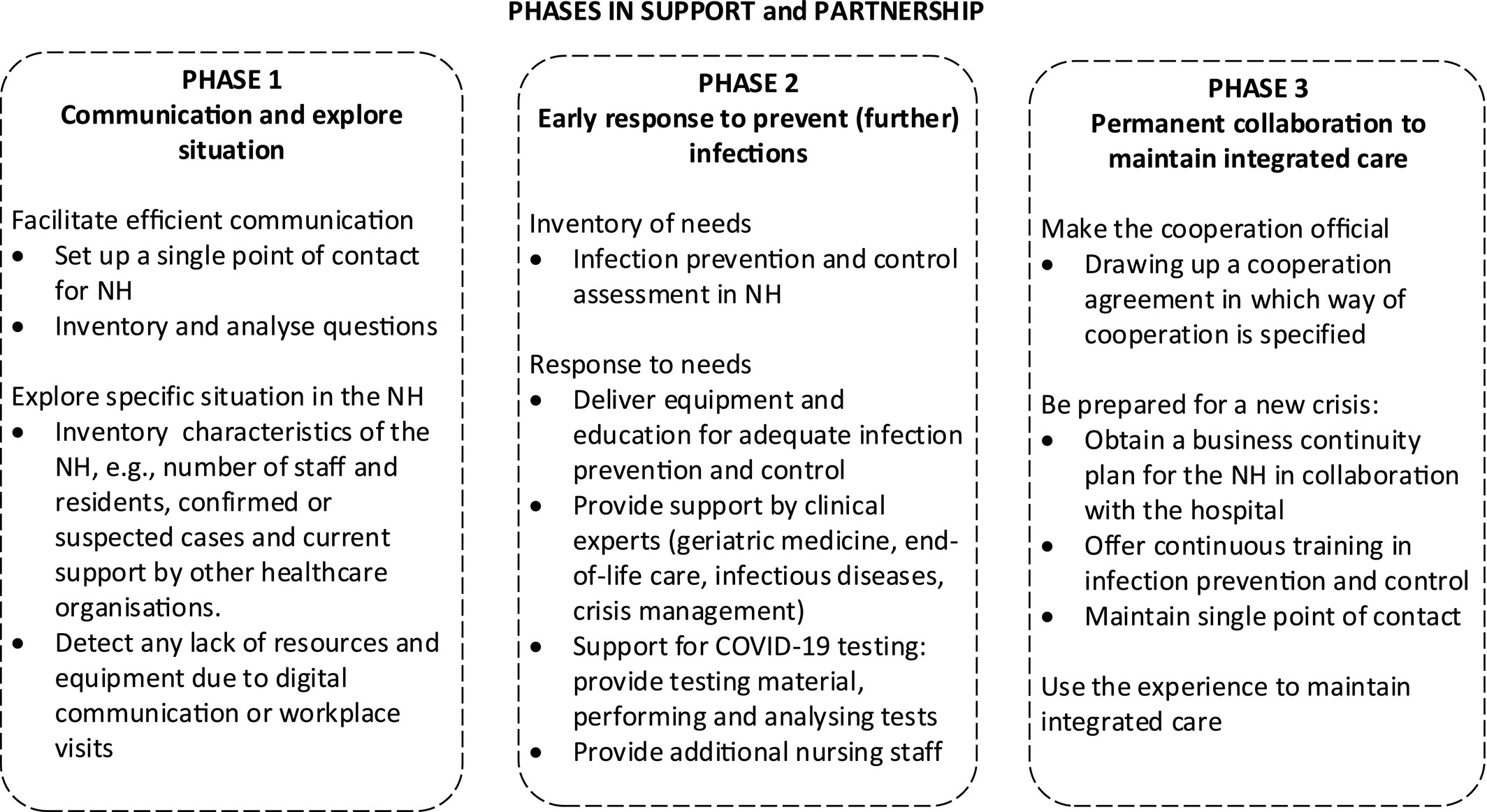
Phases of support and partnership between nursing homes and the hospital during the COVID‐19 crisis
In the initial phase, interventions were set up (a) to create an easily accessible single point of contact (a contact centre) where all questions and needs were collected and monitored, (b) to gain insight into the specific characteristics of the nursing homes (such as numbers of residents and staff, and of confirmed and suspected COVID‐19 cases, and the existing support from other healthcare organisations), and (c) to detect any lack in resources and equipment (including personal protective equipment and testing material) or in the clinical expertise needed to manage outbreaks.
The second phase involved an assessment of the specific situation for each nursing home: an immediate response to prevent the further spread of the virus. Between April 10 and May 29, a total of 26 hospital nurses from staff and management were employed in eight care homes. These provided support for several weeks in the regular and cohort wards, based on the expertise they had gained in the hospital. In addition, several workplace visits were performed by staff members with clinical expertise in infectious diseases, geriatricians and psychologists. The purpose of these visits was to obtain the information needed to tailor existing procedures to the nursing home context and its specific population. Depending on the situation of the individual residential care centre, this could involve architectural advice, treatment of laundry, infection prevention training and testing protocols.
In the last stage of the partnership, the support led to a more permanent collaboration. This collaboration aimed to guarantee the results and to maintain this form of integrated care. To achieve this, an official cooperation agreement was drawn up. Within the agreement, possible support is specified (medical expertise, training, material, medication).
3 CONCLUSION AND ADVICE
In order to meet the urgent need for support for residential care centres during the COVID‐19 pandemic, an intense collaboration and partnership was set up between the hospital and several nursing homes. This collaboration and support required significant effort and resources from the hospital. As shown, hospitals can play an important role in transitional care interventions and in coordination of chronic care with better outcomes for patients by taking a leading role in integrated care programs. (De Regge, et al., 2017). In this particular crisis, Belgian hospitals, including Ghent University Hospital, were able to provide the necessary support by requiring postponement of non‐urgent admissions and procedures from the beginning of March. This case study shows that integrated care is possible and that both the hospital and the nursing homes benefit from such a system. They have experienced at first hand that the care‐as‐usual approach is broken. Additional funding and structural changes are needed to make integrated care possible. Ghent University Hospital will continue to support the nursing homes in the region to the best of its ability and to address acute needs for support in the future. But we do strongly recommend that action is taken towards integrated care immediately, and not delayed until the next crisis. Pressure on policy makers should be increased to enable integrated care in a structural manner, overcoming any political sensitivities or structural difficulties. This type of joint approach requires specific responsibilities of the different actors and within each aspect of a crisis (Figure 2).
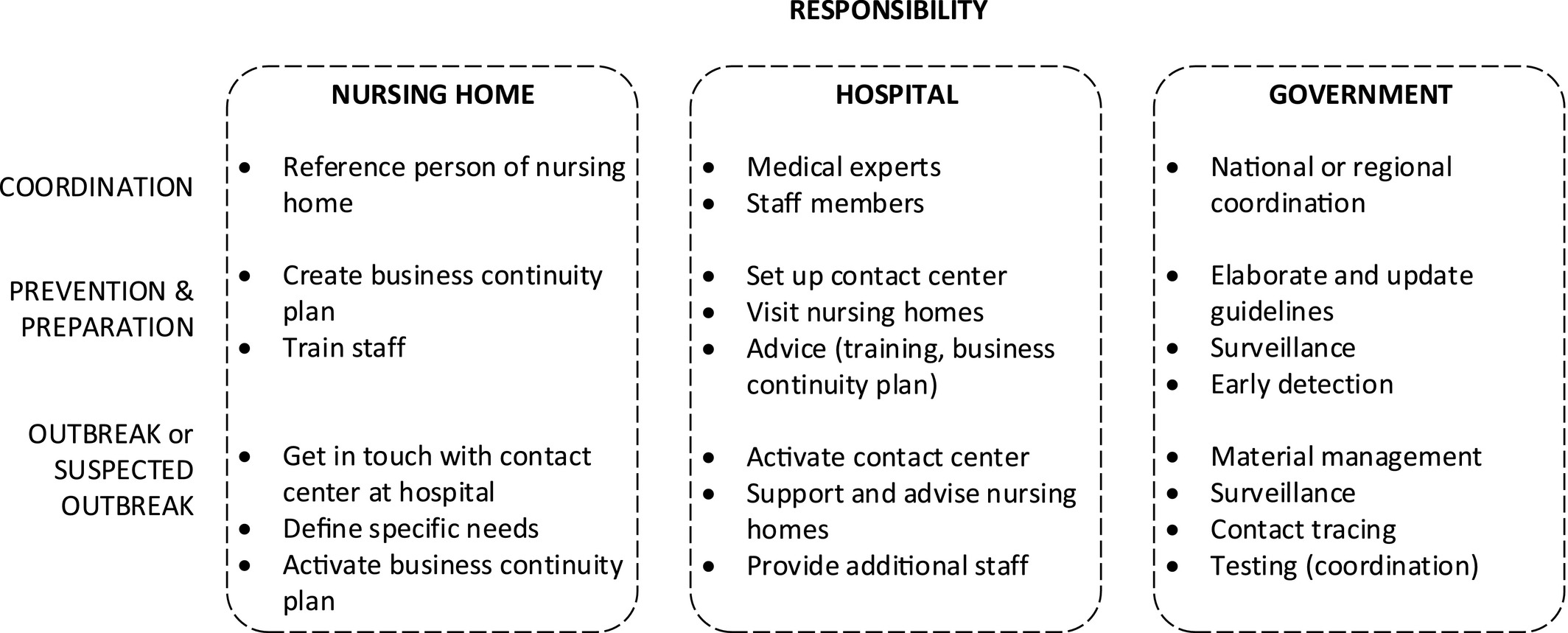
Overview of responsibilities for each actor
A global approach based on the strengths of each actor could include the development of a tailored crisis plan on which healthcare providers from the nursing homes can rely. This business continuity plan (BCP) should not only consist of protocols, but also focus on how and which medical expertise can be obtained. In this way, nursing homes become a lot more self‐reliant in times of a pandemic crisis. In the long‐term, the objective should be that the nursing homes are better prepared for similar crises and that a clear consultation and advice structure are developed with the hospital and medical experts.
This model of collaboration must ensure that nursing homes do not become small hospitals, but that they can rely on the knowledge of medical experts in an efficient and effective manner, when necessary. Moreover, as stipulated in the introduction, integration of care with a focus on creating a learning environment for both hospitals and nursing homes must be part of post‐COVID healthcare organisation, if qualitative and patient‐centred care for older people living in nursing homes is to be ensured.
By critically reflecting on and studying our case study and being transparent about the flaws in our healthcare system, we hope to convince colleagues of the importance of proactively working towards integrated care in its truest meaning. Only by offering efficient transitional care and knowledge exchange between hospitals and nursing homes, disasters like COVID‐19 can be avoided.
CONFLICT OF INTEREST
No conflict of interest has been declared by the authors.
AUTHOR CONTRIBUTIONS
All authors have contributed to the conception and writing of paper. All authors have had a significant doing in drafting and revising the article for important intellectual content.
Recent Comments