

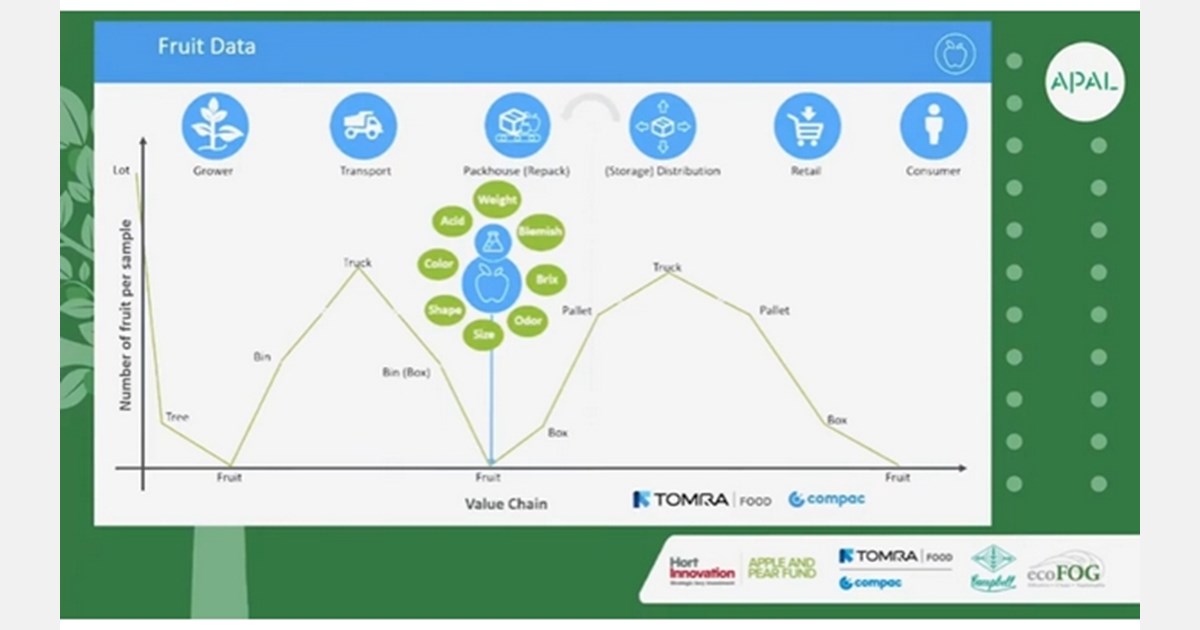

Fruit and production data can be used in ways that it has never been done before to improve a company’s efficiency and boost profits, according to global packhouse equipment and automation supplier Tomra Food.
The company is renowned for supplying turn-key packhouses across a range of horticulture commodities. Speaking at the recent APAL Post-Harvest Seminar, Director of Solutions Architecture, Paul Ramson says the data that is able to be collected and recorded can feed back into everyone’s improvement in the supply chain.
“The hort industry is under enormous pressure around the world for development,” he said. “There is demand growth, climate change, weather events, changing consumer trends, legislation and trade deals. The industry responds with growth in acreage, varietal development, supply chain optimisation, product diversification and automation. More than ever the industry is turning to ‘data’ to help drive better decision making and improve pack out. Packing and grading equipment generates a significant amount of data that is very useful to the industry. The reality is that change is happening rapidly, and in 20 years from now it is going to seem a million times advanced that what it is today.”
He added that there are several different useful data types at play in a packhouse; production and traceability level data, performance level data, quality data and auditing data. This data can be used to optimise the supply chain and can be used to make decisions and directions in terms of the next big thing that needs to be done. But consumer trends will constantly change the requirements of automation.
“The best thing about data is that it is available now,” Mr Ramson said. “You can have it on existing systems, you can retrofit it into existing platforms and you can gather it today. Inside the packing house, we have the unique opportunity to look at the fruit in an individual sense; when it is first picked off the tree in a harvesting setup, it is a very manual process with a lot of people involved so there is not a lot of automation that is able to be deployed. But inside the packhouse, a fruit sorter, like Compac manufactures, individually looks at every piece of fruit and we get this one chance in time to take a snapshot of a piece of fruit. We can learn everything about it, such as the internal/external quality, weight, shape, size and firmness.”
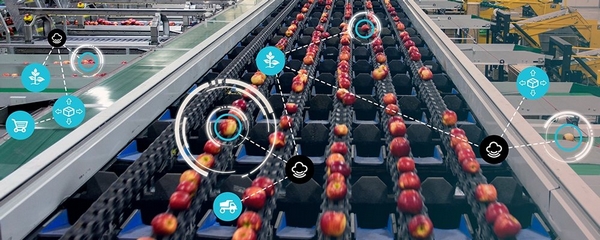
Mr Ramson says that it is “very important” that good data is manufactured during this process. It is valuable not only to go back to the grower but downstream to the retailer to talk about the product that they are about to receive and ultimately the consumer experience.
“It needs to be of a high enough resolution to give the ability to look down at small pieces of data and small enough changes between them to be able to make a decision at the right time,” he said. “But most importantly, the data needs to be accurate and correct; bad data in is going to equal bad decisions out. With good data being brought in and being integrated through a good universal cloud data collection system, you can analyse and correlate a lot of that information, visualise and report it and ultimately display it in a summarised and contextualised format. It is effectively a map of the next step that you could do.”

Tomra Food has a team of designers and engineers that design a solution that will maximise the capabilities of the client’s packhouse on an individual basis. Two of the latest pieces of the company’s technology are Inspectra2 (Near-infrared inspection) and Spectrim (optical sorting platform), with Insight, the cloud-based platform that brings all the data together.
The system has been able to advance the level of data that is being collected and analysed, from detecting a piece of fruit has an external brown mark to be able to determine what it is and how much of the fruit is affected.
“It comes up with a common grading approach to make a decision on whether an apple, for example, is good, okay or bad,” Mr Ramson said. “What you end up with as output is those clear decisions. With smart grading, it has got all the aspects of good data. It is contextualised, instead of just dark marks, you are naming it to your local challenges, to your local physiology and defects – it could be russet or rot. But it is what you want to feed back to the grower. You may not need this level of blemish inspection to make the decision of first to second class (fruit), but you do need this level of inspection to send up and down the supply chain and make changes.”
The company is working on a number of different “fruit science” projects globally that will help develop a connection between growing practices in the field right through to packing practices and ultimately the end result for the consumer.
“By tracking it across an entire division and the different paths to market, we can understand the effects of storage, shipping, packing methods and packaging can have on that piece of fruit,” Mr Ramson said. “Looking ahead, there are a lot of opportunities for this high-quality,  high-level fruit data to be applied up and down the supply chain. One could be building predictive fruit models based out of recording this data and capturing what the results look like and challenges. Payment changes could really be happening in terms of the relationship and understanding of what this data could mean towards the eating experience. This includes opportunities for payment for taste; good quality fruit that isn’t as pretty on the outside, but is still good fruit, means there is room for diversification of that fruit.”
For more information
Paul Ramson
Tomra Food Compac
Phone: +64 9 634 0088
[email protected]
www.compacsort.com
www.tomra.com/en/sorting/food
Recent Comments