


This article appeared in Electronic Design and has been published here with permission.
What you’ll learn:
- How does the rapid-response detection unit work?
- What components were used to create the RapidPlex unit, and how was it built?
It would be a major advance if there was a basic test instrument or front end that could determine if someone harbors the COVID-19 virus—and soon that might be a reality. A team at the California Institute of Technology (Caltech) has developed a standalone electronic-based unit with highly tuned, specific biochemical tags that may enable “on the spot” testing for the presence of the virus—even in persons who show no symptoms. Results would arrive in about 10 minutes.
The team’s SARS-CoV-2 RapidPlex unit uses a combination of multiple, low-cost sensors, followed by data processing and reporting to the user’s smartphone and even linked telemedicine aspects (Fig. 1).
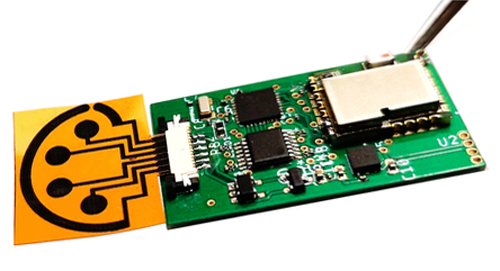 1. With the exception of the sensor array, the unit uses standard electronic components and fabrication techniques, and includes an integral Bluetooth module.
These sensors can detect extremely low levels of specific components in blood, saliva, or sweat. The unit electrochemically quantifies three important molecular biomarkers:
- The SARS-CoV-2 nucleocapsid protein (the virus itself)
- The anti-spike immune response proteins IgG and IgM (antibodies to the virus)
- The C-reactive protein (CRP) (inflammation linked to infection severity)
- The unit rapidly detects these biomarkers as well as high molecular sensitivity and selectivity. The results of the pilot study indicate that it can successfully detect these biomarkers in COVID-19-positive patient serum and saliva samples, and CRP results are well-correlated with the severity of symptoms.
Important disclosure: So far, the device has only been tested in the lab with a small number of blood and saliva samples obtained for medical research purposes from individuals who have tested positive or negative for COVID-19. Lead researcher Prof. Wei Gao noted that although preliminary results indicate that the sensor is highly accurate, a larger-scale test with real-world patients rather than laboratory samples must be performed to definitively determine its accuracy.
In addition to the deep understanding of the relevant and highly sophisticated biochemistry, the key to the viability of this instrument are the sensors and their coatings. The platform uses captured antigens and antibodies immobilized on graphene electrodes that have been laser engraved to create micropores. This low-cost, mass-producible process creates a large surface area on the sensor to make it sensitive enough to detect compounds that are present only in minuscule amounts.
The RapidPlex sensor array has four graphene working electrodes (WEs), an Ag/AgCl reference electrode (RE), and a graphene counter electrode (CE). All of them are patterned on a polyimide (PI) substrate via CO2 laser engraving, which is a fast, high-throughput and cost-effective production method (Fig. 2).
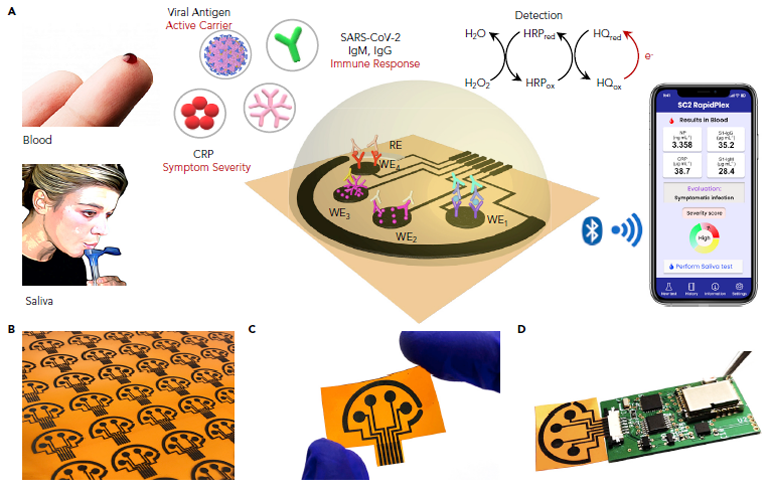 2. (A) Schematic illustration of the SARS-CoV-2 RapidPlex multisensor telemedicine platform for detection of SARS-CoV-2 viral proteins, antibodies (IgG and IgM), and inflammatory biomarker C-reactive protein (CRP). Data can be wirelessly transmitted to a mobile user interface (WE, working electrode; CE, counter electrode; RE, reference electrode). (B) Mass-producible laser-engraved graphene sensor arrays. (C) Photograph of a disposable and flexible graphene array. (D) Image of a SARS-CoV-2 RapidPlex system with a graphene sensor array connected to a PCB for signal processing and wireless communication.
Graphene’s superior properties of high charge mobility and surface area, combined with the high sensitivity and selectivity of sensing strategies involving both capture and detector receptors, should make this device a convenient tool for the rapid, accurate and stage-specific detection of COVID-19 infection in blood, as well as in non-invasive biofluids such as saliva.
The sensor coating uses 1-Pyrenebutyric acid (PBA) as the “linker” to anchor the required receptors to the graphene layer. The pyrene units of PBA strongly interact with graphene layers in the way that graphene’s original structure and properties are well-maintained. This was combined with an optimal blocking strategy for undesired reactions and affinities, so that the PBA can be used to immobilize specific biomolecular probes (e.g., antibodies, proteins).
The performance and selectivity of each constructed biosensor was individually and carefully evaluated, after which the team demonstrated the multiplexing capabilities of their four-working-electrode (4WEs) graphene-array device (Fig. 3). Advanced techniques including differential pulse voltammetry (DPV) and open-circuit potential-electrochemical impedance spectroscopy (OCP-EIS) were used to electrochemically characterize the sensor’s processes.
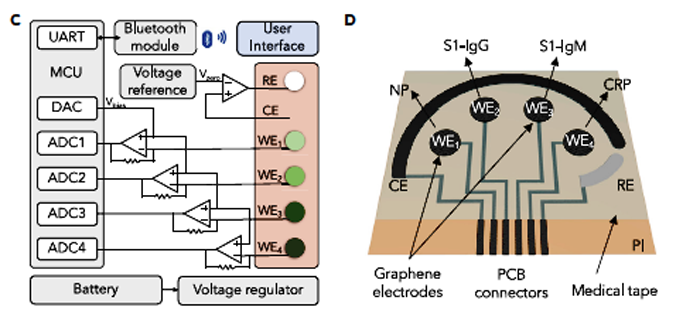 3. On the left is a block diagram of the SARS-CoV-2 RapidPlex platform shows UART, MCU, DAC, ADC, and other key functional blocks. On the right is a schematic illustration of the graphene sensor-array layout.
In use, amperometric readings (where an optimal potential is applied to the electrochemical cell and a corresponding current is obtained due to a reduction or oxidation reaction) from the four channels are taken concurrently. Data is transmitted to a user device over a Bluetooth link.
From an electronic-design standpoint, once you have finished with issues related to the sensors—their fabrication, coating, calibration and the analog front end—the remaining circuitry is fairly straightforward. The electronic system, including the printed circuit board and a lithium-ion polymer battery, measures 20 × 35 × 7.3 mm and can perform measurements continuously for over five hours on a single charge.
Details of the project are provided in their paper “SARS-CoV-2 RapidPlex: A Graphene-Based Multiplexed Telemedicine Platform for Rapid and Low-Cost COVID-19 Diagnosis and Monitoring,” published in Matter (it’s also posted here if there’s a problem with the link at Matter), along with Supplemental Material. But be aware that about 95% of the paper is about the complex biochemistry, fabrication and performance of the sensors, while the fairly standard electronics are reduced to one paragraph. However, the paper will certainly give you an appreciation of the impressive level of infectious biology and biochemistry knowledge needed (both theoretical and practical), plus sophisticated wet-lab insight and hands-on expertise required on projects such as this one.
Recent Comments