

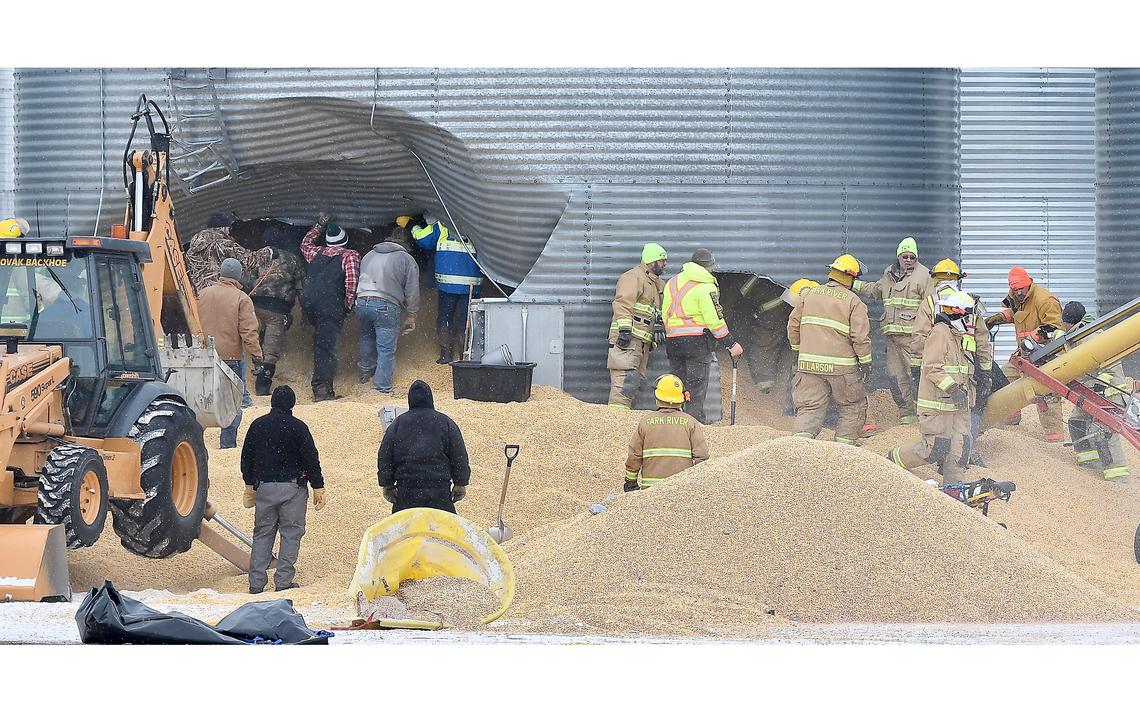

During the row crop harvest that began six months ago, grain entrapments, bin and dryer fires and storage structures burning up have been common occurrences across the Midwest.
In Grand Forks County alone, emergency responders in the past month have been called to at least four harvest-related fires and a farm-related injury. Larimore Volunteer Fire Department Chief Dustin Barber can’t recall another harvest with as many incidents in the 11 years he’s been with the department.
“It’s the worst I’ve seen it thus far,” he said.
Most of the fires are the result of foreign material in the grain that is being harvested, and the 2019 row crops, especially corn, are rife with that, said Ken Hellevang, North Dakota State University Extension agricultural engineer.

“We have immature corn, we have light test weight corn. We have corn that is more susceptible to breaking during combining. It’s a challenge getting the corn off of the cob as it goes through the combine,” Hellevang said.
The 2019 corn apparently is softer than is typical because it didn’t fully ripen, resulting in a less dense starch.
“There is a lot of foreign material in the harvested corn,” Hellevang said.
The foreign material, which could include pieces of corn kernels and cobs, dust and leaves, builds up on harvest equipment, Hellevang said. If the material comes in contact with a “hot spot,” such as a combine exhaust, it can ignite.
The debris in the corn also can get caught in dryers, reducing the grain’s flow and increasing its combustibility.
Fires typically are more common during harvests such as 2019, when farmers are under pressure to get the crop off and debris quickly builds up on equipment, Hellevang said.
“Housekeeping” tasks, such as vigilantly monitoring the flow of grain during drying and frequently cleaning dust and other foreign material off combines, can help farmers reduce the risk of fires, he said.
“Anything that they can do to make sure there is nothing that is an ignition material,” Hellevang said.
Sometimes, even after cleaning their equipment daily, fires still can ignite.
“All it takes is one hot bearing,” said Darren Bylin, a Larimore volunteer firefighter who farms near Adams, N.D. And despite farmers’ efforts to mitigate fire risks, circumstances beyond their control — what Bylin calls “bad luck” — can result in a combine or dryer fire, he said.
“It’s a dangerous occupation. You just have to be as smart as you can,” Bylin said.
Not only combines and dryers, but also grain bins should be monitored. Last fall, some farmers made the decision to combine high-moisture corn and store it rather than leave it in the field and combine in the snow.
Storage management of the wet corn is critical because the moisture, combined with the bin absorbing the sun’s heat, causes the grain to spoil. That can lead to spontaneous combustion, Hellevang said.
“With wet grain, the only way to keep it from spoiling and going out of condition is to keep it cold until it’s dried,” he said.
Farmers who are hauling out their wet corn may be tempted to go into the bin if the grain stops flowing, but they never should do so, Hellevang cautioned.
Several U.S. farmers, including producers in North Dakota and Minnesota, died last fall and this spring after getting trapped in corn bins.
“In 2009, 2010, we had a wet corn harvest, and that was a bad year as far as the grain bin deaths,” Hellevang said. “This year, I think, is worse than it was then.
“I get the news feed that summarizes all the safety news across the country. It’s the whole corn-producing region,” he said. “Any time we have grain that is going out of condition, it leads people to do things they really shouldn’t do.”
Entrapment typically occurs when farmers enter a bin in an attempt to break up crusts or clumps that form after a crust breaks, Hellevang said.
Both can result in death from suffocation after being buried in the corn. For example, farmers who climb the bin and enter from the opening in the top can break through the crust.
Meanwhile, farmers who enter the bin to bust up chunks of grain so it will flow can be sucked into the grain and get buried within seconds, Hellevang said. Today’s systems unload at a rate of 5,000 bushels per hour, which means they are moving grain at the rate of 2 cubic feet per second.
“You can be trapped in a second or two and buried within 10 seconds,” he said
Farmers must resist the urge to enter a bin, Hellevang said.
Barber, the Larimore fire chief, concurs.
“As far as deaths, don’t go in there,” he said.
Recent Comments