

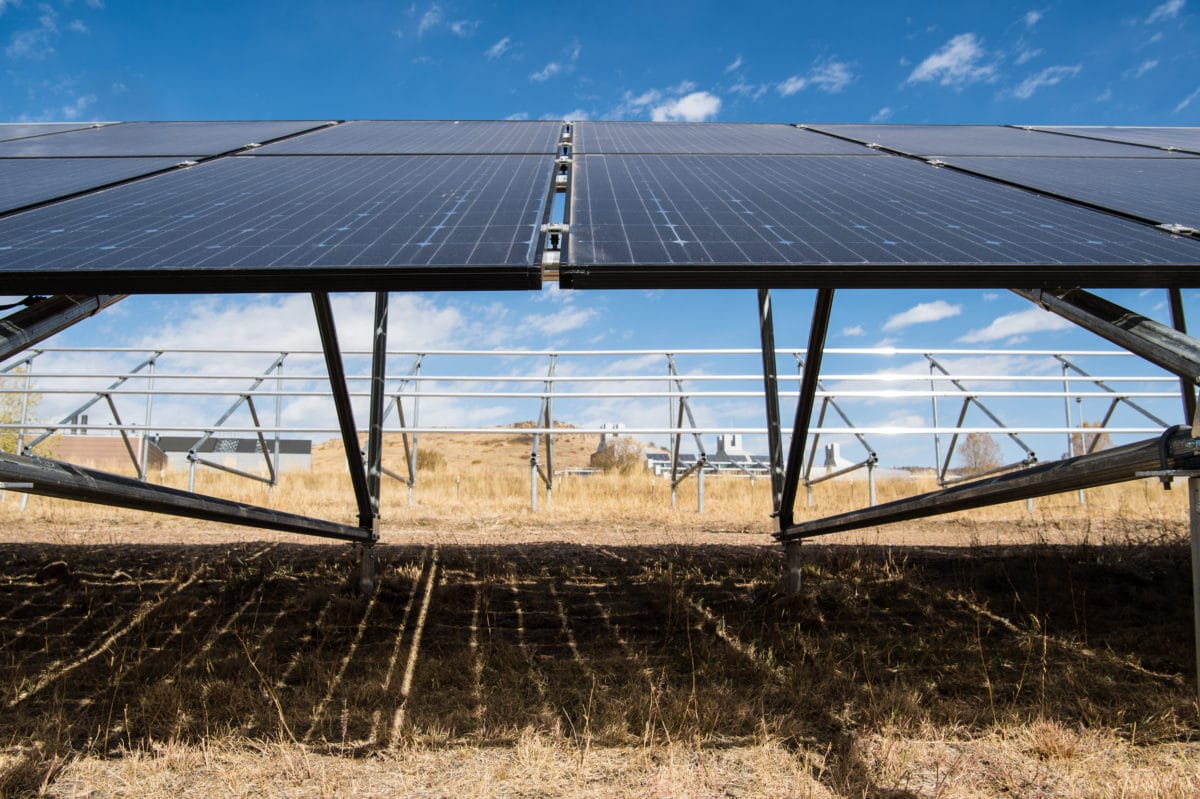

PV module production is increasingly changing from mono-facial to bifacial panels as the production gains and resulting project returns from bifacial panels are being validated. Many sources are projecting that bifacial production will overtake mono-facial within the next three to five years.

In order to maximize production returns, we at 7X Energy are starting to change our panel selection exclusively to bifacial. Due to this shift, we are evaluating the largest contributor of bifacial gain, the albedo or reflectivity of the ground surface.
In this evaluation, we tried to figure out how we could artificially increase gain for our project sites. The engineering team at 7X Energy performed research on commercially available ground material that would increase the ground albedo of its bifacial PV solar plants currently in construction.
(Read “Satellite-derived datasets to measure ground albedo for bifacial PV” from pv magazine Global.)

In addition, the team performed an economic analysis on a selected white ground cover and modeled the resultant production boost using PVsyst to take advantage of productions gains from using bifacial solar panels mounted on single axis trackers.
Here we share the results of the financial modeling analysis of two 7X Energy projects (the 200 MW Taygete II and the 130 MW Elara facilities) and offer some insights about the project feasibility economic modeling exercise.
Proposed albedo enhancing ground material
After extensive research and analysis on albedo enhancing materials, we selected a woven polypropylene white ground cover manufactured by DeWitt Co. [Ref. 1] which is typically used in agricultural ground cover applications.
The 3.2 ounce/ sq. yd. material is a UV stabilized fabric and permeable. The material is expected to last five years based on the manufacturer and is shipped in rolls with dimensions of 12’ x 300’. This material was selected based on durability, permeability, cost, and availability among other criteria.
Approach and assumptions
Our analysis was based on covering the entire surface area below the panels and between trackers as a means to providing the highest increase in yield. Previous research and analysis conducted and presented by Canadian Solar showed this scenario provided the lowest levelized cost of energy (LCOE) vs. other surface area covering scenarios [Ref. 2]. The only areas not covered were main access roads, inverter access roads, and the buffer between the trackers and project fence line.
For the financial analysis we assumed two scenarios: one that would not include the 30% ITC qualification and one that would. All economic modeling was based on the material’s 5-year expected life.
We also adjusted the modeled albedo as we expected the material to show a reflectivity reduction as the material aged and broke down. The resultant production gains were multiplied by the indicative modeled price ($30/MWh) to show increased revenue. Then, we added additional budget to the operational expense since we expected some wear and tear from maintenance techs, weather, and so on. We also assumed the annual expenses at 10% of the total capital cost for the material. And last, we included operational savings from the reduction of vegetation management due to the ground cover.
Taygete II 200MWac summary and results
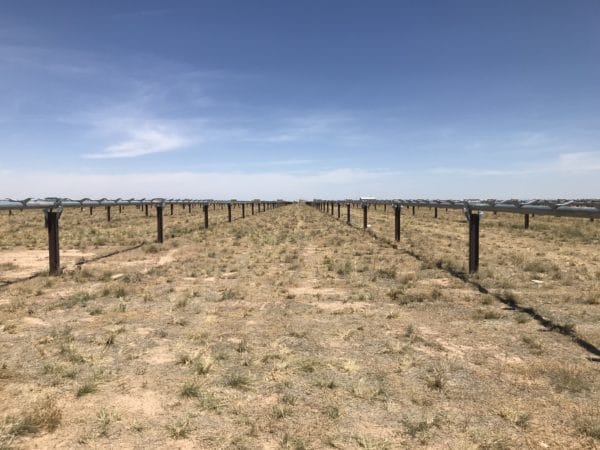
We started the project net present value (NPV) analysis on our Taygete II project, which is currently under construction in West Texas. Project details included 1.29DC/AC ratio, 0.226 measured average ground albedo, 0.26% ground coverage ratio (GCR), and 1 in portrait orientation single axis tracker. Below is the summary of the financial NPV modeling for the project.
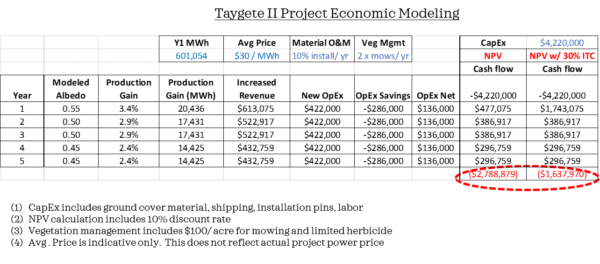
Based on the initial capital expense of roughly $4.2 million and cash flow over 5 years, we showed a negative NPV of around $2.8 million. When we assumed that the project would qualify for the 30% ITC, we still had a negative NPV on the order of $1.6 million. This was not the result we were hoping for, but we continued further modeling on additional projects.
Elara 130MWac summary and results
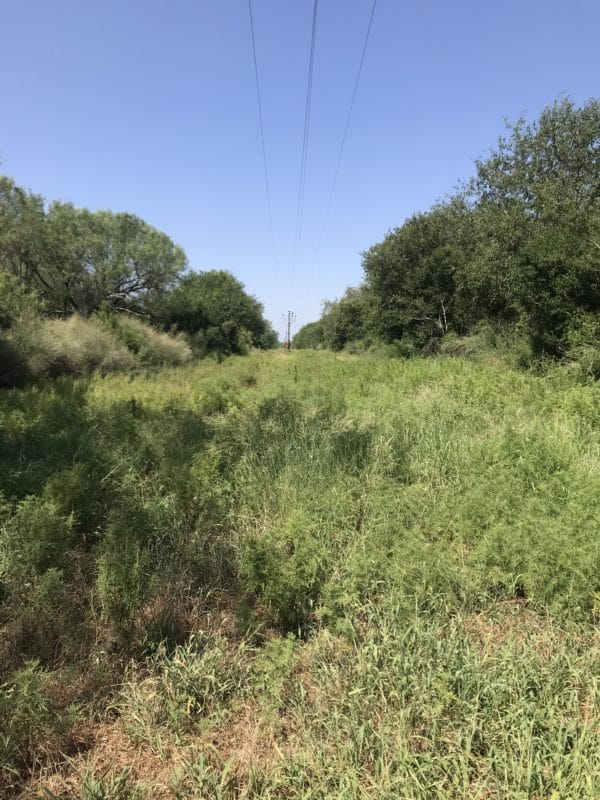
The second project was our Elara project currently under construction in South Central Texas. The Elara project has a 1.35 DC/AC ratio, 0.185 measured average ground albedo, 30% GCR, and 1 in portrait orientation single axis tracker. Below is the summary of the financial NPV modeling for the project.
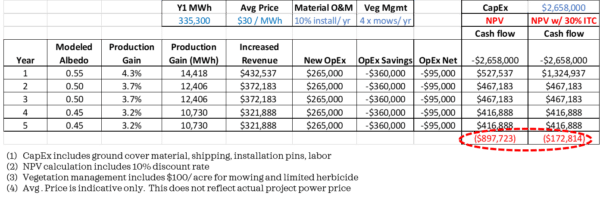
The first thing that stood out was that we still had a negative NPV although it was significantly closer to breaking even than our Taygete II project. Since the projects offer different capacities, we compared the project returns on IRR, which are -5% for Elara vs -24% for Taygete II assuming no ITC. Elara showed more economic feasibility, so we took a closer look to better understand the difference.
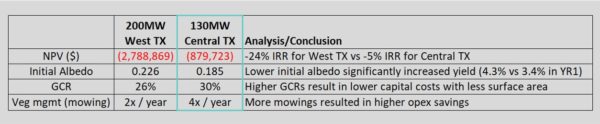
First, the delta in the initial albedo vs. the modeled albedo is higher for the Elara site. This accounted for the initial annual production gain of 4.3% vs. 3.4% at the Taygete site. Next, the GCR was higher for Elara, thus reducing the amount of surface area that the ground material covered and lowering the capital expenditure (CapEx).
Last, we had a significant savings in our operational costs because we assumed four mows per year at Elara versus just two mows per year at Taygete II. This was due to the vegetation on site and also the precipitation at the specific locations. This led to an overall annual operations savings of $95,000 at Elara vs. annual operations expenses of $136,000 at Taygete II.
From this comparison, we concluded that lower initial albedo sites, higher GCRs, and sites with at least average U.S. precipitation provide more favorable NPV returns for this albedo-enhancing material.
Analysis and optimization
Based on the results of our financial modeling exercise, it appears the material does not deliver the project returns we would like.
However, we wanted to understand what site characteristics could potentially provide the positive NPV we are looking to achieve, and model some sensitivities in the financial modeling inputs that we could change.
For this analysis, we used the Elara financial model as the basis, or baseline, and calculated the change (delta) in NPV for each isolated site characteristic to determine the gain in NPV vs. the baseline. We started with the baseline of a -$898,000 NPV; the results shown below are in NPV gain ranking order of highest NPV delta.
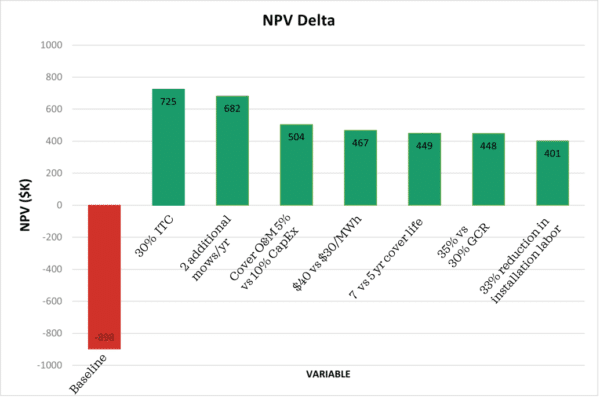
From the results, we see that the ability to capture the ITC had the highest impact on NPV, with a gain of $725,000. When we added this to the baseline – $898,000, we had a net -$173,000 NPV. This matched our Elara project modeling.
The second-highest NPV delta was a scenario in which we required two additional mows/year (for a total of 6 per year) along with limited herbicide treatments. In this scenario we gained $682,000 of NPV. Adding the ability to capture 30% ITC resulted in a positive NPV of $509,000. That is finally an encouraging value!
By adding just these two items (the 30% ITC and 2 extra mows), the ground material proved to be worth pursuing for further study and possible implementation.
The third-highest NPV is the material ground cover O&M. Here, we adjusted the operating expense from 10% to 5% of total CapEx per year. We lack operating cost tools and experience to provide a confident cost for this item, but we believe an opportunity exists to adjust it down to 5%.
Fourth on the graph is the project’s power price. We assumed competitive pricing in the model, but a number of project sites within the U.S. and internationally that have significantly higher contracted prices versus the $30/MWh that we modeled.
Following that, the ground cover life variable had a $449,000 NPV gain. Here, we assumed the ground cover lasted two more years than the expected 5-year life.
Ground coverage ratio is shown next. Increasing the GCR by 5% (in other words, decreasing the tracker row spacing and thus the plant’s surface area), we increased the NPV by $448,000. Based on our experience, 35% GCR is a more common GCR in the U.S. vs. the lower GCRs we were able to achieve with our Taygete II and Elara sites. This figure has a high potential to be included in many projects.
Moving farther to the right, we have a positive $401,000 NPV gain based on a 33% reduction in the labor to install the ground material. We think there are some labor efficiencies that could be gained in deploying the material, hence the potential for this reduction. Note, however, that if we had a higher albedo–such as 0.23–then a $308,000 loss in NPV would have occurred.
One item that stood out was the mediocre production gain with this high albedo ground cover. We expected significantly higher yields with the white ground cover-modeled albedo. When we further analyzed the PVsyst production loss breakdown, we found that the inverter AC clipping was excessively high: 5.6% vs 2.4% in year 1 on Elara for the 0.55 and 0.185 modeled albedo, respectively.
The excessive inverter AC clipping was due to the increased irradiance with the ground cover, particularly during the middle of the day. Thus informed, we redesigned the project assuming the new approach, and included the ground cover installed and optimized for the increased irradiance. This resulted in a new DC/AC ratio of 1.25 vs. the previous 1.35. We re-ran the NPV modeling and generated a -$290,000 total NPV project vs. the -$898,000 baseline.
So, even with an optimized design, we still came up short of a positive NPV. However, if we can take advantage of any of the variables noted in the NPV graph, then the additional NPV gain will net us a positive NPV project.
Conclusions
We arrived at three main conclusions when evaluating the opportunity to install an artificial albedo enhancing ground cover.
- Every bifacial project should be evaluated based on specific site characteristics, but highest NPV gains can be attributed to high vegetation management costs, high power prices, high GCRs, and lower initial albedo. The most significant NPV gain is for projects that can capture ITC.
- Attractive U.S. sites for highest NPV are expected in the Southeast U.S. with low initial albedo, high precipitation, high GCRs (expected with greater land value vs. the Southwest U.S.).
- Albedo-enhancing material shows considerable promise for bifacial PV retrofits due to lower clipping after the initial operating years and known vegetation management costs. Implementation of albedo-enhancing material can increase production to improve yield and underperformance of existing bifacial plants.
The ground cover material showed a lot of promise. But even if a project with notable positive NPV were identified, some testing still is required to prove the long-term durability, degradation rates, and validation of the installation labor and O&M.
We look forward to working with industry partners to further review and analyze–and hopefully deploy–this material on one of our bifacial projects in the near future.
Rich Clark is vice president of engineering at 7X Energy. Joshua Eudave was an intern at the company.
References
[1] DeWitt Company. http://www.dewittcompany.com/
[2] Layout Optimization of Albedo Enhancer Materials used in Bifacial PV Systems. Presented by Jean-Nicolas Jaubert, Yuanjie YU, Boahua HE, Gang YAN, Zhigen Zhang, Ray Zhao of Canadian Solar. 6th BIFI PV Workshop, Sept 17th 2019, Amsterdam.
The views and opinions expressed in this article are the author’s own, and do not necessarily reflect those held by pv magazine.
This content is protected by copyright and may not be reused. If you want to cooperate with us and would like to reuse some of our content, please contact: [email protected].
Recent Comments