

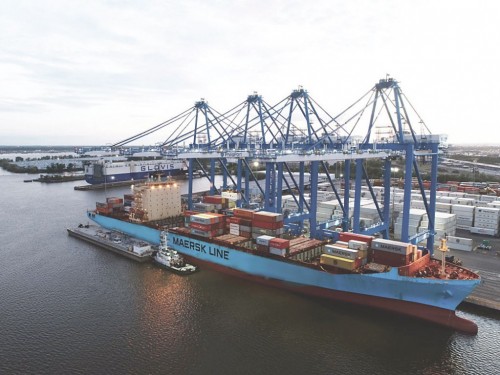

At long last, the endeavor to bring the Delaware River channel to 45-foot depth as far as Philadelphia is virtually complete, and PhilaPort – already experiencing dynamic growth in container and roll-on/roll-off volumes alike – is perfectly positioned to benefit both now and for the foreseeable future.
Jeff Theobald, executive director and chief executive officer of the Philadelphia Regional Port Authority, which in 2017 was rebranded as PhilaPort, The Port of Philadelphia, told AJOT that new larger ship-to-shore cranes already are in place, while further undertakings are well under way so that the port and its users can fully capitalize upon the deeper channel.

Indeed, no doubt the biggest development for PhilaPort (and other facilities along a 104-mile stretch of the river) is the $500 million project to deepen the Delaware River channel to 45 feet at mean lower low water, from 40 feet, which is finally reaching completion nearly two decades after U.S. Congress granted initial approval in 1992. A 6-foot tidal window can effectively provide even greater depth to Philadelphia terminals at particularly propitious times.
“We’ve had a lot of shippers, major container carriers, all waiting for this to happen, to make sure we get approvals to bring in the deeper ships,” said Theobald, a former senior executive of APL terminals who is in his fourth year spearheading PhilaPort. “Not only does it give you larger ships, but it also lets existing ships that come in go deeper and handle more cargo coming into Philadelphia. That’s exciting news.”
PhilaPort has prepared for this eventful occasion by deepening container berthing to 45 feet and erecting five super-post-Panamax container cranes at its Packer Avenue Marine Terminal, with the fifth one just commissioned in December. Also, the two somewhat smaller post-Panamax gantries at Packer Avenue are being converted from diesel operation to electric, the same cleaner power source as the super-post-Panamax units, and rebuilding of the 3,000 feet of Packer Avenue berth space is on schedule for completion by the end of 2020.
In addition, obsolete warehouses are being demolished to facilitate more space for container operations, while plans are advancing for a new, near-dock, state-of-industry 210,000-square-foot warehouse for dry cargos, to be followed by a new 160,000-square-foot warehouse for refrigerated commodities.
Another significant warehouse endeavor is nearing completion at PhilaPort’s Tioga Marine Terminals, where a $12 million, 100,000-square-foot on-dock facility with in-warehouse rail access is anticipated to attract additional forest products business. The Tioga terminal also is where Atlantic Ro-Ro Carriers calls with fortnightly service from Russia.
Even without the deeper channel – and in the face of recent tariffs – PhilaPort’s containerized cargo throughput has been averaging 12 percent year-over-year growth over the past eight years, Theobald pointed out. Refrigerated cargo growth, including broadening fruit imports from Peru, has been a key contributor.
“On the auto side, the growth has been even more dramatic, going up about 50 percent just over the last year,” he said. “The new auto business, with Hyundai/Kia on Glovis ships, has been very successful.”
Glovis America Inc. joined PhilaPort last fall in opening the $110 million, 155-acre Southport Auto Terminal and Vehicle Processing Center, a leading-edge facility for handling Hyundai and Kia imports from Korea and Mexico for distribution throughout the U.S. Northeast.
“They can do 1,000 cars a day through this facility,” Theobald said. “There’s nothing else like it anyplace in North America, so we’re quite excited about it, and Hyundai and Kia are quite excited about it. They’re going gangbusters now on bringing cars in and getting them processed through here.”
The Southport terminal, built above the 100-year-flood-plain level, also is soon to see Norfolk Southern rail ramp service.
“That just opens up all sorts of possibilities, and I think we’ll start the snowball of getting NS service here in Philadelphia going, not only for cars but actually going into doing more intermodal also, so we’re quite excited about that opportunity,” Theobald said.
Of course, shippers gain an additional rail option with NS joining CSX in PhilaPort service. CSX, with a boost from more than $14 million in state grant support, is completing bridge and underpass work to facilitate faster transit times for double-stacked containers heading to Chicago. CSX partner Canadian National Railway also now offers daily dry and refrigerated service from Philadelphia to Toronto.
“We, with our railroad partners, are very aggressively looking at going after more discretionary cargo, the Chicago stuff, Midwest stuff,” Theobald said, “and we’re getting a lot of interest from the carriers. They’re interested in alternatives. It’s a target for the future.”
Speaking of the future, PhilaPort’s plans for Southport, on 150 acres of a former U.S. Navy yard site, include construction of a new 2,000-foot-long berth to accommodate vehicle carriers, breakbulk vessels and eventually containerships. That berth is now in the engineering phase.
“The additional Southport berth will be the next major, major thing that we do that really increases the capacity for handling vessels and cars and containers,” Theobald said.
Also on the auto front, freight forwarder CFR and terminal operator GWSI in late 2019 began a containerized vehicle shipping operation near the Packer Avenue Marine Terminal. Theobald sees that operation annually bringing between 3,500 and 4,000 additional containers through PhilaPort.
And even further PhilaPort terminal development is in the cards, according to Theobald.
“We know we need to grow and we need to have land to grow, so we are actively pursuing on a number of fronts getting additional land that’s adjacent to the port through buying land or leasing land on a long-term basis,” he said. “So we are aggressively going after property, including that which can involve more warehousing capability.
“We’re pursuing what we’re going to build next,” Theobald said. “A lot of it is additional property for warehousing and more infrastructure between the roads and the I-95 freeway system.”
With PhilaPort operations expanding, efforts are moving forward as well to ensure availability of a sufficient trained workforce.
Last fall, the Citizens Bank Regional Maritime Training Center opened in Southwest Philadelphia, with support of unions, PhilaPort, the Collegiate Consortium for Workforce and Economic Development and Philadelphia Works, and Citizens Bank announced a further $75,000 investment in maritime workforce development.
“With all the container growth and auto growth,” Theobald said, “we need to make sure we have a skilled workforce to fill those jobs.”
At the October ribbon-cutting ceremony for the training center, Daniel K. Fitzpatrick, president of Citizens Bank’s Mid-Atlantic Region, commented, “We at Citizens Bank have made a commitment to providing workforce development opportunities to the communities we serve. By bringing all of these crucial partners together to create this program, we can ensure that workers have the skills needed to keep the maritime industry thriving.
Recent Comments