


Forecasting is a vital part of a company’s inventory operation. If a company overbuys, the firm loses money on unsold or marked down inventory, but underbuying can result in stock-outs and lost sales.
It’s relatively easy to make a time-series forecast. Picking the right method could be the difference between having an item in-stock and having to turn a customer away — and complex methods aren’t necessarily better.
“Simple forecasting methods, such as exponential smoothing, can perform as well as, if not better than, more complex ones,” researchers from the University of Bath and Cardiff University wrote in a 2018 paper.
In a conference preceding published last year, a team of Indonesian researchers compared two of the simplest methods for time-series forecasting. The researchers were trying to forecast the sales of carbon electrodes and concluded, based on a comparison of error rates, that a well-known forecasting method known as Holt-Winters gave them better results compared to double moving averages.
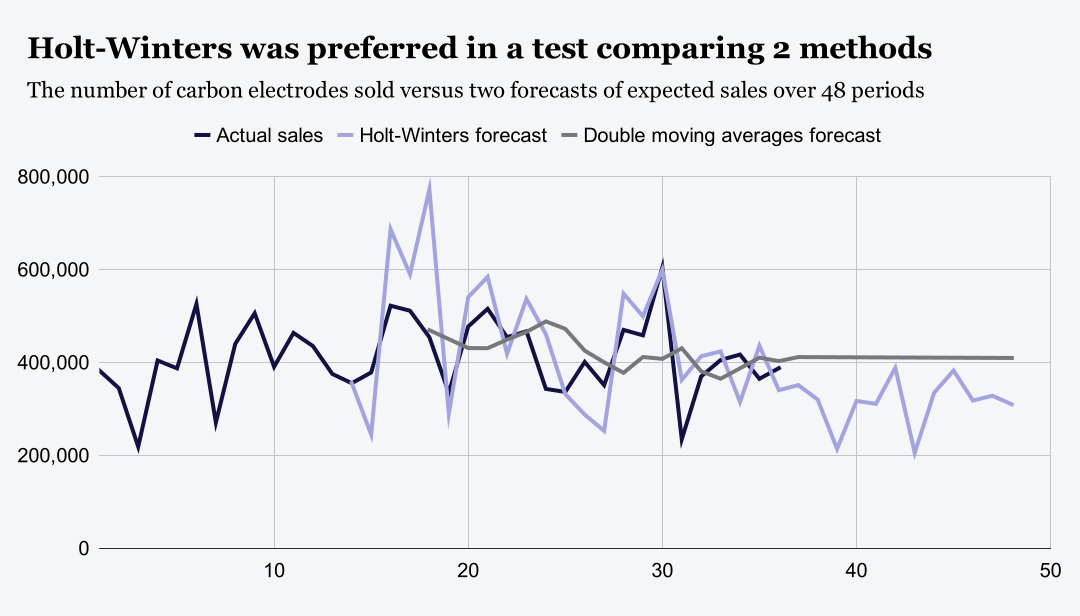
Matt Leonard / Supply Chain Dive, data from E Lesmana et al
The authors point out that actual sales numbers are not consistent, but instead have “a trend and seasonal patterns with seasonal variations that fluctuate.”
Of the two methods the authors considered, only the Holt-Winters method considers seasonality, using a “seasional adjustment factor” that takes into account not only previous sales, but the length of the season.
Double moving averages consider previous values over a certain number of periods to find the appropriate weight and slope for the forecast. This kind of forecasting technique is known for missing trends and seasonality, which the authors said appeared to be present in their data. So it might not come as a surprise that they concluded the Holt-Winters method was the best approach for their forecasting needs.
Fotios Petropoulos, a senior lecturer at the University of Bath, and his co-authors at Cardiff University, also noted that the Holt-Winters method “is arguably the most widely used method for fastmoving seasonal data.”
Great, so Holt-Winters is the way to go for forecasting seasonality, right? Not so fast.
Petropoulos and his counterparts looked at nine forecasting techniques for their paper “The inventory performance of forecasting methods: Evidence from the M3 competition data.” Holt-Winters was one of the methods considered and, despite its popularity, things did not work out as well for this technique when stacked against many other options.
“We should mention that the Holt and Holt-Winters methods showed the two worst performances amongst all contenders,” the paper stated in its results section.
The method that performed best was a relatively new forecasting method known as a multiple aggregation prediction algorithm (MAPA). This technique is specially designed for seasonality and can smooth out trends to help avoid over- or under-estimating demand.
“At the same time, it produces smooth forecasts, thus minimising the bullwhip effect, and has the best trade-off curves for inventory costs versus service levels,” the paper concluded.
Petropoulos also argues that error should not be the only consideration when forecasting for inventory.
“If a more stable but less accurate forecast results in a lower cost for the business, that is the forecast that should be used … ” the paper said. The authors suggest considering the order and inventory variances that result from different forecasting techniques. For example, does one forecast result in large swings in order levels? This is where MAPA excels thanks to its ability to smooth out trends and seasonality, the researchers argued.
What about machine learning? If your analytics team has TensorFlow you might as well use it, right? Well, again, maybe not.
Another paper, “Statistical and Machine Learning forecasting methods: Concerns and ways forward,” published in 2018, suggested that some of the more complex approaches to forecasting might not be ready for prime time. When the researchers tested machine learning methods on their dataset they found that “traditional statistical methods are more accurate.” However, they go on to clarify that while more work needs to be done “we are extremely positive about the great potential of ML ones for forecasting applications.”
By comparing classical statistical approaches to machine learning, the paper points out that “particularities of the dataset may affect the conclusions.”
So what’s the best forecasting method? It depends on the data being forecast and the needs of the business. With vendors hawking inventory management tools based on machine learning, deep neural networks and artificial intelligence, it’s worth noting that sometimes it’s best to stick with the basics.
This story was first published in our weekly newsletter, Supply Chain Dive: Operations. Sign up here.
Recent Comments