



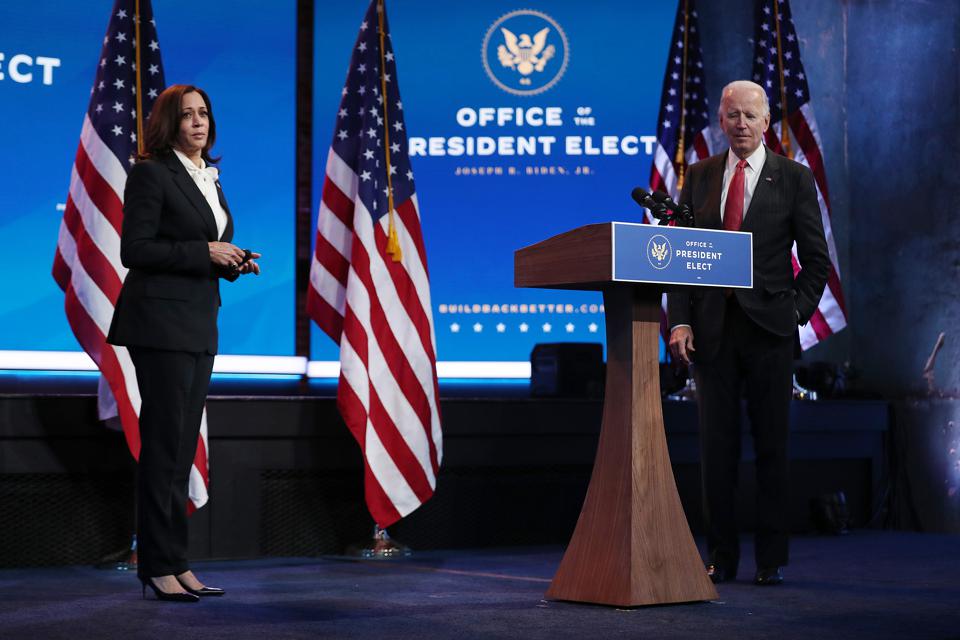
President-Elect Biden And VP-Elect Harris Deliver Remarks In Wilmington, DE (Photo by Joe … [+]
Getty Images
President-elect Joe Biden pledged that the US will rejoin the Paris Climate Agreement, a 2015 the global pact to mitigate climate change on his first day in office and announced his climate team on Saturday—a sharp change from the Trump administration’s support for the energy sector.
Critics link President Trump’s April 2019 executive order that the Department of Labor identify and address “discernible trends” in how retirement plans subject to ERISA invest in the energy sector to the flurry of anti-sustainable investing rulemaking at the Securities and Exchange Commission (SEC) and Department of Labor during the second half of 2020. This includes the SEC’s emphasis on “materiality” as the standard for disclosure without providing specific ESG guidance, the higher ownership threshold that the SEC recently imposed for filing shareholder proposals that will insulate companies from calls for increased transparency, and recent Department of Labor guidelines, detailed below, that make it difficult for fiduciaries to consider non-pecuniary factors in investment decision-making.
Like destructive floodwaters, the impact of the Trump administration’s efforts to discourage sustainable investing will recede only over time. Although investor interest in sustainable investing is growing, AssuranceMark Founder Samantha Ross explains, “recent rulemaking will depress the number of sustainable investing options and the number of sustainability shareholder proposals over a more prolonged period. This is significant because shareholder proposals were the driving force behind the significant improvements in US corporate governance in the 1990s, shareholder proposals that receive between 30% and 50% of the vote typically influence company policy although they do not pass,” and strategic engagement is also the most reliable form of sustainable investing for investors seeking impact.
As the floodwaters recede, beyond rejoining the Paris Climate Agreement, the Biden administration can accelerate the transition to a more sustainable economy in its first 100 days with four additional steps at Department of Labor and SEC.
1. Define Pecuniary Considerations for Pension Investments to Include Material ESG Factors
The Department of Labor can define pecuniary and non-pecuniary in its Final Rule on Financial Factors in Selecting ERISA Plan Investments. The Employee Retirement Income Security Act (ERISA) establishes minimum standards that govern the operation of private-sector employee benefit plans: it requires fiduciaries to run plans solely in the interest of participants and beneficiaries; for the exclusive purpose of providing benefits and paying plan expenses; and with care and prudence. The proposed rule, released in June, expressed concern that growing Environmental, Social, and Governance (ESG) assets suggest that plan fiduciaries may be violating the fiduciary duty of loyalty and about the lack of precision and consistency in the marketplace in defining ESG. Despite opposition from over 95% of the 8,700 comment and form letters, the Department of Labor released the final rule on October 30th. The final rule contains no references to ESG and instead prevents fiduciaries from selecting investments based on non-pecuniary considerations except as a tie-breaker. The final rule does not, as Head of US Policy at UNPRI Heather Slavkin Corzo explains, define pecuniary or non-pecuniary; it simply describes non-pecuniary benefits as furthering environmental, social, or other public policy goals.
The Department of Labor can incorporate the growing body of evidence of the impact of material ESG issues on returns and note the amplification of systemic risks caused by poor ESG hygiene when defining “pecuniary” and “non-pecuniary.”
2. Commit Resources to Enforce the SEC’s 2010 Guidance on the Materiality of Climate Change
In January 2010, the SEC issued interpretive guidance on existing disclosure rules that may require a company to disclose the impact that business or legal developments related to climate change may have on its business. The relevant rules cover a company’s risk factors, business description, legal proceedings, and management discussion and analysis. The guidance highlighted impact of legislation and regulation, impact of international accords, indirect consequences of regulation or business trends, and physical impacts of climate change as examples of areas where climate change may trigger disclosure requirements.
Although this guidance was progressive at the time that it was issued, the SEC’s interpretive guidance is not legally binding. The SEC did not dedicate the resources to develop a binding rule based on the guidance. The SEC can prioritize amending public company reporting obligations and redefining interpretations of materiality to enforce this guidance on climate change.
3. Establish SEC Internal and External ESG Task Forces
This past May, the Investor-as-Owner subcommittee of the SEC’s Investor Advisory Committee recommended that the SEC establish ESG disclosure requirements and that the US should take the lead on material ESG disclosure.” In July, US Senator Mark Warner (D-VA), a member of the Senate Banking Committee, called on the SEC to establish an ESG Task Force to “issue guidance on quantifiable and comparable disclosures.” The Biden administration should establish SEC internal and external ESG task forces to establish ESG disclosure requirements.
4. Comment on IFRS Sustainability Standards and Develop Global Sustainability Disclosure Requirements
The IFRS Foundation, which sets non-US global financial reporting standards, in September called for comments on the need for global sustainability standards and whether and to what extent IFRS might contribute to the development of such standards.
The Biden-Harris transition team should encourage Financial Accounting Standards Board (FASB), the nonprofit that administers US generally accepted accounting principles (GAAP) to coordinate with IFRS on a single global set of sustainability disclosure requirements. More broadly, since the US capital markets are the largest and deepest in the world, the SEC should shape the joint establishment of principles-based framework to provide issuer-specific material, decision-useful, information for investors to make investment and voting decisions. In this effort, the SEC can draw from the work of leading sustainability and integrated reporting organizations CDP, CDSB, GRI, IIRC and SASB, which in September committed to work together toward comprehensive corporate reporting.
Taking these five initial steps during the first 100 days should help Biden fulfill a campaign promise to hold polluters accountable by establishing “an enforcement mechanism to achieve net-zero emissions no later than 2050,” and restart US federal government momentum toward updated targets in the Paris Climate Agreement.
Recent Comments