

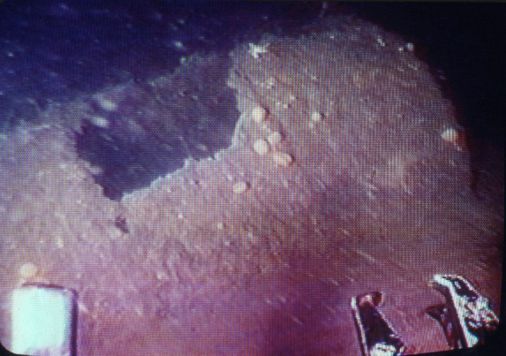

Now, the federal government is trying to bury the barrels at least three feet deep with roughly 10 million tons of sediment dredged from a $340 million project to widen shipping channels in Boston Harbor. Capping the toxic material — which includes unexploded munitions — was seen as a safer way of minimizing risks, rather than trying to bring the rusting barrels to the surface.
It’s also cheaper. Federal officials say there’s effectively no additional cost to the overall dredging project, as the sediment from the harbor would have had to be taken elsewhere anyway.
“I’ve been watching concerns about this waste site for decades, and this is a really creative solution to a longstanding environmental problem,” said Ken Moraff, water division director for the Environmental Protection Agency in New England, which has been working on the capping project with the Army Corps of Engineers since 2018.
But others have raised significant doubts about the project and the impact on the adjacent Stellwagen Bank National Marine Sanctuary, which was founded in 1992 to protect an 842-square-mile underwater plateau that is home to an estimated 130 species, from abundant lobsters to endangered North Atlantic right whales. At its closest point, the dumping ground is less than a quarter mile from Stellwagen.
David Wiley, the sanctuary’s research coordinator, led a seminal study of the area in the early 1990s. His report, which found that the federal government kept few records of what was dumped there, estimated that there could be as many as 80,000 barrels of toxic waste, most from hospitals, universities, and companies throughout the region. At least 4,000 of them were thought to contain radioactive waste, from the same sources.

With many of those barrels corroding in the salt water over decades — the federally sanctioned dumping occurred from around 1946 until it was banned in 1977 — Wiley worries about the potential consequences of dropping massive amounts of clay, gravel, rock, and sand on top of them.
“I am concerned about leakage,” Wiley said. “They could leak from the initial pressure placed upon them, as they are being covered.”
His surveys of the dumping grounds, which included sending down a submersible to record video of the area, found that about half of the identifiable barrels remained intact. The other half had clear signs of openings, some of them from rifle shots fired at them to ensure they sank while being dumped overboard.
Wiley said he isn’t reassured by promises from the Army Corps and the Environmental Protection Agency that the area is being monitored for leaks, and will continue to be. Because no one knows exactly what’s down there, he said, there’s little reason to believe that any testing would be comprehensive.
“I’d call that monitoring plan problematic,” he said. “There are so many things that could be escaping that might not be tested for.”
Charles McCreery, a oceanographer who retired from the federal Bureau of Ocean Energy Management, has spent years studying the “Foul Area” dump and similar sites around the country, which he said include toxic compounds such as pesticides, PCBs, and DDT. The dump in Massachusetts Bay has the distinction of being in shallower waters and closer to shore than any other such site, he said.
If dropping millions of tons of rock-filled sediment punctures the barrels or moves the other toxic material, it could contaminate many of the crustaceans and other bottom-feeding creatures that inhabit the area, some of which people eat, he said.
“This is a human health and environmental concern,” McCreery said. “The chemicals sequester into the fat of marine organisms and contaminate the food chain.”
There are also concerns about the sediment dredged from Boston Harbor, which until the 1990s was widely considered the nation’s dirtiest harbor, with mounds of raw sewage and a vast range of pollutants submerged in the seafloor.
Angela Sanfilippo, president of the Gloucester Fishermen’s Wives Association, knows of fishermen who became sick after pulling up barrels in their nets.
When she learned that the harbor sediment would be deposited in the area, she called it “a disaster.”
“All that debris could shift in a storm and affect Stellwagen,” she said. “We want clean water and clean fish. This is infuriating and should stop right now.”
Federal officials overseeing the dredging project insisted that the concerns are largely unwarranted.
“The material from Boston Harbor has been evaluated and is suitable for ocean disposal,” said Dave Deegan, a spokesman for the EPA in Boston.
Sediment that has been identified as contaminated won’t be used in the project but rather stored in specially built areas beneath the harbor floor, he said. The dredged material being used to cap the barrel field is mainly Boston blue clay, which the EPA has determined to be safe.
The agency’s monitoring of the area for contamination will “ensure that conditions are appropriate for ocean life in that area,” Deegan added.
Steven Wolf, who is managing the capping project for the Army Corps of Engineers, said the sediment is being dumped over the barrel field from split-hull scows that use sophisticated positioning technology to pinpoint where it lands.
The Army Corps is trying to avoid dropping the sediment directly on the barrels, he said. Instead, it is being released in large piles along the perimeter of the field, with the goal that the sediment will gently shift over the barrels.
“It’s going well,” he said, adding that the project should be finished next year.
Wolf also dismissed concerns that any leaked radioactive or other toxic chemicals would pose more of a harm to marine life as a result of the project.
“The critters that dig and burrow only go down a few inches, and this will seal or sequester the waste from the water column,” he said. “Ultimately, this is a way to put these containers out of contact with people — for many, many lifetimes.”
For those who have spent years fighting to clean up Boston Harbor and protect Massachusetts Bay, the potential benefits of the project outweigh the potential harms.
Capping the barrels, they said, is better than just leaving them there to decompose and foul fishing gear.
“I’m fairly convinced that what we’re going to have is a capping, not a crushing of the barrels,” said Bruce Berman, a spokesman for Save the Harbor/Save the Bay, an environmental advocacy group. “Thankfully, we’re past the cowboy days of ocean dumping, and this has been a transparent process.”
Peter Shelley, who spent years waging legal battles to clean up Boston Harbor at the Conservation Law Foundation, said he thought the project would “likely reduce risks.”
“The alternative of cleaning the site up would be really difficult … to do without spreading the waste everywhere,” he said.
David Abel can be reached at [email protected]. Follow him on Twitter @davabel.
Recent Comments