



“Machine learning, in-memory computing, and democratization of data are important trends that are helping organizations operate with greater agility.”
Data Analytics has helped organizations make informed business decisions. The increased usage of data analytics has resulted in the mainstreaming of enterprise-grade data management, data preparation, and data visualizations tools. In an interview with Toolbox, Bhaskar Himatsingka, Chief Product Officer at Adaptive Insights, talks how data-driven planning can help companies achieve strategic objectives, cloud performance management solutions and the importance of cloud-based planning systems. He also spotlights how machine learning (ML)has revolutionized cloud-based planning, and upcoming trends in data visualization.
Key Takeaways From This Tech Talk Interview:
- How to make the most of cloud management solutions
- The benefits of using cloud-based planning systems
- How machine learning is transforming business planning
- Important trends in data visualization for 2020 and beyond
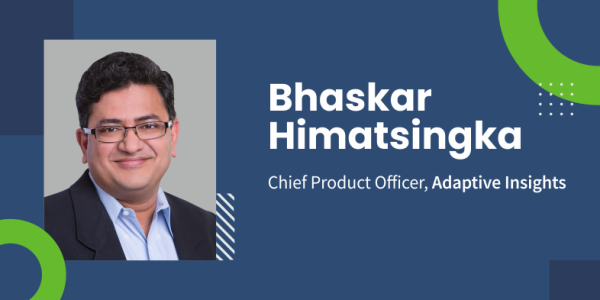
Here’s the edited transcript of the interview with Bhaskar Himatsingka:
Can you share what your role at Adaptive Insights entails?
In high school, I realized I wasn’t smart enough to be a career mathematician, so I turned to Computer Science. After I came to the U.S. for post-graduate studies, I joined Oracle working on the database kernel team. Over the years, I moved from technical staff positions to CTO at Ariba, a SaaS procurement software company now owned by SAP, and later CTO at Change Healthcare. In 2016, I joined Adaptive Insights, where I lead the engineering, product management, and technical operations teams.
What role should a CTO or CIO play in choosing and deploying mission-critical technology such as analytics for the organization? How can they work more effectively with functional leaders to help build the right set of solutions?
Too often, people learn about a certain technology and think, “We need this.” I believe that’s the wrong approach. I like to use the analogy that when you go to the hardware store to buy a quarter-inch drill bit, what you really want is a quarter-inch hole. So, for a CTO or CIO, the focus should be on going to all the relevant stakeholders across the business and asking, “What are we trying to accomplish? What problem are we trying to solve?”
I’ve seen firsthand that data-driven planning can help companies achieve strategic objectives and solve a lot of ongoing inefficiencies, but you have to start with the goal in mind.
Learn More: How AI Has Transformed the Role of a Chief Data Officer: LinkedIn CDO
What metrics could a business use to evaluate if the analytics platform is delivering the outcomes they need?
It depends on what you’re trying to achieve. It might be saving days or even weeks on a budget or monthly close, improving data integrity, increasing the number of people participating in planning and reporting, cutting in the time required to produce a report, and expanding the number of people throughout your organization actively modeling what-if scenarios and participating in decision-making. You can also tie many of these KPIs to key business metrics, like higher gross margin and reduced operating expenses.
What level of data readiness is required to make the most of a cloud performance management (CPM) solution? How can organizations prepare?
The classic data readiness best practices are always advisable whenever implementing a new solution. You’ll want to establish key metrics to ensure your data is relevant and business-ready; implement a data quality strategy; and then determine your integration strategy.
Data is often locked in separate systems and data lakes. Those silos live in your ERP, HCM, and elsewhere in your enterprise stack. So, any cloud-based CPM system absolutely must be platform-agnostic and offer easy and automated integration of data from all your various sources.
Learn More: CFO as Visionary: Using Digital Analytics to Power Strategy
What are the chief learnings that Adaptive Insights has for decision-makers about data visualization and in-memory computing? What works and what doesn’t?
When you process data entirely in memory, you’re able to create and calculate far more complex models so people in a business can understand the implications of their actions. In-memory computing helps a cloud platform scale to meet the demands of a business as it grows. But memory isn’t a blunt instrument; you need to use it efficiently to get the maximum value from it. For instance, when updating a large, complex model, it’s far better to recalculate only those cells that have changed. Doing it the old way—recalculating the entire model—is unacceptably slow and a waste of resources.
Learn More: Top 6 Analytics Trends To Drive Data-Driven Decision Making
What innovations have you seen in the data visualization space that have wide industry ramifications?
There have been so many. One great example is reporting. Only a few years ago, reporting was far more difficult and often involved a request to finance. That’s changed, and it’s become an empowering development in modern businesses. Another example is augmented analytics to automatically identify trends and opportunities, empowering both finance and business users with the capability to harness data in a way previously reserved for data scientists.
Cloud-based planning systems have transformed and democratized reporting. Now virtually anyone in the business can generate—on demand—a report that visualizes operational and financial performance for their function.
Learn More: Data Visualization Will Change How You Use Data
Can you share any upcoming projects in advanced analytics at Adaptive Insights?
We’re working to make machine learning (ML) a foundational aspect of modern, cloud-based planning. A powerful practical use of ML is its ability to serve as a reliable prediction engine for business planning.
We’re seeing Machine Learning improve the ability of managers in finance or operations to accurately anticipate outcomes and even identify anomalies in your data that could otherwise lead you to make a bad decision. Scenarios like changing the price of a product or service, remapping sales territories, or adding headcount—these are important decisions in any business, and making them with confidence helps those businesses operate with agility.
Learn More: How Can Machine Learning Improve Risk Management?
Which trends are you tracking in this space for 2020 and beyond?
Among the most important trends involve technology that helps organizations operate with greater agility. We’ve already mentioned a couple—machine learning and in-memory computing. Another is the democratization of data that allows business users across the enterprise to collaborate in ways they never could before. This is all part of making planning intelligent and anticipatory—moving from simply understanding what’s happening right now to predicting with a high degree of confidence what’s likely to happen in the future.
About Bhaskar Himatsingka:
Bhaskar leads Adaptive Insights’ engineering, product management, and technical operations teams. Bhaskar brings more than 20 years of experience building teams, technology, and products. He joined Adaptive Insights from Change Healthcare where, as CTO, he developed a new technology roadmap, led the engineering team to re-architect the way the company stored and analyzed data, and oversaw the launch of successful new products. Prior to that, he spent more than 12 years at Ariba where, as CTO, Bhaskar led the effort to re-architect the company’s on-premises products to launch its multi-tenant enterprise software as a service (SaaS) platform.
Bhaskar earned a master’s degree in computer science from the University of Minnesota at Minneapolis, and he holds a Bachelor of Technology degree in computer science and engineering from the Indian Institute of Technology in Kanpur, India.
About Adaptive Insights:
Adaptive Insights, a Workday company, is powering a new generation of business planning. Driving business agility in a fast-moving world, Adaptive Insights Business Planning Cloud leads the way for people in companies to collaborate, gain insights, and make smarter decisions faster. Powerful modeling for any size organization, yet so easy for everybody who plans. Adaptive Insights is headquartered in Palo Alto, CA.
About Tech Talk:
Tech Talk is a Toolbox Interview Series with notable CTOs and senior executives from around the world. Join us to share your insights and research on where technology and data are heading in the future. This interview series focuses on integrated solutions, research and best practices in the day-to-day work of the tech world.
Do you think machine learning has played a major role in transforming business planning? Comment below or let us know on LinkedIn, Twitter, or Facebook. We’d love to hear from you!
Recent Comments