

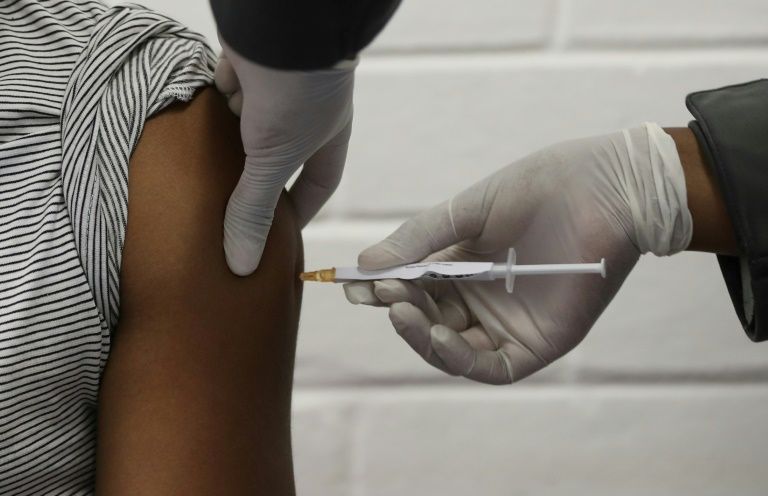

After a slow start, Africa has shifted up a gear in coronavirus vaccine procurement, securing hundreds of millions of jabs from pooling initiatives amid efforts to gain ground in the global inoculation race.
So far only a small handful of African countries have started immunising their populations against Covid-19, starting with the Seychelles and more recently Mauritius.
Wealthier nations have been accused of bulk-buying excess doses directly from manufacturers — limiting supply and securing better deals than governments with less purchasing clout.
Most African countries are relying on the World Health Organization (WHO) and the African Union (AU) to shoulder at least part of their innoculation campaigns by providing vaccines and helping to finance their rollout.
The AU announced Thursday that it had secured 400 million doses of Covid-19 jabs for its members in addition to 270 million doses set forth earlier this month.
The WHO-backed Covax sharing facility is meanwhile said to be on track to deliver 600 million vaccines to the continent by the end of 2021.
Some African countries have also started negotiating directly with suppliers.
Algeria signed a “mutual agreement” with a Russian laboratory this month to buy the contentious Sputnik-V vaccine, while Senegal is in talks to acquire doses of China’s Sinopharm vaccine.
South Africa, the continent’s worst virus-hit country, is expecting a first batch of 1.5 million Oxford/AstraZeneca vaccines on February 1.
Africa’s most industrialised economy will also get nine million shots from Johnson & Johnson, if its vaccine is approved, and is negotiating with other undisclosed manufacturers.
– ‘Ramp up’ –
During the virtual 2021 World Economic Forum this week, South Africa’s President Cyril Ramaphosa lashed “vaccine nationalism,” accusing rich countries of hoarding doses to the detriment of poorer counterparts.
It is estimated Africa will need 1.5 billion vaccines to immunise 60 percent of its 1.3 billion inhabitants — a potential threshold for herd immunity against Covid.
But the WHO on Thursday cautioned that Covax and the AU combined would only be able to deliver jabs for around one third of the continent this year.
“Reaching 30-35 percent (of the African population) could be a realistic assumption by the end of 2021,” WHO Africa’s immunisation coordinator Richard Mihigo said during a virtual press briefing.
Africa was likely to receive its first Covax vaccines before mid-February, he added, without specifying which countries would come first.
“By March we will definitely see most of the countries start vaccinating,” Mihigo predicted.
“It is a slow start, but we are expecting that in the coming months things are going to ramp up.”
While the AU says it has secured 670 million doses, delivery is expected to be slower, with only 50 million vaccines promised to be available between April and June so far.
The bulk of these pooled provisions will be Oxford/AstraZeneca vaccines, followed by a few million Pfizer-BioNTech jabs.
– New variants –
Time is ticking. Several African countries are struggling to contain a second virus wave that has proved more virulent than the first, piling pressure on weary staff and under-equipped hospitals.
To date the continent has recorded close to 3.5 million coronavirus cases and 88,000 deaths, according to a tally compiled by AFP.
Those figures remain relatively low compared to other regions, but the threat is worsening.
The WHO warned Thursday that over 175,000 new cases and 6,200 deaths had been reported over the last week alone, mostly in northern and southern Africa.
Recorded infections have increased by 50 percent in the last four weeks, and the number of deaths has doubled.
Even more concerning is a coronavirus variant first identified in South Africa and now “powering record case numbers” across Africa, the WHO said.
Known as 501Y.V2, it is thought to be more contagious and has cropped up in at least six African countries and 24 worldwide.
“What’s keeping me awake at night right now is that it’s very likely circulating in a number of African countries,” said WHO Africa Director Matshidiso Moeti in a statement.
Another virus variant first detected in Britain has also been reported in The Gambia and Senegal.
The WHO is supporting African countries to build and boost genomic surveillance capacities needed to track and respond to other potential variants.
Moeti called on governments to ramp up testing in the meantime and continue enforcing social distancing measures.
“In addition to the new variants, Covid-19 fatigue, and the aftermath of year-end gatherings risk powering a perfect storm,” she urged.
“We must stick to our guns and double down on the tactics we know work so well.”
sch-md/ri
Recent Comments