

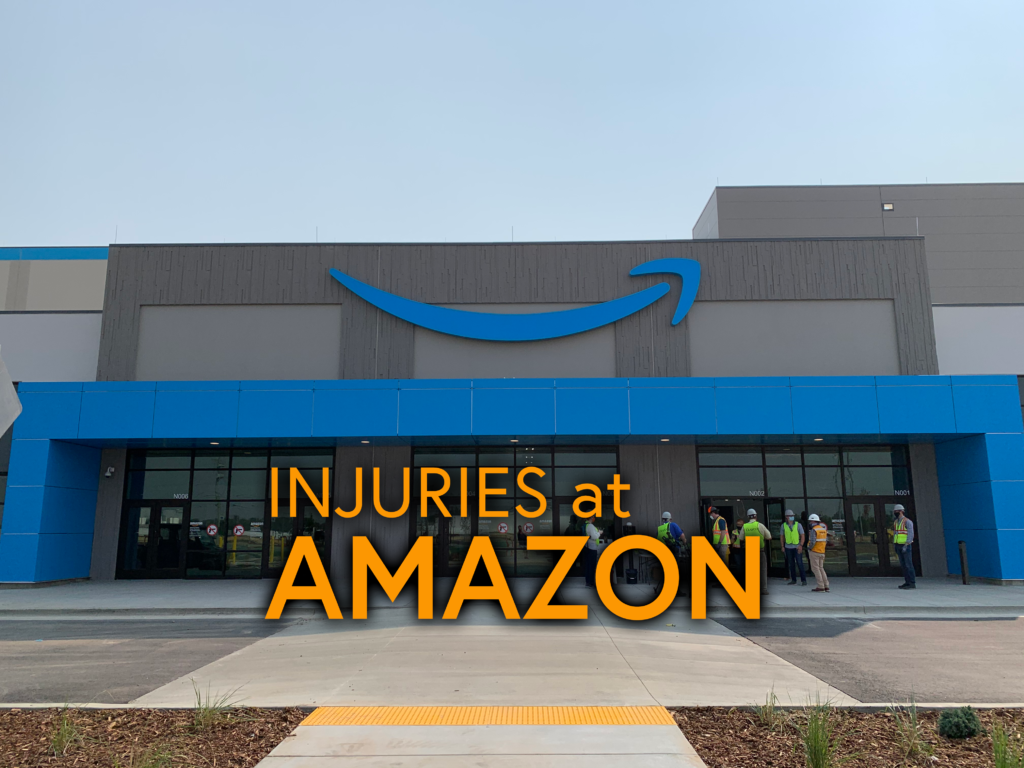

Online retail giant Amazon is setting up shop in Idaho in a big way, bringing thousands of jobs paying more than double the state’s minimum wage, millions in tax revenue and several new warehouses in the Treasure Valley.
But, if nationwide trends are any indication, it could also bring more workplace injuries to the Gem State.
[Amazon rises: Large warehouse for retail giant starts to take shape along I-84]
Injury rates in Amazon fulfillment centers across the country are more than eight times higher than the average across all of Idaho’s industries in the past two years, according to a BoiseDev analysis. A comparison of reports of serious injuries to the Idaho Industrial Commission and recently released data on years of injuries in Amazon’s warehouse network show a gulf between the likelihood Idaho workers and the company’s employees have of getting hurt on the job.
Statewide, Idaho had .82 serious injuries per 100 workers in both 2018 and 2019 across all professions, according to data from the Idaho Industrial Commission. This is in comparison to an average 9.3 injuries per 100 workers at fulfillment centers nationwide with robotics, similar to the new center in Nampa, in 2018. In 2019, the injury rate at those centers stood at 8 serious injuries per 100 workers.
A serious injury is defined by both Reveal and BoiseDev here as one that requires time off or job modifications.
More growth comes with more scrutiny
As Amazon continues to rapidly expand across the United States, the company is under increased scrutiny from worker’s rights groups and regulators for high injury rates in its warehouses. Reveal from the Center for Investigative Reporting obtained years of internal injury rate reports from more than 150 Amazon warehouses, which showed an increase of injuries over time according to their September 2020 investigation.
In response to questions about the injury rates in Reveal’s article and Idaho’s numbers, an Amazon spokesperson gave a general comment about how the company is working to address safety in its warehouses. Amazon pushed back against Reveal’s report after its publication, saying they did not properly analyze the internal documents nor show Amazon’s interest in safety. They also disputed Reveal’s classification of “serious injury,” arguing the company’s numbers are higher because they are more generous with time off.
“We continue to invest in safety training and education programs, technology and new safety infrastructure, and we see improvements through programs focused on improved ergonomics, delivering guided physical and wellness exercises to our associates at their workstation, mechanical workstation assistance equipment, improving workstation setup and design, forklift telematics, forklift guardrails to separate equipment from pedestrians, and parking lot improvements—to name a few,” spokesperson Anne Laughlin said. “While any incident is one too many, we are continuously learning and improving our programs to prevent future incidents.”
During a tour of Amazon’s Nampa facility earlier this year for the media, employees emphasized a number of safety precautions. One of those precautions included not talking while walking through the under-construction facility, but in two instances, an Amazon employee approached a BoiseDev reporter and began a conversation while walking, violating the rules they set forth.
Across the entire Amazon fulfillment network, Reveal found the company recorded 14,000 serious injuries at a rate of 7.7 per 100 workers. This was a third higher than the rate recorded in 2016 and twice as high as the injury rate in warehouses from the U.S. Bureau of Labor Statistics. Fulfillment centers with robots to assist workers fill orders at the lightning-fast speed required of the company had higher rates than the average warehouses, according to Reveal’s investigation.
Amazon has a number of projects in the works in Idaho. The centerpiece, the 2.65 million square foot Nampa fulfillment center, is set to employ 2,000 workers and started operating earlier this year to support holiday orders. The company also started work on a distribution center off Gowen Road in Boise during 2019 and recently filed permits to build a ‘sortation facility’ in the City of Boise’s industrial park off of Eisenman Road.
A roughly 141,000 square foot delivery station is also under construction in Meridian.

The closest fulfillment center to the Treasure Valley is Amazon’s Salt Lake City facility. In the two years of data available, Reveal found the fulfillment center had even higher injury rates than the rest of the Amazon fulfillment center network. The company recorded 16.1 serious injuries per 100 workers in 2018 and 11.4 per 100 workers in 2019, according to the data.
Due to the outsize risk for injuries in Amazon warehouses, Washington State recently proposed charging the company a higher premium for workers compensation, according to the Seattle Times. This would put Amazon in its own category for worker’s compensation claims, separate from other warehouses reporting lower injury rates, and charge the company and its workers 15% more.
What about injuries Idaho?
When asked if the state was concerned about the injury rates in Amazon warehouses, Nick Stout, spokesman for the Idaho Industrial Commission, said the regulator does not comment on individual companies.
“I do not believe it is appropriate for IIC to comment on any organization’s merits or concerns in particular…” Stout wrote in an email to BoiseDev.
BoiseDev FIRST members made this story possible. If you aren’t already a member, sign up now to get our daily scoop sheet in your inbox, and help support independent journalism in Boise.
It is unknown how many injuries Amazon already reported in Idaho because the state does not disclose injury reports at specific businesses or the categories they use to report injuries, Stout said. It is also impossible to compare how many injuries workers doing similar jobs to Amazon in Idaho are reporting now because each employer selects the exact category for each injury themselves.
Counting all injuries, not just serious ones requiring an indemnity claim from the state, 4,350 injuries came from the retail trade sector – the majority of reports filed with the state between July 1, 2019 and June, 30 2020. Health care are social assistance came in second with 4,300, followed by 3,979 in manufacturing. Transportation and warehousing was 12th, with 1,223 injuries.
Warehouse workers did not top the list of injuries in either Canyon or Ada County in the past two years. Of the 1,846 serious injuries in Ada County in 2018, 98 were categorized as “executive and legislative offices.” When asked for more detail, Stout said many local governments use this category when reporting injuries for police officers and firefighters. 85 of the injuries reported were not classified.
Other top categories for that year include elementary and secondary schools and supermarkets. In 2019, Ada County had 1,733 serious injuries, with “executive and legislative offices” leading with 97 reports, supermarkets with 87 and 77 from elementary and secondary schools.
Canyon County had 857 injuries in 2018, with top categories including “executive and legislative offices” at the top of the list with 53. Another 39 reports from “administration of human resource programs” and 29 from elementary and secondary schools. The two top categories stayed the same in 2019, with “administration of human resource programs” and “executive and legislative offices” at the top.
BoiseDev’s Don Day contributed reporting.
Recent Comments