

- Amazon told sellers on Tuesday that it’s delaying inventory removal orders and waiving long term storage fees at its warehouses.
- The change allows Amazon to dedicate its formidable logistics resources to delivering essential products to consumers, instead of spending efforts returning inventory to sellers.
- The change could help some merchants sell dead products by keeping them in Amazon warehouses longer, but could also prevent them from taking back them back and selling on other channels.
- Visit Business Insider’s homepage for more stories.
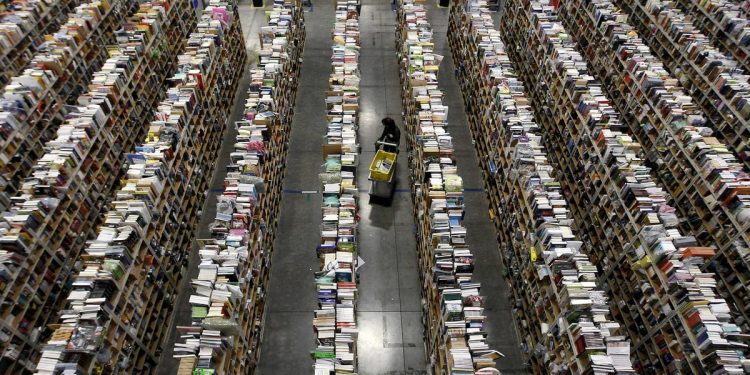
Amazon is now letting sellers keep their old, non-selling products in its warehouses longer so that it can focus its logistics resources on more urgent, essential products amid the coronavirus pandemic.
In a note sent to sellers on Tuesday, obtained by Business Insider, Amazon announced that it’s delaying removal orders from its warehouses and waiving long-term storage fees for next month. Amazon typically penalizes sellers that fail to use its warehouses efficiently, and requires an extra fee for removal of certain products that clog up space.
With the change, Amazon won’t have to use its logistics capacity — including trucks, planes, and warehouse people tracking those returns — on shipping back those products to sellers.
“To ensure the capacity to receive, restock, and ship high-priority products like household staples and medical suppliers, we have temporarily paused removal operations in some of our fulfillment centers,” the note said.
The long-term storage fee waiver for next month applies to warehouses in the US, the UK, Germany, France, Italy, Spain, Poland, and the Czech Republic, the note said.
An Amazon spokesperson confirmed the change in an email to Business Insider.
It’s the latest change in Amazon’s marketplace policy as the company scrambles to fulfill orders of vital goods amid soaring demand following the coronavirus outbreak. On Sunday, sellers discovered most of their non-essential product shipments delayed until April 21. That followed news of cancelling all non-essential shipments to consumers in France and Italy. Last week, Amazon also stopped accepting non-essentials to its warehouses in the US and European regions so it could make more room for vital products like face masks and hand sanitizers.
Products that fall under the following six categories are considered essential by Amazon: baby product; health and household (including personal-care appliances); beauty and personal care; grocery; industrial and scientific; pet supplies.
Abe Chomali, founder of XP Strategy, an agency that helps Amazon sellers, said the move shows how Amazon’s top priority right now is bringing the most in-demand product into its warehouses and ensuring delivery of those products to the end consumers. Everything else, at this point, is a distant second.
“Amazon is so busy just filling their current volume of orders that they have no time for regular inventory maintenance or housekeeping,” Chomali said.
Some products could be “stuck” in Amazon’s warehouses
The change could have mixed results for sellers, according to Chomali. Truly dead products can stay in Amazon warehouses longer and have a chance to sell without incurring fees. On the other hand, products that could have been removed and sold on other channels are now stuck in Amazon warehouses, preventing sellers from utilizing them in other ways.
“Seller concerns aren’t even on Amazon’s radar at the moment,” Chomali said.
Gabe Ray, cofounder of Evolved Commerce, said the move makes sense given the increased workload Amazon is dealing with. Sellers can still create removal orders of dead products, but they will be put towards the back of the line as Amazon prioritizes shipping essential products to consumers, he said.
“The goal is the same as always — Put the customer first and meet their demands above all else,” Ray said.
More than 51,000 people have been affected by the coronavirus in the US, and over 650 people have died from the disease. The US has declared a national emergency and is considering a slew of financial measures to help support the economy.
Amazon announced last week that it would hire 100,000 additional warehouse and delivery workers to help ease the workload. Those workers will get a pay raise of $2 per hour through April as well.
Amazon CEO Jeff Bezos expects more challenges going forward. On Saturday, he wrote in a letter to his employees, that things will only “get worse before getting better.”
“My own time and thinking is now wholly focused on COVID-19 and on how Amazon can best play its role,” Bezos said in the letter. “I want you to know Amazon will continue to do its part, and we won’t stop looking for new opportunities to help.”
Recent Comments