



A 42-year-old woman presents to the emergency department (ED) with periodic stomach pain and vomiting. While the symptoms have been ongoing for months, she decided to come to the ED after she noticed streaks of blood in her stool.
She explains that she has been having intermittent episodes of vomiting for the past 4 months, along with abdominal pain on her right side after she eats; this is what sometimes triggers the vomiting. On questioning, she says she has lost about 20 pounds over the past 4 months.
There is nothing else notable in her medical history. Physical examination notes abdominal tenderness in the right upper and lower abdominal fields, although there is no evidence of obvious abdominal distension or palpable masses. She does not use anticoagulants.
Her vital signs on presentation and throughout her time in emergency are normal and remain stable, with no evidence of tachycardia, fever, or low blood pressure.
Laboratory tests reveal a white blood cell count of 5.9 × 10⁹/L, hemoglobin of 14.1 g/dL, normal liver function tests, and results of urinalysis are unremarkable.
A CT scan of the abdomen and pelvis with contrast shows no evidence of bowel masses, or other acute pathology. In particular, clinicians see no evidence of a foreign body at the ileocecal junction.
The constellation of symptoms prompts a gastroenterology consultation. This results in an order for urgent endoscopic evaluation and the patient agrees and is released to home. Three days later, the patient presents to the gastroenterology clinic for further testing
Upper gastrointestinal endoscopy reveals mild gastritis only. However, lower gastrointestinal endoscopy identifies an obvious foreign body near the terminal ileum. Clinicians report that it resembles an undigested mini-bell pepper (Figure).
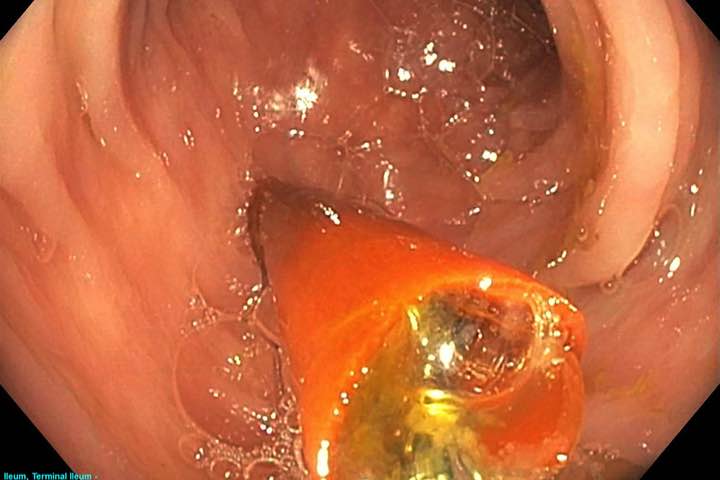
Clinicians remove the object using regular forceps. Assessment of the rest of the gastrointestinal tract finds no other evidence of pathology or reason for her abdominal symptoms.
Case Follow-up
The patient’s course is otherwise uncomplicated. A few days later, she is discharged in good condition and reports tolerating an oral diet with very little abdominal discomfort in the following days.
Discussion
Clinicians reporting this case write that in patients presenting with unexplained intermittent bowel obstruction symptoms, physicians should consider the possibility of a foreign body or bezoar in the differential.
Clinicians explain that bezoars are defined as any foreign body or substance in the gastrointestinal tract that cannot be digested in the normal fashion, which subsequently may develop into hard masses, concretions, or other matted substances. Importantly, bezoars can occasionally lead to secondary intestinal obstructions.
Bezoars are classified into four types depending on the material they are composed of. As described in Case Challenge 1, these include phytobezoars, trichobezoars, pharmacobezoars, and lactobezoars. Initial presentation may vary depending on the type of bezoar – identification of the type and location of the bezoar is central to determining appropriate management.
Endoscopic evaluation is typically required to diagnose a bezoar and determine the best approach to treatment. Management strategies for gastric phytobezoars can be divided into three categories: lavage or dissolution, fragmentation, and/or retrieval. Rates of bowel obstruction secondary to bezoars are reportedly from 0.4% to 4%.
Predisposing Risk Factors
Bezoars are believed to form as a complication of delayed gastric emptying. Underlying gastrointestinal pathology, such as previous surgery, adhesions, radiation, gastritis, or dysmotility, can lead to an obstruction following formation of a bezoar. Other risk factors include peptic ulcer disease, chronic gastritis, Crohn’s disease, carcinoma of the gastrointestinal tract, dehydration, and hypothyroidism. Other factors that may predispose to formation of bezoars include poor mastication, excessive intake of fiber, cystic fibrosis, or psychiatric illness – specifically, psychiatric comorbidities that involve strong urges to pull out one’s own hair (trichotillomania) and eat it (trichophagia).
Phytobezoars
When a bezoar develops due to accumulation of undigested plant or food material, as in this patient’s case, it is termed a phytobezoar. Phytobezoars account for approximately 40% of all reported bezoars. Celery, pumpkins, grape skins, prunes, raisins and, in particular, persimmons are common causes of phytobezoars.
Clinicians note that their patient represents a rare case (<1%) in that she had no underlying pathology or predisposition to obstruction other than the phytobezoar itself. Despite the absence of any radiographic evidence of obstruction on computed tomography, the intermittent and post-prandial nature of her symptoms were suggestive of possible ball-valve type effect due to the presence of a foreign body near the terminal ileum. They add that organic vegetable matter of a phytobezoar means it would not be evident on radiographic computed tomography.
Phytobezoars can be prevented with appropriate mastication, proper fluid consumption, and limited ingestion of high-fiber foods. While endoscopy is generally used to evaluate, treat, and remove most gastric bezoars, surgical removal is generally needed for small-bowel obstructions secondary to bezoars.
Administration of Coca-Cola is considered a primary choice for phytobezoar treatment because it is safe, inexpensive, and effective, although persimmon phytobezoars (diospyrobezoars) are notably resistant to this option and may require different treatment. Endoscopic fragmentation or surgical removal should be used to manage refractory bezoars and urgent cases that present with gastrointestinal bleeding and/or ileus.
Authors had no disclosures to report.
1969-12-31T19:00:00-0500
last updated
Recent Comments