


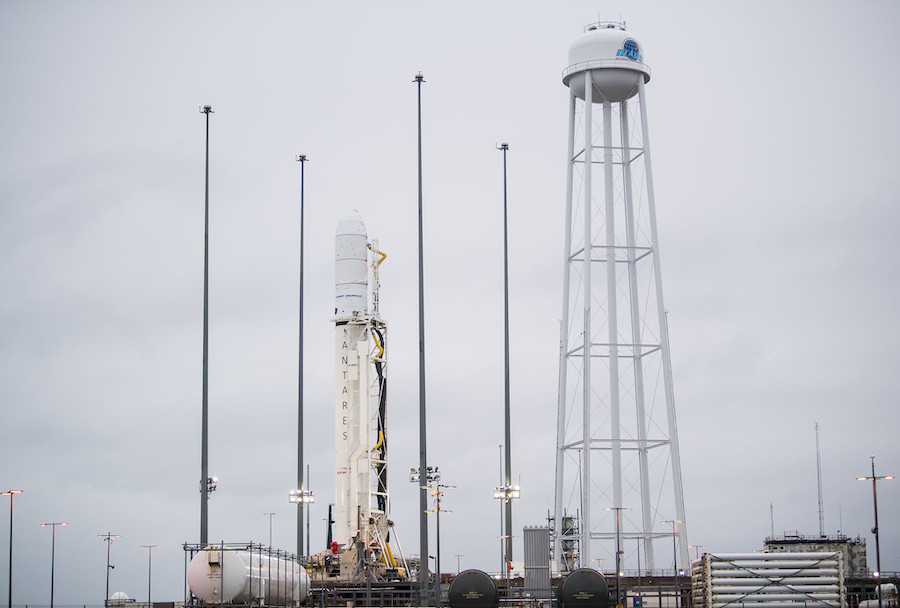
A commercial Cygnus resupply ship named for Robert H. Lawrence, Jr. — the first African American selected as an astronaut — is awaiting liftoff Sunday evening from NASA’s Wallops Flight Facility on Virginia’s Eastern Shore to begin a 35-hour trip to the International Space Station.
The unpiloted supply carrier is scheduled for launch at 5:39 p.m. EST (2239 GMT) Sunday from pad 0A at the Mid-Atlantic Regional Spaceport, a facility owned by the Virginia Commercial Space Flight Authority on Wallops Island, Virginia.
A two-stage Northrop Grumman Antares rocket, standing 139 feet (42.5 meters) tall, will haul the Cygnus cargo freighter into orbit a few minutes after sunset at the Virginia spaceport.
The Cygnus supply ship is also built and owned by Northrop Grumman, one of two companies currently flying commercial resupply missions to the space station under contract to NASA. SpaceX is NASA’s other cargo transportation provider for the space station program.
The mission is designated NG-13, and is the 13th operational resupply launch for the space station by Northrop Grumman and its predecessors Orbital Sciences and Orbital ATK.
Northrop Grumman has named the Cygnus spacecraft the S.S. Robert H. Lawrence after the first African American selected as an astronaut for a U.S. space program. The Air Force selected Maj. Robert H. Lawrence, Jr., as an astronaut for the military’s Manned Orbiting Laboratory program, which intended to develop and fly space stations in Earth orbit accommodating two astronauts for month-long missions to gather surveillance imagery of the Soviet Union and other strategic locations around the world.
The Air Force announced Lawrence’s selection for the MOL program in June 1967, but he died in an aircraft training accident in December of the same year. The MOL program was canceled in 1969, and the military astronauts selected for the program under 35 years old were transferred to NASA.
“Since Lawrence was in that age range, it is virtually certain he also would have transferred,” NASA officials wrote in a feature story on Lawrence in 2018. “All in that group flew on the space shuttle in the 1980s; it is easy to imagine that Lawrence would have piloted one of the early space shuttle missions.”
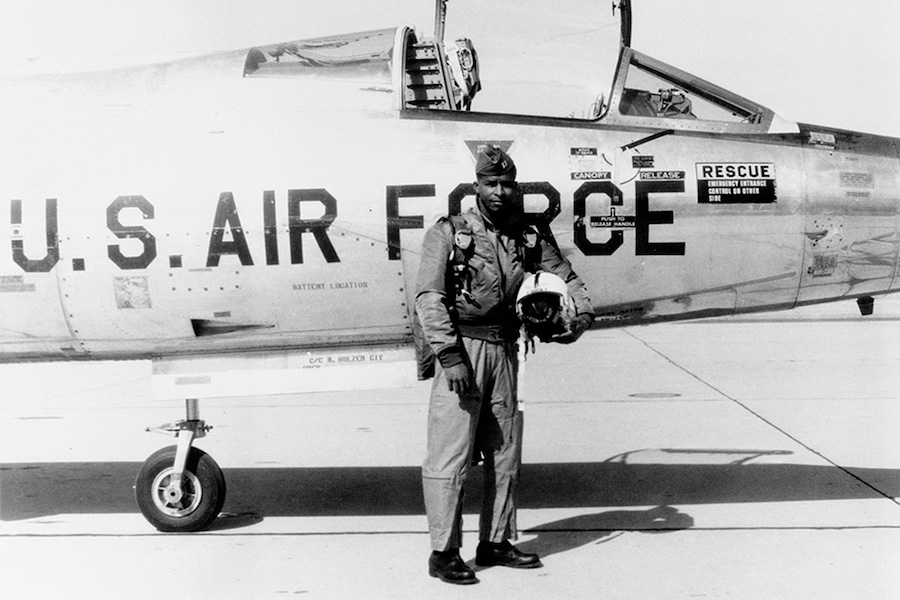
Northrop Grumman names each of its Cygnus resupply vessels after a late astronaut or other space industry official.
“In 1967, the U.S. Air Force selected Maj. Lawrence as an astronaut for the Manned Orbiting Laboratory program,” said Frank DeMauro, vice president and general manager of Northrop Grumman’s tactical space systems division. “Although his career was cut short in a tragic accident, he paved the way for future aerospace pioneers of all races and enabled increased diversity and inclusion across the industry. While Maj. Lawrence never flew into space, we are proud that Cygnus will carry his name on this mission.”
After rolling out to pad 0A Wednesday from a nearby hangar, the Antares rocket was lifted vertical for compatibility checks with its launch pad and the range safety infrastructure at Wallops. Teams rotated the rocket back horizontal to begin loading final time-sensitive cargo into the Cygnus spacecraft Saturday, then planned to raise the Antares vertical again early Sunday.
The five-hour countdown sequence is set to kick off at 12:39 p.m. EST (1739 GMT) Sunday, with loading of the Antares first stage with kerosene and liquid oxygen propellants set to start in the final 90 minutes of the countdown.
As the countdown clock ticks down to zero, the first stage’s two Russian-made RD-181 engines will ignite and throttle up before hold-down restraints release to allow the Antares rocket to climb away from pad 0A.
The twin-engine first stage will produce around 864,000 pounds of thrust at full power and burn for around 3 minutes, 14 seconds to send the Antares rocket and Cygnus spacecraft southeast from the Virginia coastline over the Atlantic Ocean.
The first stage will separate less than three-and-a-half minutes into the mission, followed by jettison of the Antares payload shroud. A solid-fueled Castor 30XL second stage motor will fire at T+plus 4 minutes, 5 seconds to accelerate the Cygnus cargo freighter into a preliminary orbit.
Burnout of the Castor 30XL stage is expected just shy of the seven-minute point of the mission, followed by separation of the Cygnus spacecraft around eight-and-a-half minutes after liftoff.
The Cygnus will unfurl two fan-shaped solar panels after release from the Antares upper stage, then commence a series of thruster burns to raise its orbit to match that of the space station some 260 miles (420 kilometers) above Earth.
Last year, NASA requested Northrop Grumman move forward the launch of the NG-13 mission from April to February to accommodate the space station’s logistics needs. Northrop Grumman officials said they brought in extra technicians to handle the accelerated preparation schedule after the launch of the NG-12 mission — the company’s previous cargo flight — in November.
The Cygnus spacecraft on the NG-12 mission departed the space station Jan. 31 and remains in orbit. It will re-enter the atmosphere for a destructive re-entry with several tons of space station trash around the end of February.
If all goes according to plan, the Cygnus spacecraft will approach the station on autopilot with the aid of laser rangefinders. Astronauts aboard the station will use the Canadian-built robotic arm to capture the Cygnus freighter around 4:30 a.m. EST (0930 GMT) Tuesday once the commercial cargo ship reaches a point roughly 30 feet (10 meters) below the orbiting complex.
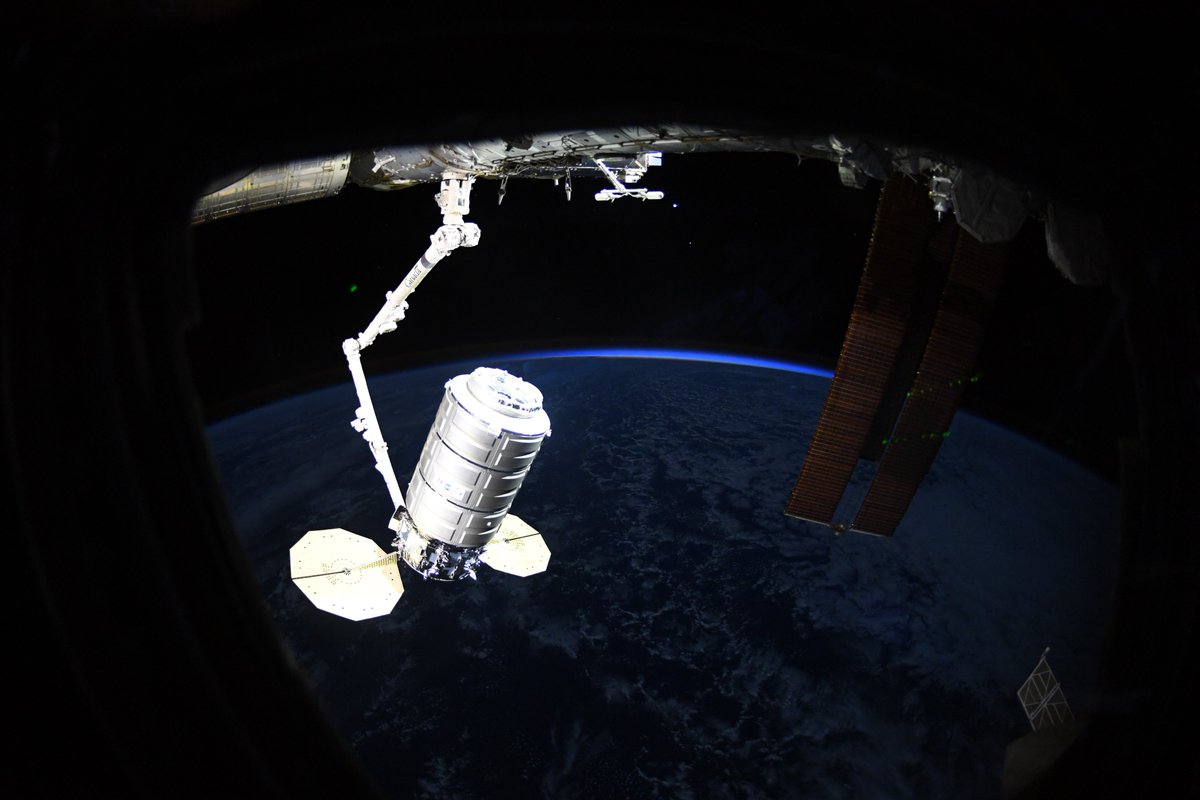
The S.S. Robert H. Lawrence is set to deliver around 7,641 pounds (3,466 kilograms) of scientific experiments, technology demonstration payloads, spare parts and crew provisions to the station.
NASA provided the following breakdown of the cargo manifest:
- 3,534 pounds (1,603 kilograms) of vehicle hardware
- 2,174 pounds (986 kilograms) of scientific investigations
- 1,669 pounds (757 kilograms) of crew supplies
- 200 pounds (91 kilograms) of spacewalk equipment
- 64 pounds (29 kilograms) of computer resources
The equipment launching aboard the Cygnus supply ship includes a scanning electron microscope built by Voxa, a Seattle-area company that aims to miniaturize and reduce the cost of nano-imaging technology.
“It’s the first portable scanning electron microscope in the world, and tomorrow it’ll also be the first portable microscope in space,” said Christopher Own, facility manger and CEO of Voxa.
Electron microscopes work by scanning electron beams over a target to create an image, telling scientists about the material’s physical characteristics and composition. A conventional scanning electron microscope can cost $1 million, and Own says his company’s unit costs around $65,000, and the price could come down if it is mass-produced.
NASA wants to test the Mochii microscope, named for the Japanese dessert, in orbit to see if the device could help scientists analyze biological samples, perform materials science experiments, and take detailed pictures of contaminants and particles that could affect the performance of equipment aboard the space station.
It sometimes takes months to get a sample back to Earth for analysis in ground-based labs. SpaceX’s Dragon capsule is the only vehicle capable of returning large amounts of cargo to the ground intact.
A microscope like the Mochii device on the space station could allow scientists to analyze samples soon after they are gathered. What’s more, the microscope can be operated remotely by researchers on the ground.
“When we came up with the concept, we thought what about the dessert mochii,” Own said. “It’s small, cute and absolutely delicious. Everybody will want one.”
Astronauts will install the microscope inside the Japanese Kibo laboratory module on the space station, and the device will go through testing to see if it meets specifications.
“The expectation, provided that the experiments are successful up there, is to leave it up there and give it to the wider community to use,” Own said.
A range of biological research experiments are also going up Sunday.
“We have an investigation going up to study cardiomyocytes, or heart cells, and see if we can more effectively grow those in space,” said Heidi Parris, assistant program scientist for NASA’s space station program office. “An investigation is looking at a certain kind of virus called a bacteriophage that is able to target specific bacteria, harmful bacteria in our bodies, while leaving the rest of our human cells intact, and the good bacteria and our microbiome intact.
“We have an investigation that’s looking at the molecular mechanisms behind bone formation and bone loss,” she said. “Bone loss is a huge issue for astronauts, and also for osteoporosis patients on Earth, so it’s a benefit if we understand that in the space environment and also on the ground.”
The Cygnus spacecraft also carries fresh fruit and vegetables, plus a shipment of conditioned hard cheddar and Manchego cheese, according to Ven Feng, manager of NASA’s space station transportation integration office.
“For the first time ever, we’re sending up some conditioned cheese in a little bit of extra space we had left over,” Feng said Saturday.
The Cygnus spacecraft will remain attached to the space station until around May 11, when it will depart to begin the second phase of its mission.
A NASA flame combustion experiment housed inside the Cygnus pressurized module will examine how flames propagate in microgravity. It’s the fourth in a series of NASA Saffire experiments developed at the Glenn Research Center in Ohio that have flown on Cygnus missions.
Previous combustion investigations in space have been limited in size and scope because of concerns about the dangers to astronauts. But the Cygnus will be far away from the space station when the Sapphire experiment begins, allowing scientists to ignite larger samples to see how flames behave in space.
For the first time, the Sapphire experiment on the NG-13 mission will ignite four burn samples, two of which will be ignited with the the air pressure inside the Cygnus spacecraft equivalent to sea level on Earth. Then the Cygnus module will be partially depressurized — and its oxygen content increased — to see how the oxygen-rich, lower-pressure environment affects the combustion of the other two samples.
The experiment will also test fire detection technology for use on future spacecraft, and automated fire clean-up systems.
The Cygnus spacecraft will also release CubeSats from an external deployer after leaving the space station.
Once the CubeSats are released and the fire experiment is complete, the Cygnus will re-enter the atmosphere and burn up in the atmosphere over the South Pacific Ocean.
Email the author.
Follow Stephen Clark on Twitter: @StephenClark1.
Recent Comments