


SOUTH HADLEY — As the popularity of social media platforms such as TikTok and Twitch rises, a recent survey has found that the number of college admissions officers who visit applicants’ social media pages has also increased.
The Five Colleges have not joined this trend, though applicants should keep their web presence in mind when applying to colleges locally or in general, according to admissions officers.
The survey released by Kaplan in January polled almost 300 college admissions offices and showed that 36% of admissions officers visit applicants’ social media pages, representing the first rise in this figure in three years. While these may include well-established platforms such as Facebook, Twitter, YouTube and Instagram, Kaplan notes that the survey was also released as applications such as TikTok, where users upload short videos, and the Twitch live-streaming video service surge in usage.
But amid this evolving social media landscape, Five College officials say their institutions have not extended their review process to actively seek out applicants’ profiles.
At Mount Holyoke College, “we really are just evaluating what the students give as their application, so unless a student is prompting us to go beyond their submitted material, we’re not essentially digging for more information,” Dean of Admission Leykia Nulan said.
Nulan said that social media is a “tricky” topic for colleges to consider, as even for staff and faculty, views can be misconstrued as reflecting the values of the college itself. But in order to “continue to create communities that are full of a diverse composition,” Nulan believes that colleges should exercise caution when judging students based on social media.
“If we whittle folks down to everything they say or do on social media, we might actually miss out on some game-changers,” Nulan said, “so I don’t think that colleges and universities should spend a lot of time analyzing student social media accounts.”
This point is especially relevant “given how young they are and what we know about student development,” Nulan added, noting that parts of the brain that oversee aspects of impulsivity and decision-making “aren’t really kicked into higher gear until you are a college student.”
Additionally, seeking out and reviewing each applicants’ social media profiles would strain many admissions offices’ time and resources, Nulan and other officers noted.
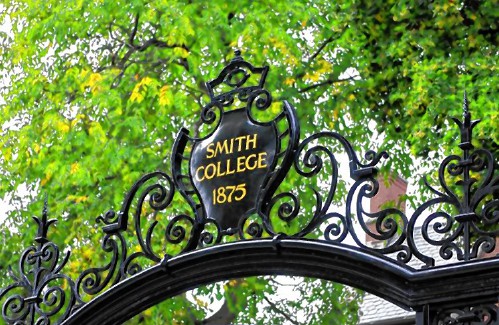
The Smith College admissions office also does not seek out applicants on social media, Dean of Admission Deanna Dixon said.
“It is most important to us that a student is able to show us their academic preparation,” Dixon said, “so for us, we are going to focus more on their academic record than what we might find through any kind of social media avenue.”
But when applying to any college, Dixon said that students should keep in mind that the admissions office may consider social media a reasonable factor to include in the decision-making process, even if the school does not actively seek out applicants’ profiles.
“I think anything that is open to the public certainly is open to the admission officer or admission office that decides that they want to use it as part of their process,” Dixon said.
“I think that students should be aware that any information that we learn about them could be important to an institution’s process, including what we learn about them in the public domain,” she said.
Most admissions officers agree with Dixon. While the majority do not search for applicants’ social media profiles, 59% of admissions officers told Kaplan that they consider social media “fair game” for colleges to consider in the application process, while 41% oppose it as “an invasion of privacy that shouldn’t be done.”
Students polled in a separate survey were in agreement with the majority, Kaplan noted, with 70% of college applicants considering their social media profiles fair game for admissions offices.
Dixon encouraged applicants to “consider putting their best foot forward,” and if they are concerned that their social media profiles may negatively impact their admissions results, applicants should think twice about what their social media presence may reflect on them.
Like Smith and Mount Holyoke, the University of Massachusetts Amherst does not actively seek out social media profiles, said Jim Roche, vice provost for enrollment management, though when material posted on social media is placed on the university’s radar, admissions officers will assess it on a case-by-case basis.
“I think there’s a big difference between knowing something about an applicant versus going out and searching something on every applicant,” Roche said.
“Information comes to us in a variety of ways outside of the application,” such as through phone calls, emails and written letters, he added. “The challenge is determining how valid the information that we get is.”
The admissions office “certainly will consider” serious allegations, Roche said. “But the good thing is that those kinds of correspondences are very rare.”
“In the rare case where that might happen, we take everything with a grain of salt,” he added. “Not everything that you see online is to be taken at face value or to be trusted.”
But often, students are open about potentially negative information on social media or elsewhere, Roche said, noting he is often impressed by how “open and honest many of the applicants are about things that they know we might see as negative.”
“I like the idea that at 17 or 18 years of age, they’re mature enough to know that it works in their favor if they bring it up,” he said, noting that these incidents are not always deal breakers for admissions.
“When you’re 15, 16, 17 years old, sometimes you do things that are not well-thought-out in advance,” Roche said. “They’re not egregious enough to make that defining factor in the admissions decision.”
Amherst and Hampshire colleges also do not examine social media as part of their application process, representatives of the colleges told the Gazette.
Jacquelyn Voghel can be reached at [email protected].
Recent Comments