
Tech News, Magazine & Review WordPress Theme 2017
  • Home
  • Supply Chain Updates
  • Global News
  • Contact Us
  • Home
  • Supply Chain Updates
  • Global News
  • Contact Us
No Result
View All Result
No Result
View All Result
Home Supply Chain Updates

Are US carload volumes improving?

usscmc by usscmc
March 5, 2020
Are US carload volumes improving?
Share on FacebookShare on Twitter

U.S. carloads appeared to be moderating their months-long decline in February, with carloads down only 0.8% from a year ago if coal carloads are excluded from the total, the Association of American Railroads (AAR) said yesterday.

February coal carloads tumbled 21.1% year-over-year, AAR said.

Excluding coal and grain carloads, U.S. carloads were flat in February compared with the same period in 2019. They were up 62 carloads year-over-year for the week ending Feb. 29. 

But including coal and grain, U.S. carloads in February totaled 927,084 caloads, down 7.3% year-over-year, with the decline “driven almost entirely by coal,” said AAR Senior Vice President John Gray.

“Excluding coal, carloads in February were down just 0.8%, their best showing in a year,” Gray said.

Total February U.S. traffic was 1.92 million carloads and intermodal units, which is 8.1% lower than the same period a year ago.

But 10 out of 20 commodity categories posted year-over-year carloads gains, “the most in more than a year,” Gray said. Among the gains were chemicals, which rose 2.9%; petroleum and petroleum products, which were up 7.2%; and all other carloads, which increased 12%.

Meanwhile, U.S. intermodal units totaled 997,683 containers and trailers, down 8.9% from February 2019. 

Gray noted that even though the coronavirus outbreak is creating a lot of uncertainty, its impact on U.S. rail traffic appears limited. However, if the projected sharp declines in U.S. port volumes come to fruition in the weeks ahead, that could impact rail volumes. 

“Supply chain disruptions related directly or indirectly to the coronavirus may have played some unquantifiable role in the decline in U.S. intermodal volumes in February, but intermodal has been falling for more than a year,” Gray said. “The headwinds facing railroads that pre-date the virus include lingering trade impacts and economic uncertainty; severe winter weather in parts of the country; blockades in Canada that shut down rail traffic there and impacted domestic traffic too.”

On a year-to-date basis, U.S. traffic year-to-date totaled 4.36 million carloads and intermodal units, down 6.8% year-over-year. Of this, U.S. carloads were down 6.5% to 2.09 million carloads, while intermodal units slipped 7% to 2.24 million containers and trailers.
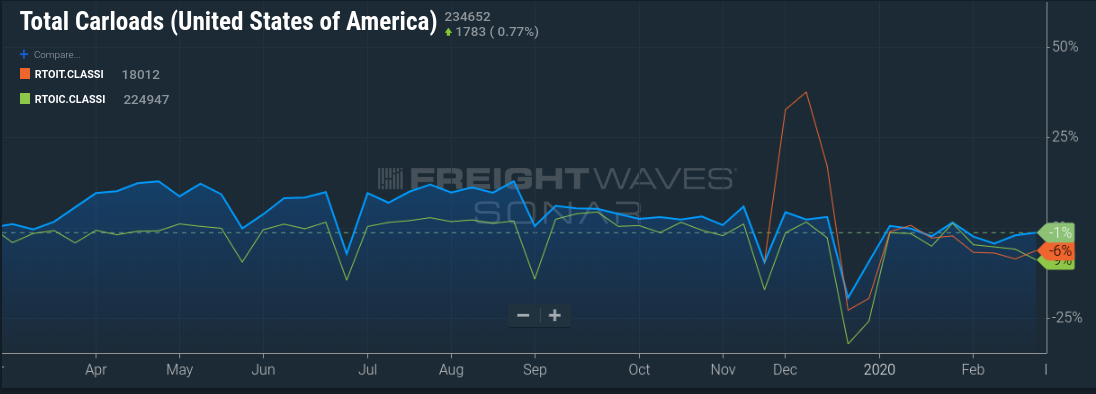
U.S. rail carloads over the past year are graphed in SONAR as the blue line (RTOTC.USA). Intermodal units are graphed on a relative basis to carloads. The orange line is intermodal trailers originated by the Class I railroads (RTOIT.CLASSI), and the green line is intermodal containers originated by the Class I railroads (RTOIC.CLASSI). Source: SONAR/AAR

The uncertainties ahead

Although the drop in U.S. port volumes in the coming weeks could put pressure on intermodal volumes, that pressure could be relatively short lived because China’s ocean cargo volumes are rising to pre-Lunar New Year levels. Cargo volumes and ship calls have swiftly rebounded at Chinese ports, confirming that the cogs of global trade are grinding back into motion, FreightWaves reported on Tuesday. 

That said, the U.S. consumers’ response to the coronavirus, coupled with uncertainties over China’s manufacturing output and its subsequent effects on the global supply chain, could serve as potential headwinds for intermodal volumes over the next several months, according to a FreightWaves Passport research note. Another factor that could affect intermodal volumes is the extent that truck rates strengthen this year, FreightWaves market expert Michael Baudendistel said earlier this week.

usscmc

usscmc

No Result
View All Result

Recent Posts

  • How Hapag Lloyd captured a major market share in the Container Shipping Industry in USA
  • Why USA’s East Coast is the Favorite Destination for Manufacturing Companies
  • How Trade Relations Between the USA and UK Improved After Keir Starmer Became Prime Minister
  • Tips and Tricks for Procurement Managers to Handle Their Supplier Woes
  • The Crazy Supply Chain of Walmart Spanning Across the Globe

Recent Comments

  • Top 5 Supply Chain Certifications that are in high demand | Top 5 Certifications on Top 5 Globally Recognized Supply Chain Certifications
  • 3 Best Procurement Certifications that are most valuable | Procurement Newz on Top 5 Globally Recognized Supply Chain Certifications

Archives

  • July 2024
  • June 2024
  • May 2024
  • April 2024
  • March 2024
  • February 2024
  • January 2024
  • December 2023
  • November 2023
  • October 2023
  • September 2023
  • August 2023
  • July 2023
  • June 2023
  • May 2023
  • April 2023
  • March 2023
  • February 2023
  • January 2023
  • December 2022
  • November 2022
  • October 2022
  • September 2022
  • August 2022
  • July 2022
  • June 2022
  • May 2022
  • April 2022
  • March 2022
  • February 2022
  • January 2022
  • December 2021
  • November 2021
  • October 2021
  • September 2021
  • August 2021
  • July 2021
  • June 2021
  • May 2021
  • April 2021
  • March 2021
  • February 2021
  • January 2021
  • December 2020
  • November 2020
  • October 2020
  • September 2020
  • August 2020
  • July 2020
  • June 2020
  • May 2020
  • April 2020
  • March 2020
  • February 2020
  • January 2020
  • December 2019
  • November 2019
  • September 2019

Categories

  • Global News
  • Supply Chain Updates

Meta

  • Log in
  • Entries feed
  • Comments feed
  • WordPress.org
  • Antispam
  • Contact Us
  • Disclaimer
  • Home
  • Privacy Policy
  • Terms of Use

© 2025 www.usscmc.com

This website uses cookies to improve your experience. We'll assume you're ok with this, but you can opt-out if you wish. Cookie settingsACCEPT
Privacy & Cookies Policy

Privacy Overview

This website uses cookies to improve your experience while you navigate through the website. Out of these cookies, the cookies that are categorized as necessary are stored on your browser as they are essential for the working of basic functionalities of the website. We also use third-party cookies that help us analyze and understand how you use this website. These cookies will be stored in your browser only with your consent. You also have the option to opt-out of these cookies. But opting out of some of these cookies may have an effect on your browsing experience.
Necessary
Always Enabled
Necessary cookies are absolutely essential for the website to function properly. This category only includes cookies that ensures basic functionalities and security features of the website. These cookies do not store any personal information.
Non-necessary
Any cookies that may not be particularly necessary for the website to function and is used specifically to collect user personal data via analytics, ads, other embedded contents are termed as non-necessary cookies. It is mandatory to procure user consent prior to running these cookies on your website.
SAVE & ACCEPT
No Result
View All Result
  • Home
  • Supply Chain Updates
  • Global News
  • Contact Us

© 2025 www.usscmc.com