


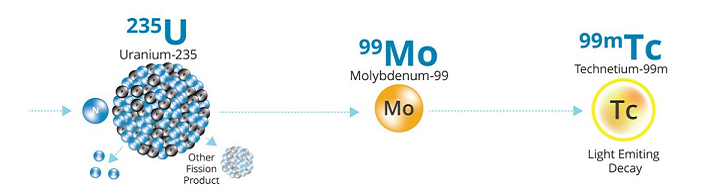
Just a few years ago, the FDA approved the first Molybdenum-99 (Mo-99) to be produced domestically without the use of highly enriched uranium (HEU). This medical isotope helps radiologists detect bone decay, heart disease, and some types of cancers that are difficult to find, and in 2018, the US Department of Energy’s National Nuclear Security Administration (NNSA) reported that Mo-99 was used in over 40,000 medical procedures daily in the US – a number that has likely increased. So a team of scientists from the DOE’s Argonne National Laboratory turned to 3D printing to try and get more out of this important isotope.
(Image: SHINE Medical Technologies)
“Every year, doctors rely on Molybdenum-99 to conduct millions of medical procedures to diagnose illnesses like heart disease or cancer. But producers of this medical isotope lacked an easy, cost-effective way to recycle it – until now,” Dave Bukey, the Integrated Communications Lead at Argonne, told 3DPrint.com.
Argonne, the nation’s first national laboratory, employs people from over 60 nations, and works to come up with solutions to important national problems in science and technology, often turning to 3D printing to solve them. The laboratory often works with researchers from other companies, universities, and agencies to help solve these problems, as well as advance the nation’s scientific leadership.
 Mo-99 decays into technetium-99m, which is then used by radiologists to develop pharmaceuticals for medical procedures. It can be made from enriched molybdenum, but it’s definitely not cheap, costing roughly $1,000 per gram. But now, it’s possible to scale up recycling of isotopically enriched molybdenum, Mo-98 or 100, for the first time in the US, thanks to Argonne’s recycling method and some 3D printed parts.
This method was first pioneered back in 2015 by the laboratory’s Mo-99 program manager, Peter Tkac, and his team, and is faster, more reliable, and cost-effective.
Tkac said, “Our original method would have been very difficult to automate.”
The team’s original recycling process for enriched molybdenum was, as Bukey aptly described in an Argonne post, “tedious.” Along with other corrosive chemicals, used enriched molybdenum was converted into an acidic solution, then purified with test tubes and funnels in a lengthy, multi-step process.
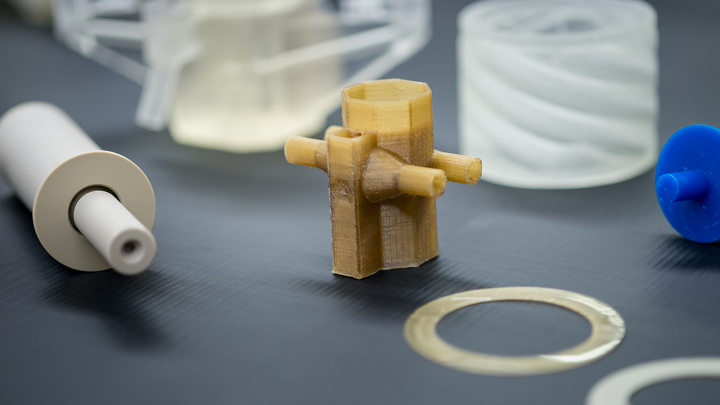
Argonne scientists 3D printed parts like these to accomplish the recycling milestone.
In 2016, Tkac and other researchers turned their attention to automating the process, together with aerospace engineer, 3D printing expert, and fellow Argonne employee Peter Kozak. Instead of relying on the funnels and test tubes, they instead used 3D printed acrylic contactors, which use centrifugal force (acts outward on a body moving around a center) to spin and separate the chemicals.
“We printed each contactor as one piece with streamlined features and fewer external connections. This allows us to push the liquid through the system as quickly and reliably as possible,” Kozak explained.
These 3D printed contactors made the recycling of enriched molybdenum more efficient and less expensive, according to the research team, which includes Alex Brown and Brian Saboriendo. An article published in the Journal of Solvent Extraction and Ion Exchange in December explained that this updated recycling process was better able to separate enriched molybdenum from potassium and other contaminants.

The laboratory’s new 3D printing approach makes its recycling method — pioneered in 2015 by Mo-99 program manager Peter Tkac (left) and others — faster, more reliable, and more cost effective. Also shown: Peter Kozak (center) and Brian Saboriendo (right). Not shown: Alex Brown.
However, the team did run into a problem – after about 15 hours of operation, the 3D printed plastic contactors were corroded by hydrochloric acid used in the recycling process.
Kozak said, “Our experiment was successful. But if you want to move into full production, you need material that will survive a lot longer than that.”
Tkac and Kozak soon discovered polyetheretherketone, or PEEK, which is more durable than the original acrylic plastic they were using, and also resists the Argonne recycling method’s organic solvents and mineral acids. However, PEEK does shrink during 3D printing, which causes the material to warp, so Kozak changed the temperature and speed of the 3D printer’s fan to compensate for this difficulty. This allowed the team to 3D print their contactors out of PEEK, which made them stronger and more flexible. Now, they can quickly, efficiently, and cost-effectively recycle enriched molybdenum, thanks to 3D printed PEEK parts that can stand up to the chemicals that separate the Mo-99 from other materials during the recycling process.
The DOE National Nuclear Security Administration’s Office of Defense Nuclear Nonproliferation and Office of Material Management and Minimization supported this important research.
Discuss this story and other 3D printing topics at 3DPrintBoard.com or share your thoughts in the Facebook comments below.
(Images by Argonne National Laboratory)
Recent Comments