
Tech News, Magazine & Review WordPress Theme 2017
  • Home
  • Supply Chain Updates
  • Global News
  • Contact Us
  • Home
  • Supply Chain Updates
  • Global News
  • Contact Us
No Result
View All Result
No Result
View All Result
Home Supply Chain Updates

B.C. man embarks on 2-month trek by train and cargo ship to reduce carbon footprint

usscmc by usscmc
January 9, 2020
B.C. man embarks on 2-month trek by train and cargo ship to reduce carbon footprint
Share on FacebookShare on Twitter

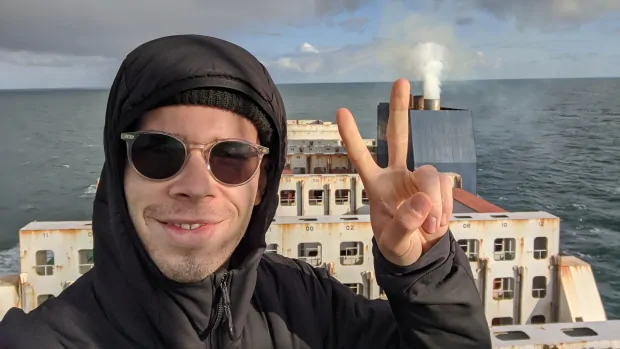
Like many people, Will Vibert had to make a transatlantic journey to get home for Christmas. But instead of hopping on a plane, the British Columbian made alternative travel plans in an effort to reduce his carbon footprint.

Vibert left Milan, where has been living, on Oct. 26, and made his way to Hamburg by bus, stopping in Lyon, France, and Bern, Switzerland, to visit friends. He boarded a cargo ship in Hamburg on Nov. 18 and arrived in Halifax a couple weeks later. From there, he took trains across the country, arriving in B.C, on Dec. 15. 

He documented the experience in the Guardian.

In an interview with As It Happens host Carol Off, Vibert called the trip an “amazing experience,” and said he would recommend it to others — if they have the time. Here’s part of that conversation.

Most people would have just hopped a plane. Why did you decide to do it this way? 

I realized that as much as I tried to be environmentally conscious at home, that’s kind of this huge blind spot.

It was the fact that I was taking flights all over the world, and that cancels out kind of any steps I try to take at home to reduce my carbon footprint. 

I wanted to prove to people that it was possible to still travel the world, but not do it by plane.

As long as you have time to do it. 

Exactly. That’s kind of the crucial thing. So I know most people don’t, and I’m never going to shame them for that.

How did you arrange to cross the Atlantic on a cargo boat? 

Basically, the shipping companies, they will sell surplus cabin space through various travel agencies. … Luckily, there was something that worked for me. 

What was the routing? 

It left Hamburg and we stopped in Antwerp and stopped in Liverpool en route to Halifax.

So you spent, what, two weeks onboard? 

It was 15 days. 
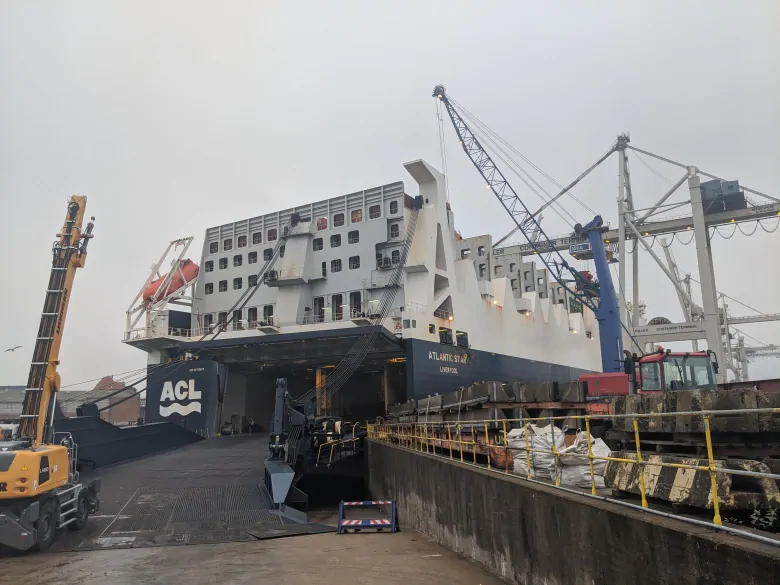
Vibert took this photo of the cargo ship while he was boarding in Hamburg, Germany. (Submitted by Will Vibert)

Most people crossing the Atlantic [are] on a very nice cruise ship with all kinds of shuffleboard and swimming pools and nice restaurants and stuff. So you were onboard with a bunch of, I guess, burly sailors. Did you have much social life? 

Yeah, I actually did. It was remarkably, remarkably fun and time went by really fast. There were two other passengers with me as well, and they were great. 

We had dart tournaments and played board games, watched movies. We were kind of just left on our own to do whatever we wanted. 

Vibert, right, and another cargo ship passenger play a game of chess. (Submitted by Will Vibert)

What kind of accommodations did you have on board? 

Every passenger gets their own cabin and it’s actually extremely, extremely comfortable. Nothing fancy, but you know, I had my own bed, my own desk, my own private bathroom. 

And the food? 

The food was nothing amazing, but it was certainly fine.

There’s a lot of meat, which I don’t really eat much of. But other than that, I can’t really complain when you’re getting three hot meals a day and the crew is so nice. 
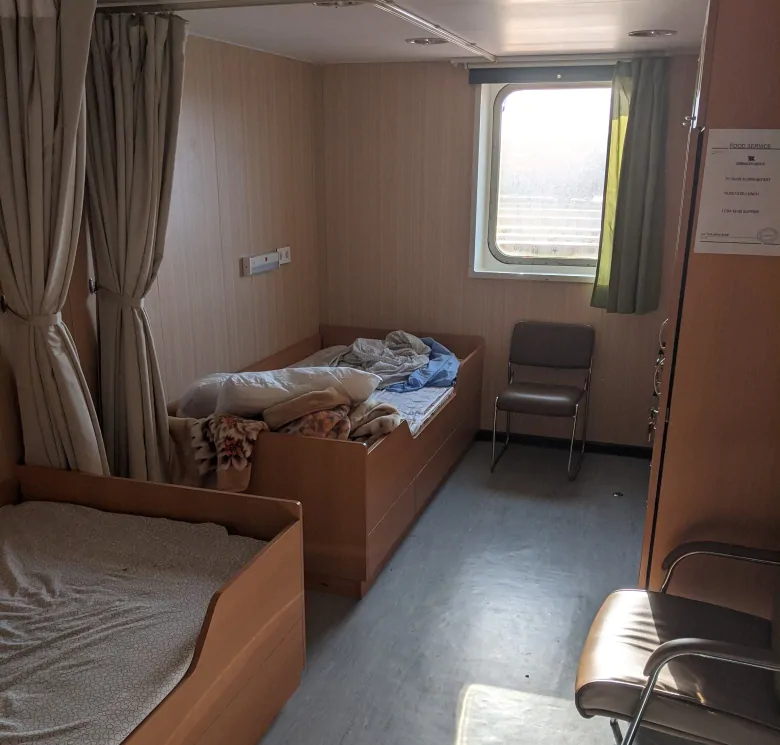
Vibert’s cabin on the cargo ship. (Submitted by Will Vibert)

How much did that cost to cross the Atlantic on that boat? 

It was a little under 1,500 € ($2,179.38 Cdn). That’s including food and everything. 

It seemed like a lot, but once I kind of had the experience of being on board I realized, actually, this is something that’s very special … [and] it no longer felt like that much money to pay for the experience.
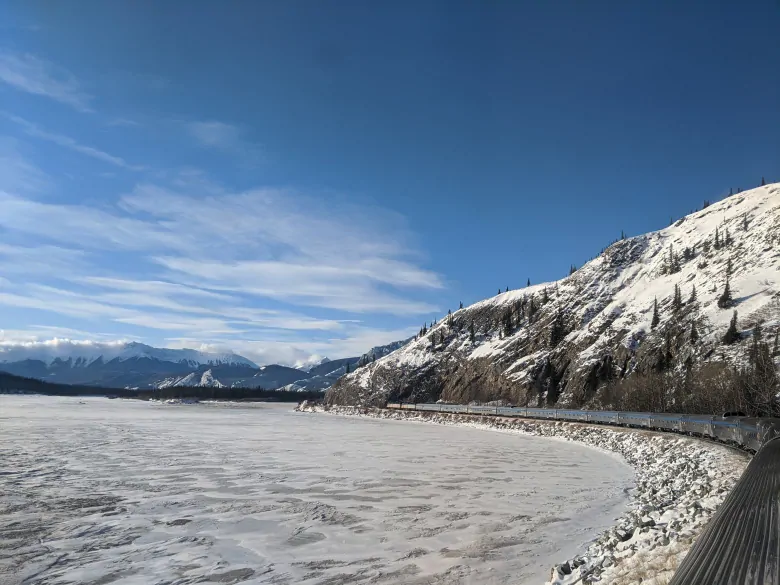
Vibert snapped this photo while he was on the train near Jasper National Park in Alberta. (Submitted by Will Vibert)

What was your total carbon emissions at the end of your trip? 

The total was just about 260 kilos of CO2 emissions, and most of that was just coming from the train. 

How much would it have been if you’d flown from Germany to Vancouver?  

The one-way flight would have been 1.3 tonnes.

Do you recommend this to people? 

I do. I know it’s not feasible for many people, but if someone is looking for, you know, a different kind of adventure — one that has a low carbon footprint — I really could not recommend it more.

It was really an amazing experience.


Written by Katie Geleff. Interview produced by Kevin Ball. Q&A has been edited for length and clarity.

usscmc

usscmc

No Result
View All Result

Recent Posts

  • How Hapag Lloyd captured a major market share in the Container Shipping Industry in USA
  • Why USA’s East Coast is the Favorite Destination for Manufacturing Companies
  • How Trade Relations Between the USA and UK Improved After Keir Starmer Became Prime Minister
  • Tips and Tricks for Procurement Managers to Handle Their Supplier Woes
  • The Crazy Supply Chain of Walmart Spanning Across the Globe

Recent Comments

  • Top 5 Supply Chain Certifications that are in high demand | Top 5 Certifications on Top 5 Globally Recognized Supply Chain Certifications
  • 3 Best Procurement Certifications that are most valuable | Procurement Newz on Top 5 Globally Recognized Supply Chain Certifications

Archives

  • July 2024
  • June 2024
  • May 2024
  • April 2024
  • March 2024
  • February 2024
  • January 2024
  • December 2023
  • November 2023
  • October 2023
  • September 2023
  • August 2023
  • July 2023
  • June 2023
  • May 2023
  • April 2023
  • March 2023
  • February 2023
  • January 2023
  • December 2022
  • November 2022
  • October 2022
  • September 2022
  • August 2022
  • July 2022
  • June 2022
  • May 2022
  • April 2022
  • March 2022
  • February 2022
  • January 2022
  • December 2021
  • November 2021
  • October 2021
  • September 2021
  • August 2021
  • July 2021
  • June 2021
  • May 2021
  • April 2021
  • March 2021
  • February 2021
  • January 2021
  • December 2020
  • November 2020
  • October 2020
  • September 2020
  • August 2020
  • July 2020
  • June 2020
  • May 2020
  • April 2020
  • March 2020
  • February 2020
  • January 2020
  • December 2019
  • November 2019
  • September 2019

Categories

  • Global News
  • Supply Chain Updates

Meta

  • Log in
  • Entries feed
  • Comments feed
  • WordPress.org
  • Antispam
  • Contact Us
  • Disclaimer
  • Home
  • Privacy Policy
  • Terms of Use

© 2025 www.usscmc.com

This website uses cookies to improve your experience. We'll assume you're ok with this, but you can opt-out if you wish. Cookie settingsACCEPT
Privacy & Cookies Policy

Privacy Overview

This website uses cookies to improve your experience while you navigate through the website. Out of these cookies, the cookies that are categorized as necessary are stored on your browser as they are essential for the working of basic functionalities of the website. We also use third-party cookies that help us analyze and understand how you use this website. These cookies will be stored in your browser only with your consent. You also have the option to opt-out of these cookies. But opting out of some of these cookies may have an effect on your browsing experience.
Necessary
Always Enabled
Necessary cookies are absolutely essential for the website to function properly. This category only includes cookies that ensures basic functionalities and security features of the website. These cookies do not store any personal information.
Non-necessary
Any cookies that may not be particularly necessary for the website to function and is used specifically to collect user personal data via analytics, ads, other embedded contents are termed as non-necessary cookies. It is mandatory to procure user consent prior to running these cookies on your website.
SAVE & ACCEPT
No Result
View All Result
  • Home
  • Supply Chain Updates
  • Global News
  • Contact Us

© 2025 www.usscmc.com