


So many choices. So little time. Lift truck maintenance parts management can be a little overwhelming at times. Worse yet, it may seem fairly mundane. But it’s not, and it can have quite an impact on your fleet operations. As the experts say, it’s better to take the time to make a choice that will keep your fleet up and running.
“The best practice whether you go in-house or contract,” says Megan McGriff, Toyota Material Handling’s manager of parts sales, customer service and marketing, “is to do your due diligence up front and make sure you have immediate access to those parts most likely to maximize the uptime of your lift truck fleet.”
And as she and others say, both the in-house and contract route are viable, depending on your particular circumstances.
There’s just about a 50/50 split between in-house and contract decisions, says Dave Norton, vice president of corporate quality and customer care at Raymond. Hyster’s vice president of fleet services and aftermarket Pat DeSutter says the ratio is trending with how customers manage service with a shift to contract over in-house maintained inventory. The exact ratio aside, there does seem to be a trend to contract management of maintenance parts.
That said, there’s also the matter of the overall service decision. In fact, discussions with key people for this article typically digressed, temporarily at least, into the overall service decision. Yes, the two are somewhat intertwined yet are independent. You can actually mix and match, depending on your circumstances.
It’s also worth noting that the parts management decision has morphed noticeably since the Great Recession. Previously, “all MRO spend was a nebulous bucket. Basically, it was considered to be the cost of doing business,” explains DeSutter.
Now, MRO spend is much more carefully scrutinized, he says. “Management wants to better understand the cost of MRO. They require strong insights into why what’s in inventory is in inventory and how much it’s costing the company,” adds DeSutter. Fortunately, he says, it is not uncommon to see a 15% to 20% reduction in MRO costs with tight controls.
In fact, Dave Sweet, director of parts and service at Raymond dealer Associated, says parts not used at least annually do not need to be kept in stock on site. “It’s just not good business to stock those parts,” he says. He adds that there should probably be some spares on hand for parts required three or more times a year.
Meanwhile, one other major shift is coming in parts management—online parts purchasing. Traditionally, buying anything lift truck related online has been a third-rail for lift truck suppliers and their dealers. However, that is changing. Quickly. Going forward, the most common word used here is omni-channel just as with your favorite retailers.
Let’s start with the basics of the two approaches of parts management and the pros and cons of each.
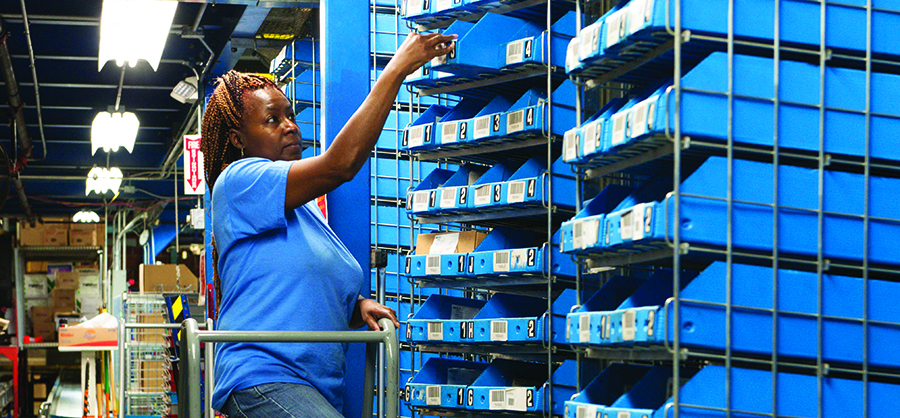
Weekly visits by parts consignment representatives are highly effective at ensuring parts are always available.
Make the best decision for you
Even though you probably aren’t at this point right now, we’ll start here with a blank slate. As in, you have never had lift trucks in your facility before. It just makes explaining parts management options more understandable more quickly.
Also, this article doesn’t cover the in-house vs. contract maintenance decision process. However, the article on pg. 16 does. Here, we’re just focused on parts management.
Several different scenarios exist for both the in-house and contract routes, explains Chris Thomas, KION North America’s aftermarket product development manager.
With in-house parts management, the company usually maintains its own inventory of parts on site, Thomas says. This typically occurs at a facility with its own on-staff techs to maintain trucks and even other aspects of the building such as HVAC.
Sometimes in this scenario, the company selects and owns the parts. Having parts on site gives the facility tightest control and immediate accessibility of parts, explains Toyota’s McGriff. Not to mention optimum visibility.
As a general rule of thumb, you don’t want to go it alone too much, says Craig Bruns, Crown Equipment’s vice president of customer support. He strongly recommends that you should, at the very least, work closely with your local dealer to determine the parts and quantities that should be in stock for the fleet out on the floor. As he points out, dealer staffs are uniquely trained and qualified to perform all aspects of lift truck maintenance.
Alternatively, the facility can choose to keep no parts in stock. Instead, the facility orders them as needed from the dealer. Unfortunately, parts delivery could take a day or two rather than having them immediately available. As you can well imagine, ordering parts only as needed can also potentially cause serious downtime for one or more lift trucks in the fleet.
Online parts ordering is still another option; however, we’ll wait until later to get into the details of that.
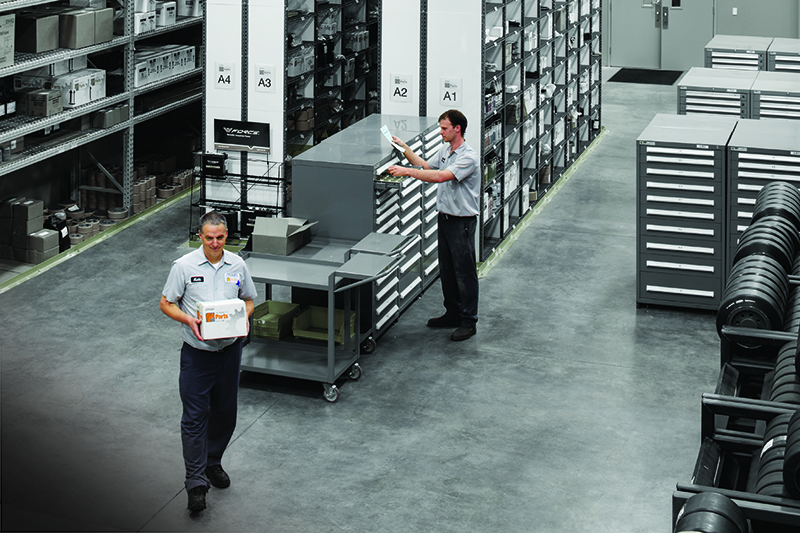
Yet another option for in-house maintenance operations is consignment, says Sweet at Associated. This arrangement puts the parts in the facility but contracts with a dealer to track and maintain inventory in consignment lockers or other storage equipment. Here, a facility has the benefits of having parts immediately available without the responsibility of managing inventory.
Furthermore, parts in the locker are owned by the dealer until used, eliminating capital outlays for parts ahead of time. That quickly answers management’s questions about why something is in inventory—it’s not.
“A parts consignment representative (PCR) visits weekly, restocking what’s been used and making other inventory adjustments as needed,” says Sweet. He strongly recommends weekly visits by PCRs rather than longer gaps. The former, Sweet says, almost always proves to be most effective at ensuring the right parts are always available.
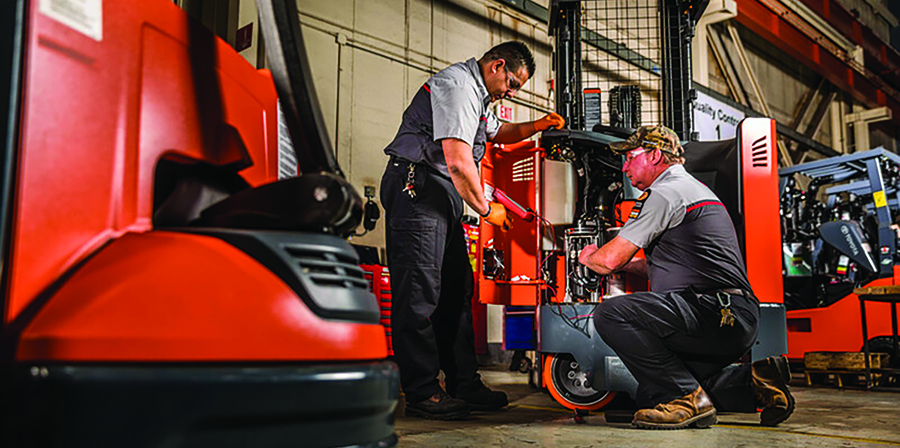
Dealer staff technicians are uniquely qualified and trained in all aspects of maintenance.
Consignment also greatly simplifies what Bruns says is essential in parts management—individual parts tracking. It eliminates the need for the facility to develop its own inventory tracking system from bar code scanners to software. It also eliminates the need to have an on-site person to manage the inventory.
Sweet also points out that consignment “puts the customer first.” That ensures a tighter relationship with the dealer even if maintenance is done by in-house techs. Just the regular contact between the two organizations is generally beneficial for all involved, says Sweet, who has plenty of experience making the relationship side of parts management work best.
Typically, consignment is handled a little differently if lift truck service is on a contract basis. While parts may be kept on site in consignment lockers, that isn’t always necessary. Instead, contract techs bring parts with them when they visit the facility. In any regard, an overall maintenance contract ensures nearly immediate availability of repair parts.
It is worth noting, says Raymond’s Norton, that all of these approaches ensure a facility has access to genuine OEM parts. Using third-party, non-OEM parts “creates the real risk they will not meet OEM specs and fail prematurely,” Norton adds. It’s worth noting that ANSI/ITSDF B56.1 and OSHA have set standards for OEM parts to ensure consistency and reliability.
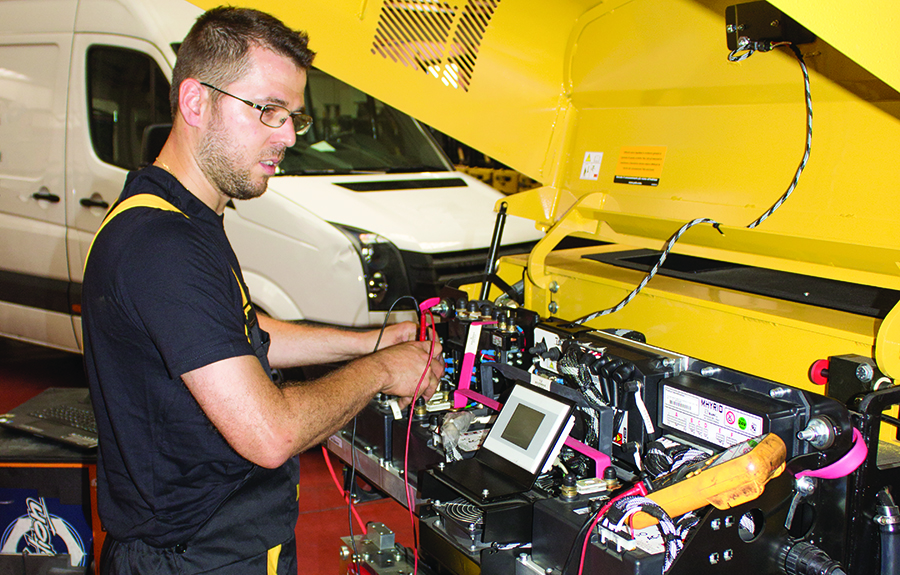
The parts management decision should be based on how best to maximize lift truck uptime.
The online (r)evolution
There once was a time when many thought lift trucks were ripe to be purchased online as a commodity. Time has disproven that theory but parts management will, in all likelihood, turn out to be quite a different story.
Today, most lift truck suppliers offer some type of online parts purchasing. But in most cases, the scheme is at least somewhat different from most Web purchases today.
As you would expect, online parts buying runs through OEM portals. In most cases, a company must have an established account to access the portal. Furthermore, not all parts are typically available through the portal.
For example, Norton explains that “buying parts online through the Raymond portal is not just a click-and-buy transaction.” Raymond is hardly alone here. The rationale, explain suppliers, is that companies need to be pre-approved for credit and other business reasons to make a purchase.
The approach is accepted, at least in part. Sweet of Associated says roughly 30% of the dealer’s customers purchase parts through Raymond’s portal. It’s worth noting that typically not all parts are available through most portals.
However, this scheme is beginning to change. Earlier this year, Toyota opened its own 24/7 online parts store, stocking all of Toyota’s roughly 600,000 parts. McGriff explains the intent is to “deliver increased accessibility, consistency and transparency in the parts purchasing process.”
She adds that the portal is completely public and does not require user names, pre-registrations or other restrictions common to lift truck parts portals. “It’s all about the customer experience. It wasn’t easy at first to get buy-in internally or with dealers. However, everyone is now in agreement this is the way to go,” she says.
McGriff and others in various stages of considering this Amazon-like approach say the intent is to manage maintenance parts buying with an omni-channel approach. By that they mean the customer will be able to easily work with the OEM in several modes and buy parts as the customer chooses with equal levels of service.
Clearly, the omni-channel approach is the future of parts management regardless of your decision to keep it in house or on contract.
Companies mentioned in this article:
Recent Comments