

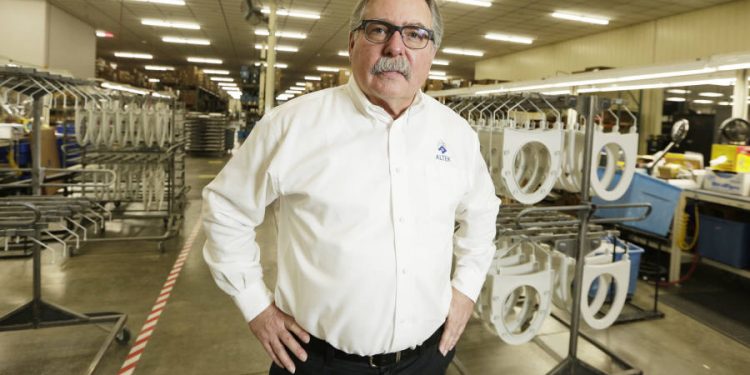
Rick Taylor had a meeting with his company’s management team last week to discuss what to do with their growing inventory of toilet seats.
Strictly speaking, the meeting was about entire lavatories: toilet seats, but also sinks, counters, and the materials to make them all. Mr Taylor is vice-president of Altek, a contract manufacturer in Washington state that is among the 680 companies supplying parts for Boeing’s 737 Max, work that slowed last April and stopped in January.
The production changes hurt Altek’s sales and left it with raw materials and half-built and finished products to store around its factory. The meeting was called to total up the costs of expensive paint and adhesives that were due to expire, so the company could pass that information to Altek’s customer, Collins Aerospace, a top-tier Boeing supplier.
Collins and Boeing have treated small suppliers well, Mr Taylor said, but profitability has still been squeezed. “You’re never happy when business is off 7 per cent,” he said, referring to last year’s sales, “because you’re carrying the same overhead . . . It erodes that profit margin”.
Small manufacturers across the US are hurting from the silencing of the 737 Max assembly line, a reality that could haunt Boeing when the plane maker restarts and increases production.
Boeing tried for months to keep production going, albeit at reduced rates, but it became clear the grounding of the Max would drag on beyond a year. The plane has been out of service since March after the second of two fatal crashes that killed 346 people in total, triggering an overhaul of the plane’s software and pilot training that are still awaiting regulatory approval.
US industrial output declined 30 basis points in January from the previous month, partly because of the shutdown, and economists predict the crisis will shave half a percentage point off gross domestic product in 2020.
“We’re passing the pain all the way through the supply chain,” said Pat Moody, president of Klinger IGI, a gasket and seal maker with $10m in revenue and operations in Oregon and Colorado, which makes components for the Max’s cabin systems.
The production halt had decreased the company’s sales between 5 and 10 per cent, Mr Moody said, and he, in turn, had decreased his raw material orders, encouraging Klinger IGI’s suppliers to seek other customers.
“We will lose purchasing power, which will affect pricing,” he said. “When Boeing wants to ramp this all back up, we’ll be in a situation potentially where the materials cost more. Are we going to be able to increase pricing to Boeing based on the reductions in volume? I don’t know.”

Altek avoided laying off any of its 210 employees because executives immediately sought replacement work last April when Boeing cut Max production from 52 a month to 42, but other companies have cut jobs. Spirit AeroSystems, the Wichita, Kansas company that makes the Max’s fuselage, laid off 2,800 in January. Component maker Precision Castparts laid off 150 this month in Oregon.
The threat for Boeing is that the longer it idles its own machines and workers, the greater the risk of long-term damage to the supply chain.
Suppliers that lay off employees now may struggle to rehire them, considering the 3.6 per cent US unemployment rate. Defence contractors were already recruiting in Wichita for workers who want to move to California or Florida, Ron Epstein, Bank of America analyst, pointed out.
Other worries: companies under pressure may have to delay needed investments in machinery; those without enough capital to weather the stoppage could shutter entirely.
Large suppliers were better equipped financially to handle the production halt than small ones, yet a small supplier may be just as critical to Boeing’s operations, said Eric Bernardini, co-head of the aerospace practice at restructuring consultancy AlixPartners. The aerospace industry employs more than 525,000 people in the US, and 43 per cent work at companies with fewer than 1,000 employees.
“You’re talking about the whole supply chain for commercial aerospace,” he said. “The shorter [the halt] is, the better it is. I cannot remember anything even close happening in the industry for the last 40 years.”

In 2009, Boeing was building 32 737s a month. By 2019 that number had risen to 52, and Boeing anticipated raising it to 57 before the second plane crash upended the manufacturer’s plans. Airbus, too, grew production of single-aisle planes by 76 per cent over the same period.
But aerospace suppliers, who traditionally enjoyed higher profits than plane makers, became stretched financially over the decade as they loaded up on debt to invest in machinery, plants and hiring. Mr Bernardini said, “their position on the 737 or [Airbus] A320 programmes and the resulting predictable revenues were something they could — literally — take to the bank.”
Boeing has said it expected aviation regulators to clear the Max for flight in mid-2020 but said it would slowly restart production before then in order to limit the damage to the supply chain. Greg Smith, chief financial officer, said last week that it would take “a couple of years” to reach a rate of 57 a month.

Most suppliers think production will restart in March or April, according to a recent note by Ken Hebert, an analyst at Canaccord Genuity. He forecasted an initial rate of fewer than 20 per month, with the company attempting to reach 30 per month by December.
“The resumption of production ahead of the recertification points to the importance of starting up the line sooner rather than later, to try and mitigate future risk,” Mr Hebert wrote. “As Boeing looks to step up the rate in 2021-2022, this is when other issues could come to the fore.”
Boeing need to “resynchronise” its supply chain, Mr Bernardini said, and “decisions made now by Tier 3 and 4 suppliers will affect Boeing’s 2021 production rate”. Yet uncertainty makes decision-making difficult for owners and executives in the supply chain.
Mr Epstein, the analyst from Bank of America, echoed the sentiment. “We were talking to a little supplier this morning and they said in the last three months they were given seven different production scenarios,” he said. “How do you plan for that?”
Larry Waltz, president of Waltz Bros machine shop in Illinois, is another supplier having to navigate that uncertainty. The business makes rod pistons for Triumph Group, another key Boeing supplier, and Triumph asked it to halt shipments for now, possibly resuming in June.
Waltz is “holding the whole bag”, Mr Waltz said, on costs for those components and work in progress.
Meanwhile, Mr Taylor at Altek and Mr Moody at Klinger IGI said they were trying to make the best of the situation by diversifying their customers, and in the case of Klinger IGI, to make their manufacturing processes leaner.
That dovetails with the counsel Mr Bernardini gave to AlixPartners’ clients, namely to use the shutdown as an opportunity to improve operations. Yet the advice sometimes prompts a wry response: “They answer, ‘That’s very nice, but I need to survive first’.”
Recent Comments