


WASHINGTON – The problem was massive in scale, but Matanya Horowitz, then a graduate student at the California Institute of Technology, thought he might have a fix.
The year was 2012. Plastic recycling facilities were not only expensive, but also horribly inefficient as most of the waste ended up in landfills. But as he watched artificial intelligence advance autonomous vehicles and facial recognition, Horowitz wondered if AI-powered robots could do the job of human pickers to lower costs and reduce contamination — the bane of recycling.
“If you are reducing the cost and can show customers the quality of what they’re buying, you can create a liquid commodity market where right now there’s a guy running around with a clipboard,” said Horowitz, CEO of the Colorado startup AMP Robotics, which has robots at two dozen recycling facilities around the country, including one in Austin. “It’s a green war.”
As governments move to reduce the huge volumes of plastic waste choking the world’s oceans, a wave of entrepreneurs, scientists and multinational companies are rushing to overhaul the world’s recycling systems, bringing the latest technology and manufacturing practices to an industry that has long struggled to keep pace with the massive amounts of plastics produced by modern society.
Leading the way are the businesses that have the most to lose from a public and regulatory backlash against plastics — petrochemical makers that have invested tens of billions of dollars to build and expand plants along the Texas Gulf Coast. Chemical companies and product manufacturers are responding to efforts to ban single-use plastics such as shopping bags and straws by committing to create a circular economy for plastic waste.
They are putting money into initiatives from chemical recycling technologies that break down plastics into their chemical building blocks to educating residents on what to put into recycling bins. The biggest players, such as the Exxon Mobil and the Houston chemical company LyondellBasell, are working with investors, nonprofits and scientists to expand existing recycling programs and create more efficient ways to process recycled plastic so it can compete with the cheap, virgin material they produce.
“A weakness historically has been the recycling industry and the [petrochemical] industry have been entirely separate,” said Jim Seward, senior vice president of research and development and sustainability LyondellBasell. “But this is in a way something very new right now. You’re seeing a coming together of the industries and a level of commitment from players like ourselves that was not there before.”
On HoustonChronicle.com: Plastic’s trash crisis
It’s a tall mission. The national recycling rate for plastic is about 9 percent, according to the latest data from the Environmental Protection Agency. Even in regions with the most up-to-date equipment, such as Washington, D.C., existing technology has proven inadequate.
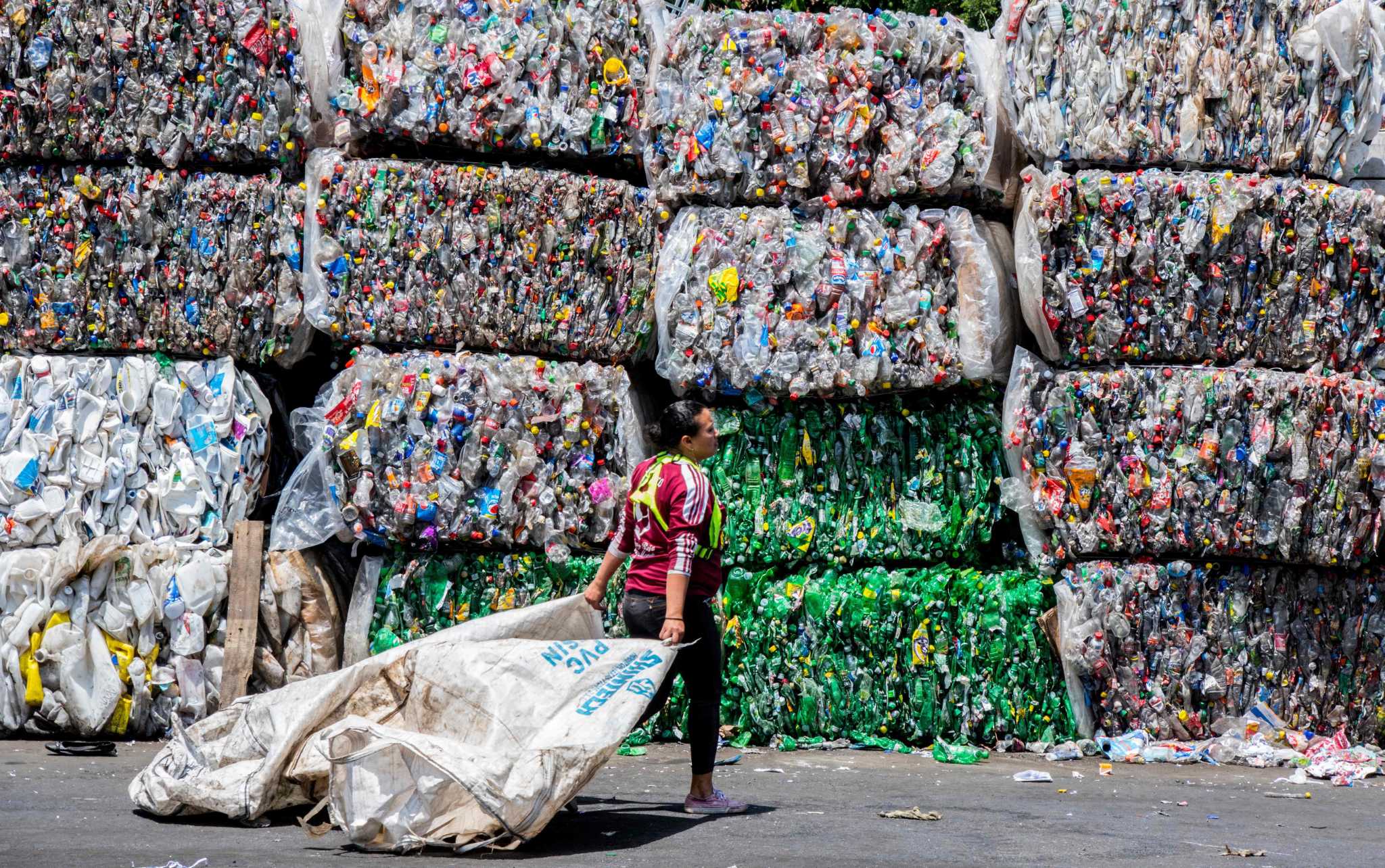
At a recycling facility in suburban Maryland run by the Houston company Waste Management, about 90 tons of water bottles, food containers, grocery bags and seemingly endless forms of plastic packaging collected from recycling bins are processed each day.
Out of that, less than half will be separated by optical sorters than can distinguish so-called high value plastics that manufacturers like to shred and reuse in everything from bottles to clothing, according to Waste Management. The majority of the material — most of it adorned with a triangular symbol attesting to its recyclability — will be compressed into giant cubes and stacked on wooden pallets for sale to junk dealers, who will pick through it for better-quality plastics that machines and workers missed.
“The bulk of it gets sent to (be burned at) the waste energy facility in Baltimore, or to the landfill,” said Michael Taylor, who manages five northeastern recycling facility for Waste Management. “The manufacturers claim it’s recyclable, but it’s not going to be recycled at a facility like this.”
Moon shot?
More than 26 million tons of plastic waste were dumped into U.S. landfills in 2015, the most recent year for which EPA data was available. The world’s largest plastics manufacturers have pledged to end that practice by 2040, something they claim they can accomplish without a government mandate banning single-use plastics — which the petrochemical industry has fought vigorously in state houses and city halls for more than a decade.
Unlike aluminum and glass, plastics are incredibly difficult to recycle. There are multiple types of plastics of varying quality, each of which must be separated. Contaminants such as colors and additives are hard to remove, making the homogeneous plastic pellets manufacturers demand difficult to produce.
“The production of virgin plastics is so cheap, there’s no way [recycling is] going to be economic,” said Ted Siegler, a former state regulator in Maryland, Nevada and Vermont, now working as an environmental consultant. “I don’t see a big moonshot coming. People will nibble around the edges, with bans on certain single use plastics and some improvements in chemical and mechanical recycling.”
Scientists are looking to reinvent how recycling works, moving beyond the practice of grinding used plastic into minuscule flakes to be melted and reformed into containers and high-end fleece sweaters. Rather, they are using chemicals and heat to revert plastics to their chemical components, providing the feedstock to make new plastics from scratch or produce fuels from such as naptha
On HoustonChronicle.com: As plastic bans spread, industry went on the attack
.Researchers at Lawrence Berkeley National Laboratory in California are even working on a type of plastic that can be broken into its basic chemicals by simply dipping it in sulfuric acid.
A slew of chemical recycling projects are getting built around the United States and Europe. Lyondell Bassel is planning to build a test facility in Italy next year. Brightmark Energy, a two-year old waste management company in San Francisco, recently said it planned to spend $1 billion building chemical recycling facilities, with one already nearing completion in Indiana.
“There’s going to be more announcements. This is an industry on the move,” said Craig Cookson, senior director of recycling and recovery at the American Chemistry Council, a trade group representing petrochemical companies.
Startups are also pouring into the recycling space, many with funding from the New York investment fund Closed Loop Partners, which is backed by consumer product companies including Unilever, Coca Cola, Pepsico and Amazon. One of Closed Loop’s companies, Cambridge Crops, is working on a clear film made from a biodegradable material to replace plastic wrap. Another, the Utah startup Renewlogy signed a deal with the city of Phoenix earlier this year to process lower-grade plastics and turn them into fuel.
Mix of solutions
Their progress has reached the point that Wall Street banks such as Goldman Sachs and Citigroup are investing in Closed Loop Partners’ funds, said Bridget Croke, spokeswoman for Closed Loop.
“There’s a lot of questions marks and everyone wants a silver bullet,” Croke said. “We’re digging into the economics, and we don’t think there’s going to be one winner. It’s going to be a mix of solutions.”
But what consumer products companies and chemical makers are trying to achieve will require more than technological breakthroughs. They will need to shift consumers’ relationship with plastic itself.
One of the numerous problems facing recycling operations is how little of plastic ends up in recycling bins — even in communities with curbside pickup programs. Moreover, much of the plastic that does get into recycling bins is contaminated by food waste and other trash and sent to landfills.
Consumer product companies, including Coca Cola, are working with the nonprofit Recycling Partnership to educate Americans about what to put in their recycling bins. A 2017 pilot project in Coca Cola’s hometown, Atlanta, mailed out explainers on what should and should not be recycled and then sent consultants to neighborhoods to go through bins with residents to point out their errors. Among the 5,000 households that participated, recycling increased 27 percent and contamination fell 57 percent. The program is being expanded to communities around the country.
Fuel Fix: Get energy news sent directly to your inbox
Often, it’s the low-tech approaches that make the difference, said Cody Marshall, chief community strategy officer at the Recycling Partnership. Some cities, for example, have the same colored bins for trash and recycling. Just by changing the colors to differentiate the bins can keep a lot of trash out of the recycling stream, Marshall said.
But however efficient recycling system become, the larger problem of cheap virgin plastic remains. Low prices for oil and natural gas, the primary feedstocks for petrochemicals, have made it cheaper and easier to make plastic than recycle it. Making matters worse, China’s decision to virtually halt imports of plastic waste from abroad has left recycled plastic piling up in the United States with no place to go.
“We want to recycle, but we have to make sure there’s a demand,” said Brent Bell, vice president of recycling at Waste Management. “I’m always hearing, ‘I’m just going to buy virgin, and I’ll call you when the price changes.’”
Public backlash
But demand could soon pick up. Facing a backlash from a public upset by stories of beached whales found with dozens of pounds of plastics in their stomachs, the majority of the world’s largest consumer product manufacturers — such as Coca Cola, Pepsico and Procter & Gamble — have pledged to shift away from virgin plastic in the decades ahead.
Only right now there is simply not enough recycled plastic on the market to meet their targets, said Roberta Barbieri, vice president of global water and environmental solutions at Pepsico.
“There are pinch points that impact the effectiveness of the recycling system all along its value chain,” she said. “If we can implement solutions for those pinch points, we can fix the system.”
This is the third and final story in a series examining the growing crisis around plastic waste.
Twitter: @osborneja
Recent Comments