

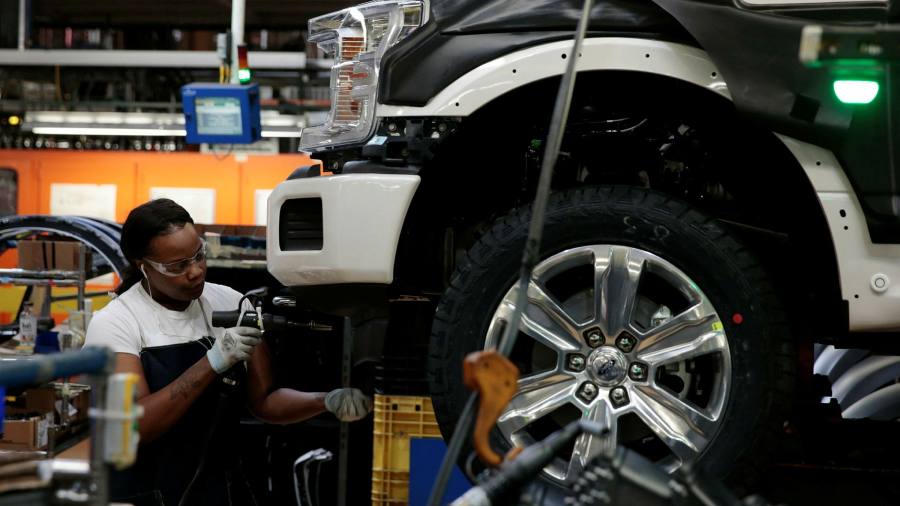

What started out as “temporary” lay-offs earlier this month at General Motors’ plant in Kansas City soon became “indefinite”. Across town, Ford slowed down production of its F150 pick-up truck, the company’s cash cow, and did the same at another facility in Michigan.
The carmakers were responding to a crippling shortage of the indispensable chips that are used to build modern vehicles, for everything from automatic braking systems to airbags and electronically adjusted seats.
The shortages have shone a light on a cyclical corner of the electronics industry where there is often too much or too little supply, a problem that has been exacerbated by unpredictable demand for semiconductors during the coronavirus pandemic.
In Washington, the crunch has led to heightened scrutiny of global semiconductor supply chains, and illustrated the extent to which parts of the US manufacturing base are reliant on Taiwan’s TSMC, the world’s largest chip foundry and a supplier to companies ranging from Apple to Volkswagen.
“It’s events like this that expose the shared risk that companies have,” said Kristin Dziczek, vice-president at the Center for Automotive Research. “It’s when we have a big disruption and then we find out like, ‘holy cow we’ve got all these eggs in this basket’.”
The problem has quickly become a domestic political crisis, leaving the White House scrambling to find a fix to lessen the impact on the blue-collar workers that President Joe Biden courted during last year’s election campaign.
Clarence Brown, president of a local chapter of the United Auto Workers union, said the financial blow to the more than 1,500 workers sent home from the Kansas City GM plant would be bad at the best of times, but that during a pandemic “it’s fairly devastating”.
Brian Deese, Biden’s top economic adviser, has written to the Taiwanese government to ask for their help — but it remains unclear whether high-level diplomacy can exhort private companies to divert more of their products to US buyers.
The carmakers have been partly hit by a boom in demand for chips from consumer electronic companies, which started building up their inventories at the exact moment the carmakers were cutting orders to prepare for a pandemic sales dip that did not materialise.
US trade policies may also play a part. Export controls on SMIC, China’s largest chipmaker, have further constrained supply by forcing many customers to look elsewhere for their chips.
The threat of more trade controls as the US tries to limit China’s access to critical technology have caused further anxiety, with many companies hoarding chips to prepare for a future supply crunch.
The US semiconductor industry has seized on the crisis to bolster its long-running campaign to secure more taxpayer dollars, which it says it needs to stay innovative and competitive against heavily subsidised rivals overseas, including in China.
It also argues it needs state support to boost domestic manufacturing of chips, which has fallen behind Asia.
Last week, a broad range of industry groups renewed lobbying efforts aimed at the Biden administration to appropriate money authorised by Congress in the Chips Act, passed as part of last year’s defence spending bill.
The bill provides $10bn for new chip manufacturing plants in the US, as well as funding research at the Department of Energy and National Science Foundation.
In a letter to Biden, the Semiconductor Industry Association, along with other trade groups, argued that chips fuelled the economy. It said manufacturing more domestically would enhance national security by making sure the US was not cut off from the supply of chips critical to several sectors, including the military.
“The absence of US incentives has made our country uncompetitive and America’s share of global semiconductor manufacturing has steadily declined as a result,” the groups wrote.
While there has always been some support for boosting funding to chip companies in US Congress, the car plant lay-offs have grabbed the attention of a wider range of lawmakers.
Earlier this month, about 15 senators representing car manufacturing states such as Michigan, Ohio, Tennessee and Illinois, began agitating for billions of dollars of extra cash for domestic chip manufacturing.

But most analysts say two separate issues are being conflated. Protecting national security normally refers to making more of the chips needed for high-end computing and most likely to be used for military purposes; it would not solve the shortage of the less advanced chips that carmakers need.
Boosting US manufacturing to secure the supply of chips for national security purposes including for the military would require investing in “the bleeding edge” of technology, said Peter Hanbury, a partner at Bain, whereas cars use older technology and different sized chips.
“Everyone is saying the same things, ‘we want semiconductors’, but I think they actually have very different goals,” added Hanbury.
The supply and demand factors that resulted in the current crunch for carmakers were unrelated to where the chips were made, said Chad Bown of the Peterson Institute. “Even if we had more global manufacturing in the United States, I don’t think the problem would necessarily be any different.”
And it is not just US carmakers who have struggled to cope with the shortage, with many European rivals experiencing similar problems.
Others make the distinction between the US having the most sophisticated technology and intellectual property versus manufacturing, arguing semiconductors do not necessarily have to be made on US soil to secure supplies.
Clete Willems, a former Trump trade official, said that federal funding could be directed towards research and development to maintain the US chip industry’s technological edge without the US having to build domestic fabrication plants.
“It’s not as much of a question of reliance as it is a question of maintaining an innovation edge over time,” said Willems, referring to US competition with China.
He argued that building strong relationships with allies like Taiwan, South Korea and Japan, where many chips are manufactured, would be more effective than the US “trying to do everything”.
Additional reporting by Kathrin Hille in Taipei
Recent Comments