

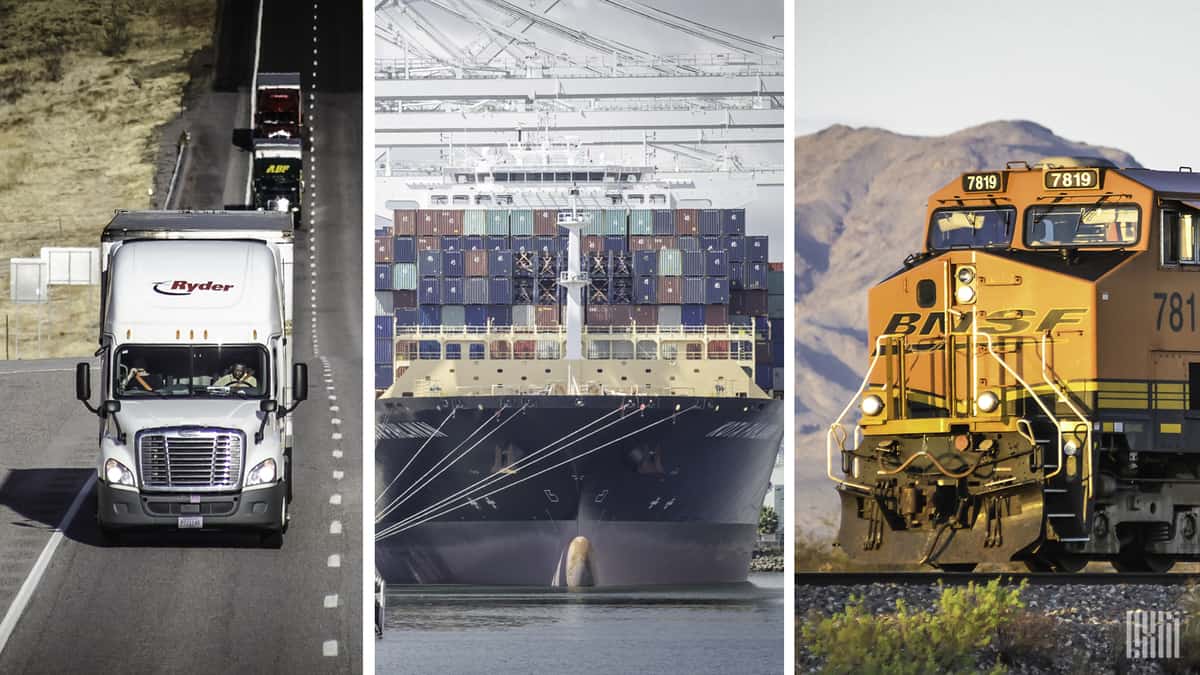

U.S. lawmakers negotiating new surface transportation legislation will need to include a long-term infrastructure funding plan if they’re going to satisfy the nation’s truck, rail and ocean carriers, as well as the carriers’ customers.
That theme was prevalent throughout roughly 75 comments submitted to the U.S Department of Transportation (DOT) in response to the agency’s request for information on a National Freight Strategic Plan. While DOT has acknowledged that investment in freight infrastructure must be considered in transportation initiatives, users of the infrastructure assert that not enough attention or money is coming from the federal government.
“Lagging investment in critical infrastructure and inadequacy of long-term funding solutions” is one of the three most important challenges facing the U.S. freight transportation system, asserted the Consumer Brands Association (CBA) in comments filed in response to DOT’s request. CBA represents the $2 trillion consumer packaged goods industry. Its members include some of the country’s largest private truck fleet operators.
Eliminating freight “pinch-points” would “be an easy way to evaluate progress on the most strategically important national freight system goals,” the group noted, and evaluating long-term success “may require the development of new KPIs [Key Performance Indicators], as a way of capturing overall impact and contribution to the national freight system.”
“There’s no national vision or strategy that evaluates how individual investments impact the overall safety and reliability of the goods movement system,” Elaine Nessle, executive director for the Coalition for America’s Gateways and Trade Corridors (CAGTC), told FreightWaves. “Even though states have plans that have focused state investments on intrastate commerce, we haven’t taken that systemwide approach needed to make those investments across the entire supply chain.”
In comments filed with DOT, Nessle and CAGTC, whose members include the nation’s largest container ports, called for minimum annual federal funding of $12 billion for a multimodal competitive grant program. The current multimodal grant program, Infrastructure for Rebuilding America, made available $900 million for 2020.
The American Trucking Associations (ATA) agreed, noting only the federal government is in a position to “look at investment decisions in the context of national impacts and determine which investments can produce the greatest economic benefits regardless of jurisdictional considerations.”
While ATA ranked a shortage of labor as the No. 1 challenge in the trucking industry, the Owner-Operator Independent Drivers Association (OOIDA), which represents small-business trucking companies, ranked underinvestment in highway infrastructure as the country’s most important freight challenge.
“Owner-operators and independent drivers must foot the bill for repair costs caused by inadequate infrastructure,” the group emphasized, citing an internal study finding that OOIDA members spend roughly $5,000 a year on repairs due to highway damage or poor road conditions. “For owner-operators, these costs result in less income and less investment for maintenance, equipment, and other critical safety upgrades.”
Nucor Steel [NYSE: NUE], one of a handful of shippers providing comments, placed infrastructure at the top of its main challenge list. “Significant additional spending on transportation infrastructure is critically needed including, but not limited to, highways, bridges, rural connectors, locks and dams,” the company stated. “Additionally, with the growth of trade associated with the new USMCA, the nodes where the infrastructure of the US, Canada, and Mexico come together will need to be addressed.”
Even railroads, which compete with trucking for certain types of freight and frequently point out that they rely on their own profits to pay for their networks, acknowledged that a long-term funding plan is needed.
Norfolk Southern [NYSE: NSC], one of the four largest U.S.-based railroads, maintained that DOT “should institute policies that ensure long‐term viable funding sources for public and private transportation infrastructure, including highways, and that ensure that the primary users are paying for that infrastructure in some manner.”
Recent Comments