

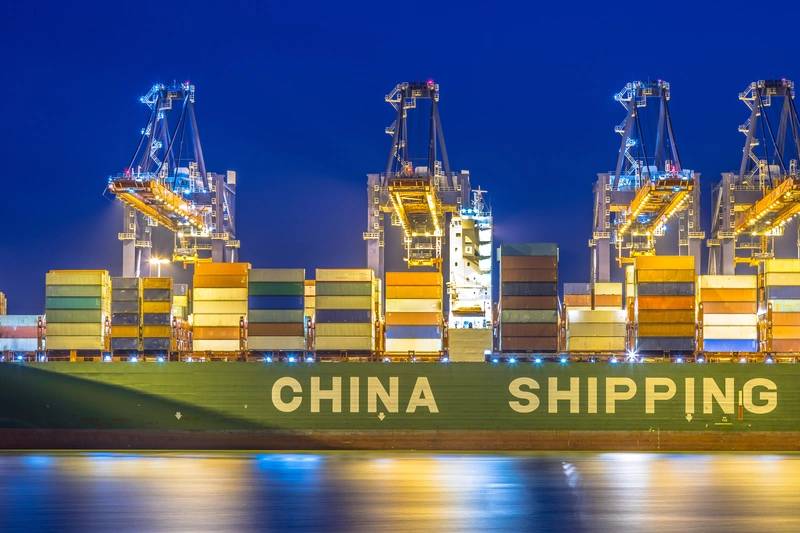

Severe congestion at Chinese ports is easing, say officials and industry participants, although a logjam of refrigerated containers has disrupted supplies of fresh and frozen food and pushed up freight rates outside China.
Thousands of refrigerated containers carrying meat, seafood and fruit from around the world to China have been stuck for weeks at the country’s ports after Beijing extended its Lunar New Year holiday and cities around the nation restricted free movement to curb the spread of coronavirus
With skeleton staffing at ports and few truck drivers available to transport cargoes onwards, refrigerated containers – known as reefers – were either stranded at already congested ports or redirected around Asia to find places where they could be plugged in to power to keep their contents fresh.
In recent weeks Beijing has allowed more travel and offered financial support to companies to restart operations. Some ports chartered trains to bring truck drivers back to clear containers.
“There were staff shortages everywhere, at berths, among inspectors, truck drivers and at downstream companies. But it’s getting much better now, as people are coming back,” said Zhang Ruxing, secretary general of the container division at the China Ports & Harbours Association.
German shipping company Hapag-Lloyd told Reuters in a statement that port congestion in China has eased, berthing operations have improved and terminals have resumed normal working conditions.
More places to plug in reefers had also become available and the company is no longer diverting cargoes on a large scale, it said.
About 18,000 twenty-foot-equivalent unit (TEU) reefers were still at Shanghai and Tianjin ports as of March 6, the port association said this week, down from 27,000 in mid February.
Shanghai, the world’s largest container port by volume, and Tianjin have added 7,000 new spots to plug in reefers, expanding storage capacity for chilled cargoes by 40%, it said.
About a third of rerouted cargoes have been brought back to China, it added. An official from Busan Port Authority confirmed that the South Korean port that has taken some of the rerouted cargoes is seeing a decline in numbers.
A Shanghai-based fruit importer, who asked to be identified only as Huang, said port congestion has eased and shipping lines were giving priority to perishable cargo.
However, despite a recovery in port logistics and operations, the logjam has dampened the confidence of many exporters and importers who were waiting for less congestion to resume business.
“Everyone is waiting for port capacity to fall from about 80% capacity currently to 50% to be more certain,” he said.
Reefer shortage
With many containers still tied up in Asia and shipping lines cancelling sailings, a large imbalance in reefer supply around the world is also pushing up freight rates, said Frank Madsen, global director of reefer and marine logistics at Danish freight forwarder Blue Water Shipping.
Spot, or short-term, freight rates have increased as much as 200%, he said, and are set to rise further.
“There’s both a space and equipment issue that we think could continue for four to eight weeks,” Madsen said, noting that fewer ships leaving China meant it was harder to return the reefers.
Factory activity in China plunged to its worst level on record in February, and while more businesses have reopened in recent weeks, analysts do not expect activity to return to normal until April.
Meanwhile, new containers are still being loaded for China, particularly for goods like frozen pork, which is in high demand, even as prices rise due to soaring freight rates. Pork accounts for about half of Blue Water’s reefer business.
A severe shortage of pork in China following a disease epidemic has pushed imports in recent months to record levels, further squeezing the space available for reefers at ports.
In mid February, about 10,000 reefers containing meat were stuck in Chinese ports, estimated a Beijing-based meat importer, about twice the usual level, though many of those have now been unloaded.
(Reporting by Muyu Xu and Dominique Patton; additional reporting by Jane Chung and Emily Chow; editing by Richard Pullin)
Recent Comments