

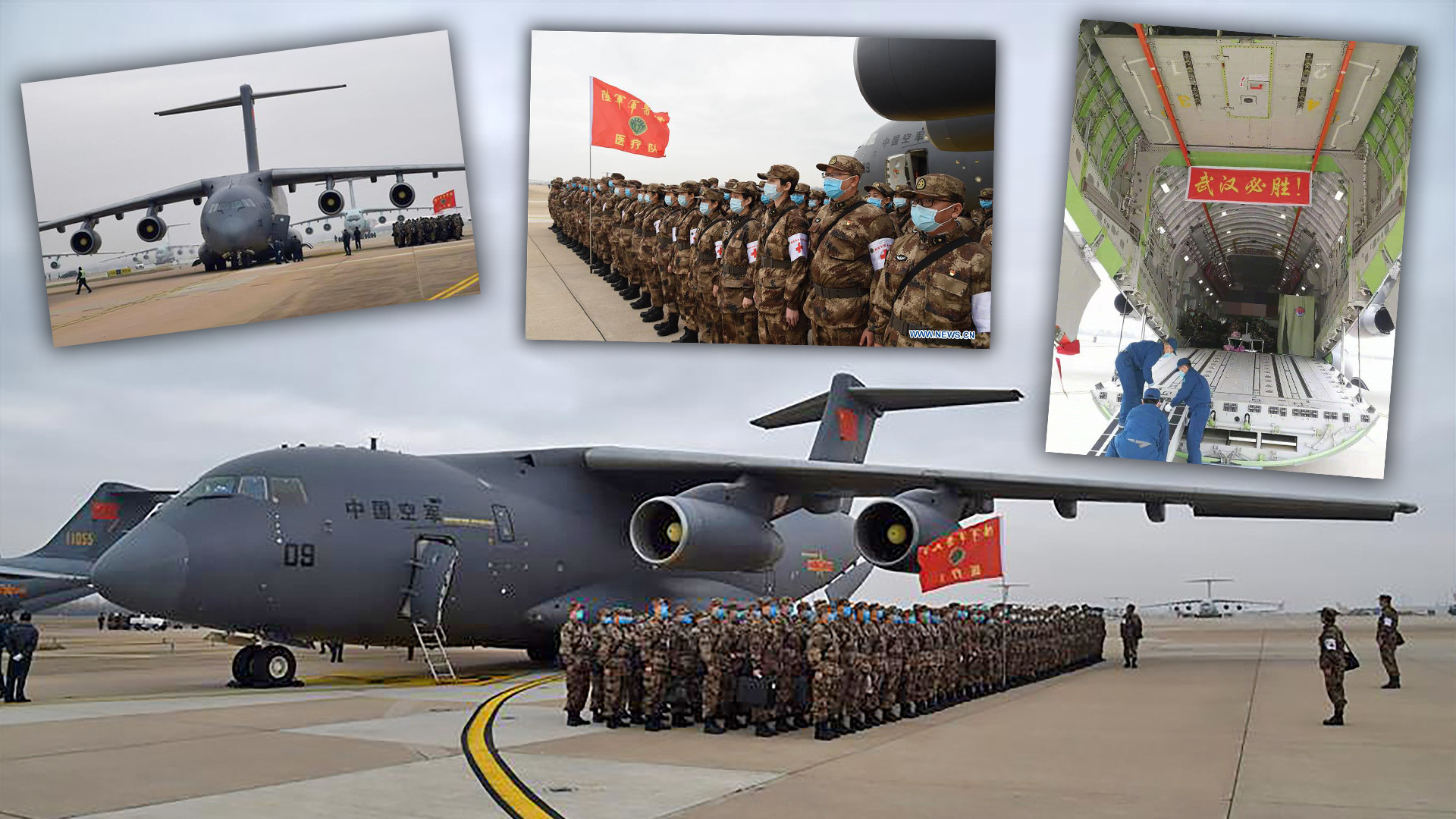

The Chinese People’s Liberation Army Air Force, or PLAAF, has conducted a large airlift operation to bring medics and other humanitarian supplies to the city of Wuhan, which is the epicenter of a massive outbreak of a novel coronavirus that began late last year. The force included six of the PLAAF’s newest Y-20 airlifters, as well as other aircraft. This comes amid growing criticism, within the country and among the international community, of how authorities have handled the epidemic, which has killed at least 1,355 people in China.
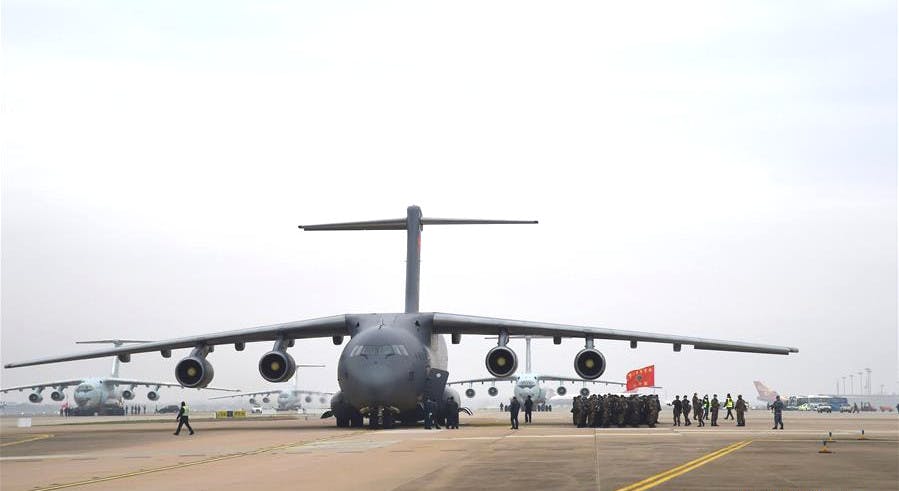
The PLAAF aircraft arrived at Tianhe International Airport in Wuhan on Feb. 13, 2020. In addition to the six Y-20s, three Russian-made Il-76s and two Chinese-built Y-9s also ferried in medical personnel and other cargo. Chinese state media said that the country’s Central Military Commission, China’s top military body and technically the military wing of the Chinese Communist Party, ordered the airlift.
The airlift force brought 947 personnel and 47 tons of cargo to Wuhan. A total of approximately 1,400 military medical personnel arrived in the city, including via ground transport, according to state media reports. Chinese authorities plan to eventually deploy 2,600 medics from across the People’s Liberation Army to the city, where they will help overwhelmed hospitals treat patients with the new strain of coronavirus, known formally as COVID-19. This will bring the total number of PLA medical personnel in Wuhan to approximately 4,000.
Chinese internet
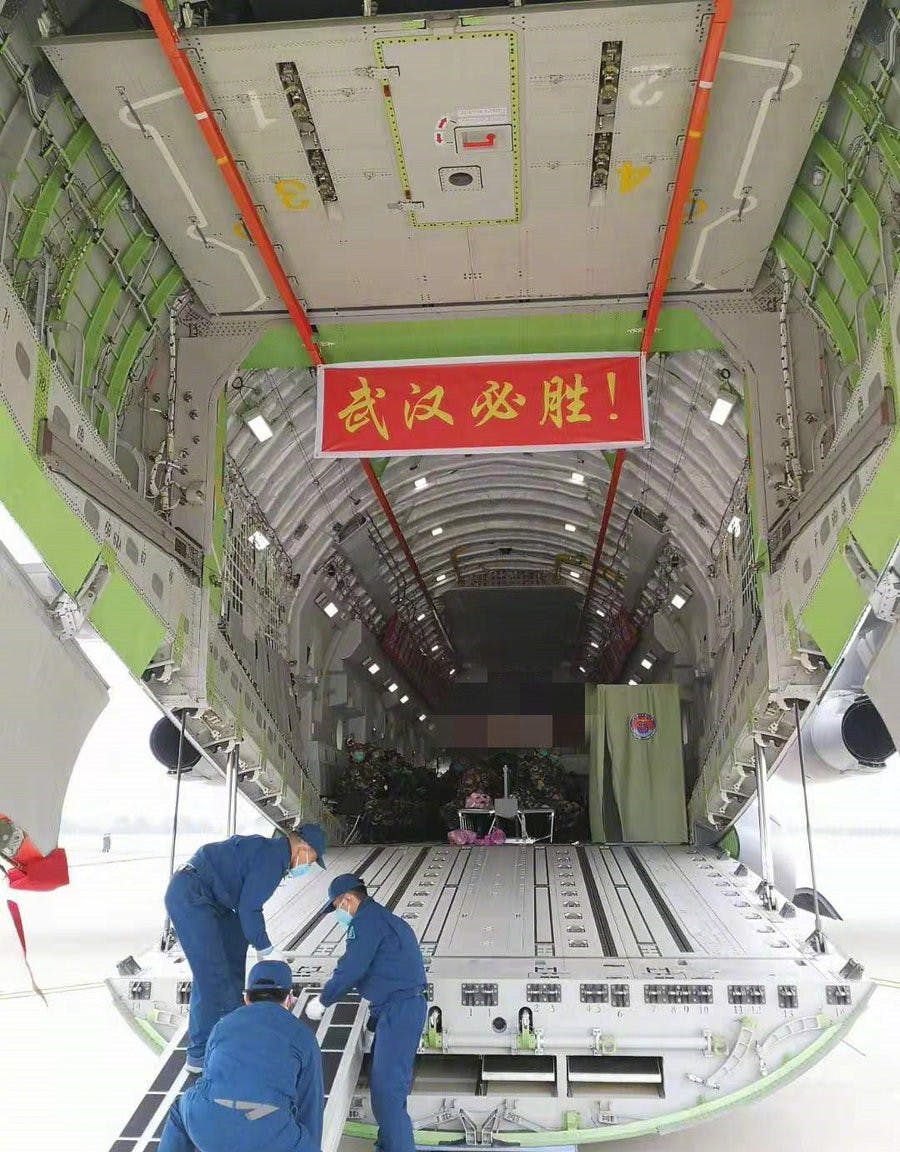
An interesting look inside the main cargo bay of one of the Y-20 airlifters the PLAAF sent to Wuhan.
The Y-20, which first entered operational service in 2016, can reportedly carry a maximum payload, including both personnel and cargo, of 132,000 pounds. The Il-76s that the PLAAF also sent to Wuhan have a payload capacity of up to 96,000 pounds. The Y-9s, which are four-engine turboprops rather than jet-powered like the Y-20s and Il-76s, can each carry up to 50,000 pounds of cargo.
The employment of the Y-20 specifically is notable given how heavily the People’s Liberation Army has promoted it as a major development that has significantly expanded its abilities to conduct large-scale airlift operations inside and outside of China. It’s unclear exactly how many of these aircraft the Xi’an Aircraft Industrial Corporation has built so far. Exclusive satellite imagery The War Zone obtained in December 2019 showed at least 20 of these planes in various states of completion at Yanliang Air Base, which is also home to Xi’an and elements of China’s Flight Test Establishment.
Xinhua/Li Yun
One of the six Y-20s and the three Il-76s are seen at Tianhe International Airport in Wuhan on Feb. 13, 2020.
However, the Y-20, very loosely analogous to the U.S. Air Force’s C-17A Globemaster III airlifter, remains hobbled in many respects by the lack of a modern, high-bypass turbofan engine to power it. At present, the domestically-developed high-bypass WS-20 turbofan, which is supposed to replace the existing Russian-made low-bypass Soloviev D-30KP-2s on the Y-20s, isn’t expected to enter production until 2024 at the earliest.
Regardless, the operation in Wuhan does give the PLA, which has a general dearth of real-world combat experience, an opportunity to actually carry out a major airlift in a more complex, if non-combat environment. Chinese state media itself has been quick to tout that this is the first outing for the Y-20 specifically “in non-military action.” Realistically, it appears to also be the first time the planes have been employed in response to an actual contingency of any kind.
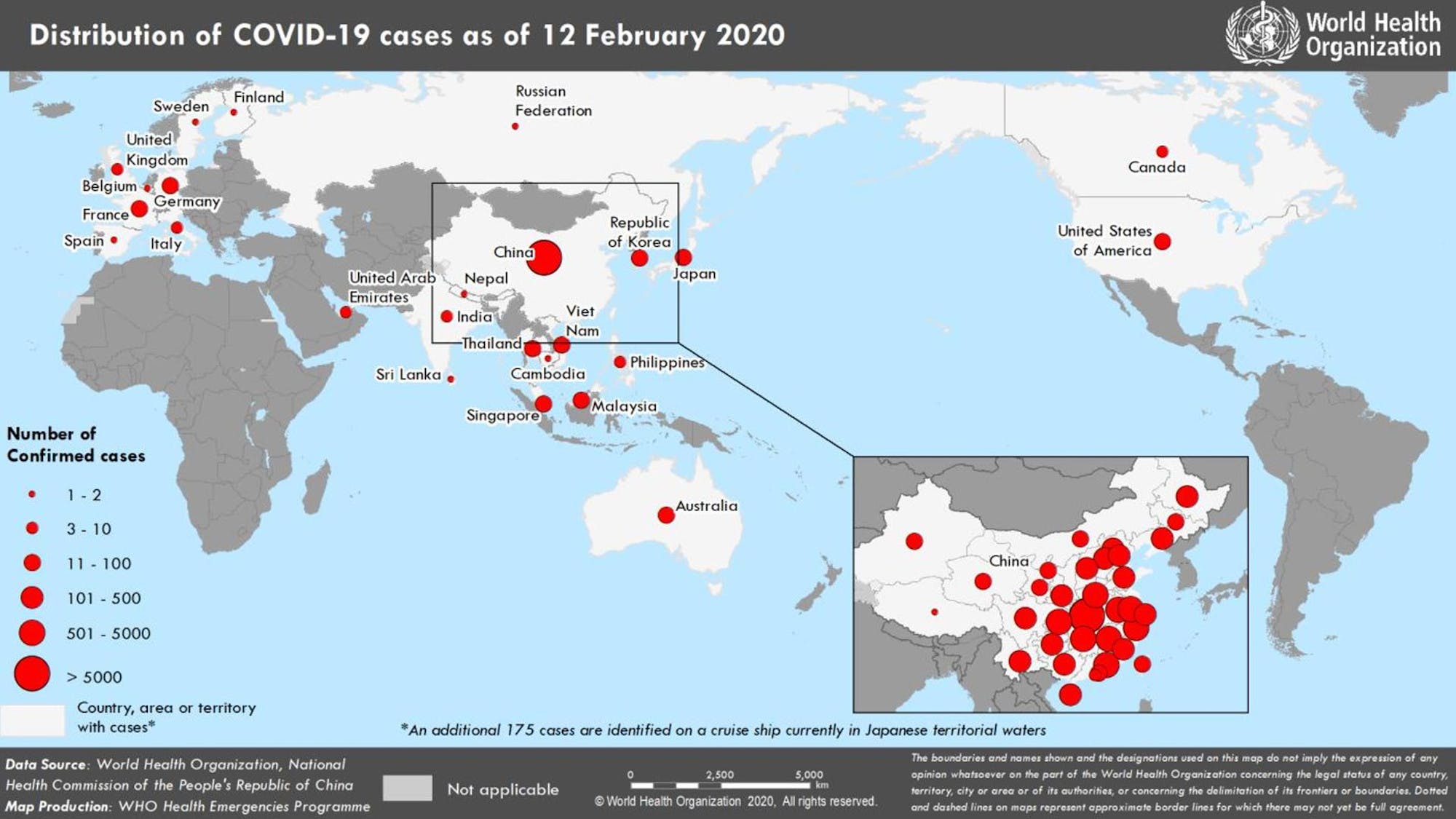
The COVID-19 first began in Wuhan in December 2019. It quickly spread to the rest of Hubei province, where the city is located, and elsewhere in China. Cases of the virus have since popped up in at least 23 other countries.
However, China has, by far, seen the highest total number of infections, as well as deaths. On Feb. 13, authorities in Hubei province revised their reporting methods and announced that there were actually 14,840 additional cases and had been 242 more deaths than were previously known. In total, since December, almost 60,000 people in China have contracted the virus and 1,355 people have died. At the time of writing, there have only been two confirmed deaths outside of China – one in the Philippines and one in Japan – and less than 500 reported cases overall. Chinese authorities have put Wuhan, as well as a number of other cities, under a near-total lockdown for weeks now in an attempt to curb the spread of the virus.
WHO
The spread of COVID-19 as of Feb. 12, 2020.
As such, the airlift into Wuhan also appears to be a very public attempt on the part of the Chinese government to demonstrate its commitment to tackling the epidemic amid increasing complaints about its handling of events. This criticism has even begun to come from within China, with an especially notable outpouring of anger following the death of Dr. Li Wenliang earlier this month. Li had tried to raise the alarm about how dangerous COVID-19 was last year, but authorities subsequently sent police to his home to order him to remain quiet about the virus.
The airlift also follows a notable recent shakeup in the leadership in Hubei, including the replacement of the province’s Communist Party boss and its health commissioner. It comes amid reports of the limited response from the People’s Liberation Army, despite its apparent extensive capabilities to respond to the international military crises and humanitarian ones, as well.
On Feb. 6, 2020, Defense One had published a detailed accounting of PLA support to the response to COVID-19, based on publicly available information, which noted that the first military medical units had only arrived in Wuhan almost a month after the outbreak began. That piece, which is worth reading in full, also said:
“They arrived in relatively small numbers: three medical teams were reported to have been sent from Shanghai, Chongqing and Xi’an, totaling 450 personnel. The subsequent lack of any major following deployment was striking, especially as needs ranged from supply to construction, such that regime officials even turned to making false claims of building hospitals in record time.”
“The PLA’s relative lack of response is even more puzzling given that Wuhan is home to major military units that should be capable of deploying to a contingency. These include the Joint Logistics Support Base [联合保障中心], notionally the center of the PLA Logistic Support Force’s network of warehouses and stockpiles). According to China’s 2019 defense white paper, the PLA Joint Logistic Support Force ‘comprises the support forces for inventory and warehousing, medical services, transport, force projection, oil pipelines, engineering and construction management, reserve assets management, and procurement.'”
“The timing was also noteworthy. Despite the base in Wuhan, and theoretically at least, a streamlined ability to flow units into and out of the province, the PLA Logistics Support Force only established a ‘response and coordination mechanism’ on Jan. 26th, almost a month after the virus began to spread and 15 days after it was officially acknowledged. Even then, official reporting on this ‘mechanism’ describes it as offering communications and funding capabilities, rather than distributing stockpiles, delivering aid, or mobilization of hospitals under its management.”
The Defense One piece also specifically highlighted the absence of the Y-20s, and the PLAAF, in general, from the already limited military response efforts. Overall, the PLA’s involvement in the crisis remains very small compared to its size and resources. However, the airlift, together with the leadership reshuffle, may well point to change in how authorities plan to try to tackle the COVID-19 outbreak going forward.
There are already some other indications of shifting policies at the highest levels in recent days, including the decision to allow a team from the World Health Organization to come in and help investigate the origins of the epidemic and what can be done to stem it. Beijing had rejected WHO offers for weeks and is still declining similar offers from the U.S. Centers for Disease Control and Prevention, or CDC.
However exactly the Chinese response to COVID-19 continues to evolve in the coming weeks and months remains to be seen, but there is a definite possibility that we may now see increasing PLA involvement, including PLAAF airlifters, such as the Y-20.
Contact the author: [email protected]
Recent Comments