

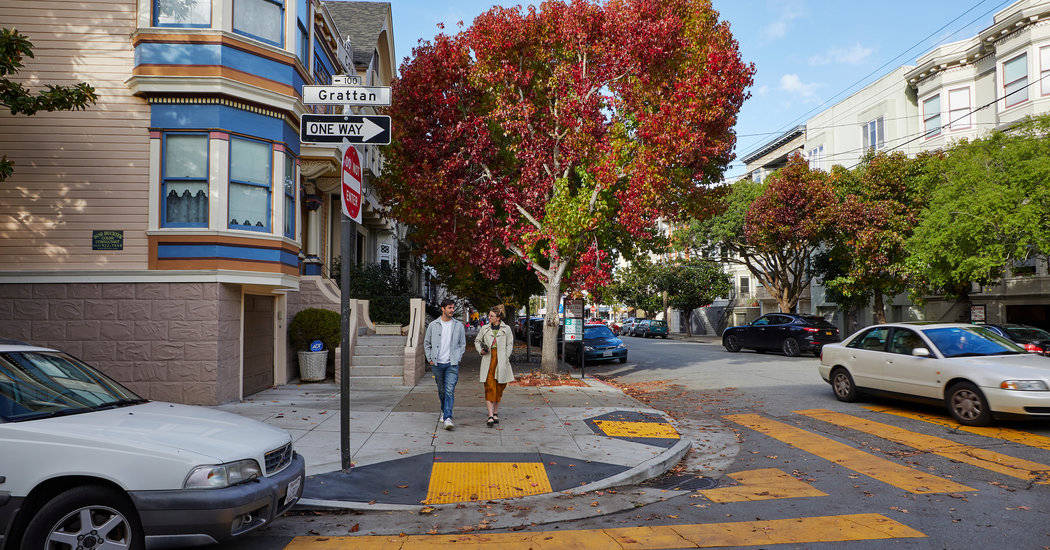

Devang Bhatt and his wife, Lamisa Parkar, were living in Boston in 2013 when he landed a job in San Francisco with Genentech, a biotechnology company. Ms. Parkar temporarily stayed back in Boston while Mr. Bhatt settled in corporate housing in San Francisco and went out alone each weekend to scope out condos for around $1 million.
They wanted at least two bedrooms, with a backyard for their Shetland sheepdog, Duke, as well as parking and nearby public transportation. From Boston, Ms. Parkar would make a list of open houses she wanted her husband to attend, and Mr. Bhatt would spend Saturdays driving to check them out.
Cole Valley, a small, charming San Francisco neighborhood that borders Golden Gate Park with leafy streets lined with Victorian homes, initially felt out of their price range. So when he wandered into the three-bedroom, top-floor unit of a classic Victorian row home, built in 1904 and having survived two major earthquakes, he knew he had gotten lucky. Despite its beauty, the property’s age showed, and it needed upgrades. But after sitting on the market for months, the condo’s price had been slashed, putting it within the couple’s budget.
“Back then the good properties were selling so quickly, for all cash at 30 percent over the offering price,” said Mr. Bhatt, 40. “But this one had been on the market before and the competition was low.”
Ms. Parkar, 38, flew to San Francisco, and they quickly offered $1.035 million. They did an additional $200,000 worth of renovations, breaking down walls to create an open living room, and adding central heating, a half bathroom and new floors. In six years, their family has expanded: A son was born in 2018, and another baby is on the way. Cole Valley, Mr. Bhatt said, has been the right place for their family.
“There are lots of kids in the neighborhood and we can walk to three different parks, which is great,” he said. “People are so friendly here. Our stroller is big and we also have a dog, so we take up the entire sidewalk when we are walking, but people are quite understanding and they give us space. It’s a family-oriented neighborhood.”
Ms. Parkar, who also works in the health care industry, takes the N Judah line of the Muni Metro light-rail line, which makes two stops in Cole Valley, directly to her job in downtown San Francisco. Mr. Bhatt rides the Genentech shuttle bus, which collects employees in the morning and deposits them at the company’s South San Francisco headquarters.
Living in Cole Valley, he said, has made the difference for their happiness in the city. “Every neighborhood in San Francisco has its own character and vibe, but Cole Valley is really a small village within itself,” said Mr. Bhatt. “The dry cleaners know us by name. At the pet store, they give treats to our dog.”
Kimberly Rosania purchased her Cole Valley home in 2018, while she was doing her doctoral training in child psychology. She had gotten used to taking BART from Hayes Valley, where she and her husband were previously renting, to an internship at Children’s Hospital Oakland. When she completed her degree, she found a teaching position at Stanford — a plum job, but one that forced her to abandon the ease of public transportation and drive to work instead.
She commutes by car three days a week, and spends two days a week at home with her 2-year-old daughter. And while she admits she hates the 35-mile drive to Palo Alto, she loves her days in the neighborhood. “Cole Valley is a friendly, safe neighborhood that feels almost suburban, but you’re still connected to all the things I love about the city,” she said.
Ms. Rosania, 35, jogs through Golden Gate Park with her daughter in the stroller, pops into the local grocery for croissants and coffee, and takes advantage of the many playgrounds scattered around the neighborhood. “I feel very welcomed as someone with a little person with me,” he said. “There are so many restaurants I can walk into where they have crayons and high chairs for my daughter, and also good food.”
Her husband works at a tech company in downtown San Francisco, and the N Judah train makes his commute easy. On the weekends, he gardens in the backyard of their three-bedroom home, which they bought after an intense bidding war for $3.95 million.
“We wanted to find a house where the three of us could easily spend time together at home,” said Ms. Rosania. “All the other stuff, the neighborhood — it was the icing on the cake.”
What You’ll Find
Cole Valley wraps around the southeast corner of Golden Gate Park, just below Haight-Ashbury. Cole Street, its commercial thoroughfare, has a number of quaint mom-and-pop shops, including Cole Hardware and the gourmet spot Say Cheese.
There are also a number of popular restaurants, including Zazie, a French bistro whose weekend brunch has become something of an institution; upscale Mexican Padrecito; and Beit Rima, a newcomer with Palestinian cuisine. At The Ice Cream Bar, an Art Deco-style soda fountain with a 1930s vibe, employees wear bow ties and all the sweets are made from scratch.
The N Judah Muni Metro light rail line has stops at Carl Street and Cole Street, as well as at Carl Street and Stanyan Street.
What You’ll Pay
With classic Victorian rowhouses and less than a fifth of a square mile of land, Cole Valley has high prices and limited inventory. But following a trend seen across San Francisco, home values are cooling.
“Cole Valley is very expensive because, for one thing, very little comes on the market. People who are there are there to stay,” said Marc Dickow, a partner at Core7 Real Estate and the 2020 president of the San Francisco Association of Realtors. “And it’s beautiful. I haven’t gone into a single house in Cole Valley that wasn’t, like, wow.”
In 2019, the median price for single-family homes and condos in Cole Valley was $1.55 million, down from a median of $1.8 million in 2018 and $2.43 million in 2017, according to the San Francisco Association of Realtors.
Renters will pay upward of $2,000 for a studio, and as much as $5,000 for a two-bedroom apartment.
The Vibe
Steve Silberman has lived in Cole Valley since 1981. Seven years ago, when a major storm caused flooding and a neighborhood blackout, he went to Say Cheese on Cole Street. Cash registers were down and electricity was out, and the owner, Roger Soudah, had put out cured meats, cheeses and breads for locals to take on the honor system.
It hardly surprised him. “People are good to each other here,” said Mr. Silberman, 62, a science writer. “There’s a kind of awareness among neighbors, of being concerned and earnest about one another’s lives, but not intrusive.”
Mr. Silberman, the author of the 2015 book “NeuroTribes: The Legacy of Autism and the Future of Neurodiversity,” said the community vibe is what prompted him to start a Cole Valley Community Facebook group, which today has nearly 6,000 members. He has watched over the years as those members have become younger and wealthier.
“When I moved here there were many more older people, and now I myself am an older person,” he said. “The prices have increased so much that basically the only people who can afford to buy here are working at Facebook or Google or Apple, or in the financial district.”
Mr. Silberman rents his home, as does his mother, who moved to the neighborhood 12 years ago after his father died.
“It’s a very charming neighborhood,” he said. “The downside, of course, is that the median home price is many times the national average. I wrote a book that became an international best seller, but I will never be able to buy a house here. I’m renting and hanging on by the skin of my teeth.”
The Schools
San Francisco Unified School District operates on a lottery system, meaning children are not guaranteed placement in the school nearest to their home. The system, officially called the SFUSD Student Assignment System, was created 18 years ago in a bid to desegregate classrooms.
Nevertheless, many families with young children choose Cole Valley because of Grattan Elementary, where 56 percent of third-graders taking the California Smarter Balanced Assessment Exam during the 2018-19 school year met benchmarks for English language arts, compared with 52 percent in the school district and 49 percent across California. In math, 60 percent met benchmarks, compared with 58 percent across the school district and 50 percent statewide. (According to the California Department of Education, students with scores at or above benchmark levels on these tests are ready for higher-level coursework).
There are no public middle or high schools within Cole Valley’s boundaries. The Ashbury Campus of the Lycée Français de San Francisco, a multicampus private school with French immersion classes, sits just outside the neighborhood and welcomes students from preschool through fifth grade.
The Commute
On the N Judah line, the ride to downtown San Francisco from Cole Valley takes about 20 minutes. Shuttle buses from several of the city’s major tech companies, including Google and Facebook, have pickups in the neighborhood. For drivers, the ride to South San Francisco at rush hour will take about 35 minutes; Silicon Valley will take more than an hour.
The History
The spot at Carl and Cole Streets where commuters now catch the N Judah line was once a streetcar stop, which helped turn the neighborhood into a transit hub. It slowly evolved from farmland into what it is today, and during the 1990s dot-com bubble, many tech millionaires, including Craig Newmark of Craigslist, called the area home.
Recent Comments