


Pakistan’s flour troubles are not just a supply-side glitch. And while quick-fix prescriptions may exalt virtues of better administrative control, the governance failure is also fiscal in nature.
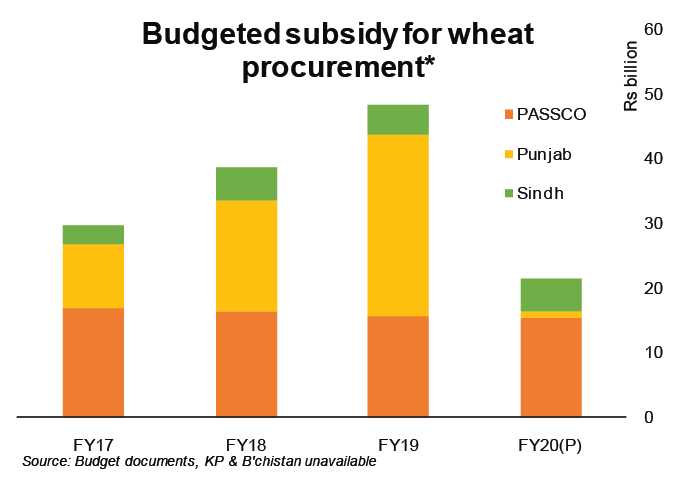
The wheat market is one of the major beneficiaries – pun intended, if you will – of sarkar’s largesse, with annual subsidy of Rs 30-40 billion (including four provinces). The common refrain is that the subsidy is afforded to procure the commodity from growers at above market rates, to incentivize sustained production for an ever-growing roti loving nation.
That is correct but may not be the full story. Close to twenty five percent of wheat harvested is procured by federal and provincial governments through PASSCO and Food departments. At prevailing support (procurement) rate of Rs 1,365 per 40kg, the size of governmental footprint comes out over Rs 200 billion, annually.
Because government procurement has strategic national food security considerations, inventory is usually maintained at what some may consider abnormally high levels. This means that government stock also has cost of maintaining inventory among other incidental costs. Logically, this also means that the cost of government’s procurement and the cost at which it issues wheat to buyers cannot be same.
 In any other line of business, the differential would be deemed trader’s margin, a value-adding role for a market agent connecting producers and consumers. Except, the government is not in the procurement business to mint profits, but to fulfil the twin objectives of ensuring “affordable” and “consistent”. And how miserably does it fail on both accounts!
The latter objective need not demand any more emphasis (For more, read “Wheat crisis, what about poor governance” published on January 23, 2020). But the former oft-goes missed even from informed discussions. In an ideal world, where public welfare reigns supreme – the government would aim to issue wheat at a price lower than cost of procurement, while absorbing the difference.
Instead, because of costs incidental to inventory maintenance – inclusive of the salaries of the administrative control staff – the cost of final wheat issue is much steeper. According to one estimate by Asif Sharif of Pedavar, incidental costs go up to Rs 15-20 per kg, which if correct is more than 40 percent of cost of procurement.
Of course, like any well-meaning state assuming charge of welfare, the government tries its best to not pass on this cost. Thus, the wheat issue price – the rate at which the stock is released to private parties such as mills – only partially reflect these incidental costs.
What’s wrong with this noble objective? Put simply, in governance there are no marks for effort – especially one that fails. Consider, that in best of years – the Punjab government recovers only two-third of its expenditure on wheat through sale proceeds. If this were Shangri-La, the difference could have perpetually been funded by subsidies. Alas, if wishes were horses.. The exchequers’ pockets only go so deep, thus subsidies can only fulfil part of the difference. Enter commodity operations.
Like most debt numbers, that the outstanding debt stock owed by federal and provincial governments against commodity operations stands at Rs750 billion would be of little concern in isolation. But consider that over the past decade, wheat procurement has become synonymous with commodity operations, as procurement of other grains have been gradually phased off. Recall also, that annual government procurement of 5-6 million tons is valued at Rs200 billion at current prices.
Consider also that on average between 40 – 60 percent of procurement cost is recovered through its sale proceeds. Yet, the commodity operations debt stands at over 3.5 times of annual procurement. Now, consider one last nugget: while federal footprint has remained largely stable over the last decade – growing at just 3 percent CAGR – provincial share has registered phenomenal growth, at over 9 percent per annum.
The kindest interpretation of the phenomenon is that increasing dependence on commercial borrowing for commodity operations reflects widening differential between procurement rate, actual cost, and issue price. And while limiting fiscal space at the centre means federal has done well to contain its debt share, provincial performance has been dismal. Also, bear in mind that information related to issue price is not publicly available.
The kindest explanation version also dictates that the government is absorbing the gap, yet still failing to ensure “consistent” supply of “affordable” wheat to the end-consumer. What of the subsidy you ask? Considering that as a percentage of outstanding debt stock, it frankly amounts to little – eight percent at its highest over the last decade; barely sufficient to even cover debt servicing portion.
Some may highlight these figures patronizingly – as if the government is doing too little to ensure national food security: turn the problem on its head. Maybe, by insisting on retaining the role of intermediary in wheat value chain, the government is doing too much. It adds to the cost of transaction, partially funds it through explicit subsidies to procurement bodies, and then passes on the implicit financing cost onto the taxpayer. All the while failing to ensure that wheat remains affordable or adequately available. Whether that’s value-adding or not, the reader may judge best.
Recent Comments