

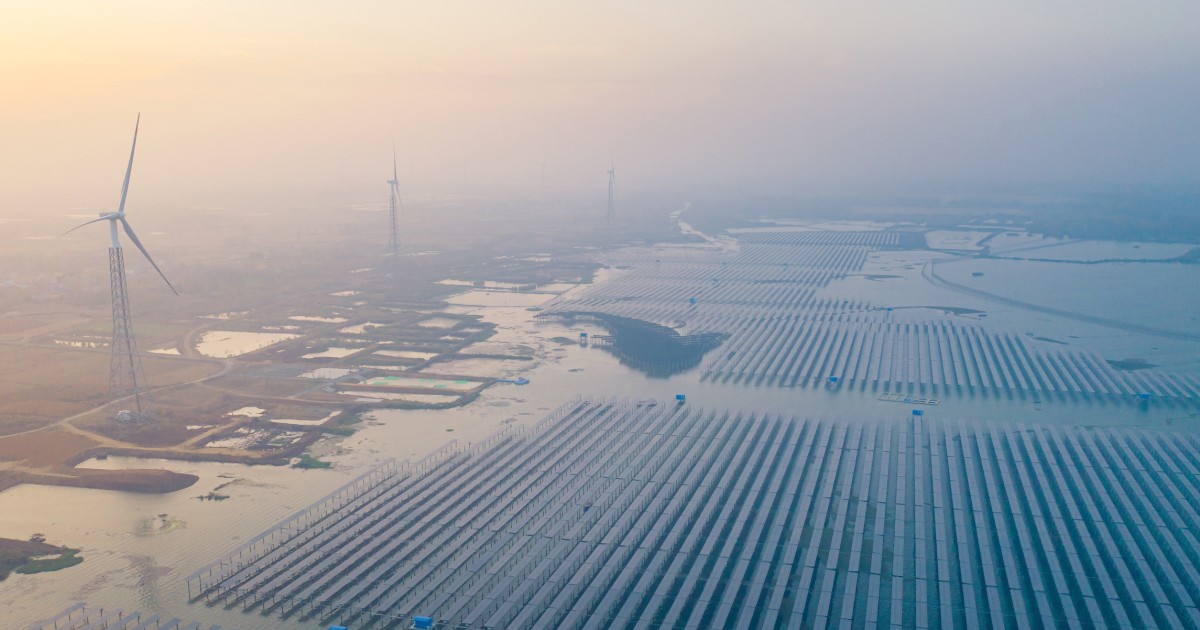

The coronavirus hasn’t just upended oil markets. The virus is also casting a shadow over renewable energy markets as solar and wind developers face an uncertain global supply chain.
The uncertainty, especially if neither the Trump administration nor Congress offers policy clarity, has the industry worried about project delays, which could then prompt missed opportunities to take advantage of federal tax credits.
“Renewable energy relies on a global supply chain,” said Greg Wetstone, CEO of the American Council on Renewable Energy.
“There are very real concerns about the ability to get critically important parts of the supply chain in a timely fashion, and that’s particularly important for our sector because a critical piece of the financing are tax credits,” Wetstone said, adding that those tax credits have hard deadlines.
Wind producers, for example, won a yearlong extension of their production tax credit, but projects must begin construction this year to qualify.
Renewable energy developers acknowledge they’ll likely face disruptions from the coronavirus pandemic. However, they don’t know how long the market disruptions will last or whether things will get worse should logistics face challenges or workers get sent home.
There are big questions that have yet to be answered, said John Smirnow, vice president of market strategy for the Solar Energy Industries Association: “How long is the industry going to be disrupted? In the U.S., how is it going to affect employees? Are we going to see installations slow down or be put on hold because people are limited in travel? We’re certainly concerned about that based on what we’ve seen in other countries.”
Already, some U.S. companies have had to alert regulators and utilities of potential project delays.
For example, Chicago-based Invenergy sent Wisconsin’s Public Service Commission a notice of force majeure, which excuses it from its contract deadlines due to unforeseen events, citing potential delays for its Badger Hollow Solar Farm project.
“Due to events beyond Invenergy’s control involving the global spread of the coronavirus … including, without limitation, related travel restrictions, factory shutdowns, and the resulting disruptions to global supply chains, there exists the potential for delays in the performance of certain of Invenergy’s obligations under the Agreement,” the Feb. 10 notice reads.
A contractor for Florida-based NextEra Energy Resources sent a similar notice to the Wisconsin regulators on Feb. 6, noting that coronavirus-related shutdowns and restrictions were “adversely impacting” a supplier’s ability to meet deadlines for its Two Creeks Solar Project.
That notice has since been rescinded, though, according to NextEra.
“We are actively monitoring the potential impact of the coronavirus on our renewable projects and the associated supply chain,” said Steve Stengel, NextEra’s senior director of communication. “None of the expected in-service dates of our projects have been impacted at this time.”
Smirnow said companies could be sending these notices out of precaution “given the fluidity of the situation.”
Renewable energy developers are suffering problems in the global supply chain. The root of much of that is China, a major manufacturer of components for solar plants and wind turbines.
“The renewables industry has been there for a better part of two decades, and a lot of commitments were made in the run-up to the phaseout of the credit,” J.C. Sandberg, who serves on GE Renewables’s leadership team, told a March 4 forum in Washington hosted by ACORE.
“This is something that no one anticipated,” he added of the coronavirus.
Even so, some analysts say the effect on the U.S. solar industry might be blunted by tariffs President Trump imposed on imported solar panels two years ago. Those section 201 tariffs took effect in 2018 and started at 30%, decreasing 5% per year through 2021.
Much of the U.S. solar industry has staunchly opposed the tariffs. A report from the Solar Energy Industries Association last year found the tariffs would cost 62,000 jobs and a loss of $19 billion in investments between 2017 and 2021.
But those tariffs have actually reduced the United States’s reliance on China for solar panels, modules, and other equipment, said Xiaojing Sun, a senior research analyst at Wood Mackenzie. The tariffs “created a different supply chain” for the U.S. The rest of the world still relies mostly on China for its supply, she added.
It’s a “blessing in disguise,” Sun said. Because of the tariffs, Chinese solar modules aren’t as cost-effective for U.S. buyers, pushing supply chains to Southeast Asian nations such as Vietnam and Malaysia, where manufacturing hasn’t been affected as severely by COVID-19, she noted.
ACORE’s Wetstone said the solar sector is facing “real impacts” from the coronavirus, even with the tariffs in place. There have been slowdowns in manufacturing outside of China that affect U.S. developers, he added.
Either way, the renewable energy sector is looking for as much clarity as possible, especially when it comes to tax policy.
“I think there’s been a lot of churn in the industry about, ‘Could there be an additional runway on safe harbor as far as IRS guidance goes?'” Sandberg of GE Renewables said at the forum, speaking about the tax credit deadlines. “That’s kind of top of mind right now as we race to fulfill and meet deadlines in 2020.”
Wetstone said he and others in the industry would be urging Congress and the White House to keep the renewables sector in mind as it crafts a more significant response to economic downturns from the coronavirus. The White House has floated several ideas to help stabilize the economy and assist struggling industries, even reportedly considering policy relief for U.S. shale companies facing market volatility from the coronavirus and oil price wars.
But Smirnow said the renewables industry has also had “ongoing conversations” with the federal government about how to address effects from the coronavirus.
That could include an express provision in any legislative or administrative package “that ensures that no one loses their ability to qualify for tax incentives because of delays associated with the coronavirus,” Wetstone said.
Ultimately, though, Sun said the renewable energy sector should be able to weather the delays. Already, factories in China are back up to nearly full capacity, running at 90%-95% capacity, she said.
Sun compared the delays to a “snow day,” where kids stay home and miss a few days of school. “Many schools have catch-up days” at the end of the semester to finish any work that was missed, she said.
“In my head, I see that as what the renewable energy industry is going to do,” Sun said, adding that both countries and industries have incentives to ramp production back up quickly.
“Both have an incentive to not just sit there,” she said.
Recent Comments