


Governments and health care agencies across the globe are working to slow and stop the spread of COVID-19, the disease caused by the coronavirus. This has not just impacted people’s health, but also their jobs and the health of our global market.
Manufacturers are struggling to manage the pandemic’s growing impact on their supply chains because factories and plants have shut down or significantly reduced their production — particularly in China. Many companies rely on China as a single-source supplier to secure parts or keep costs low. However, it’s at times like this where a supply chain’s lack of resiliency is clear.
>>The Latest WUWM & NPR Coronavirus Coverage
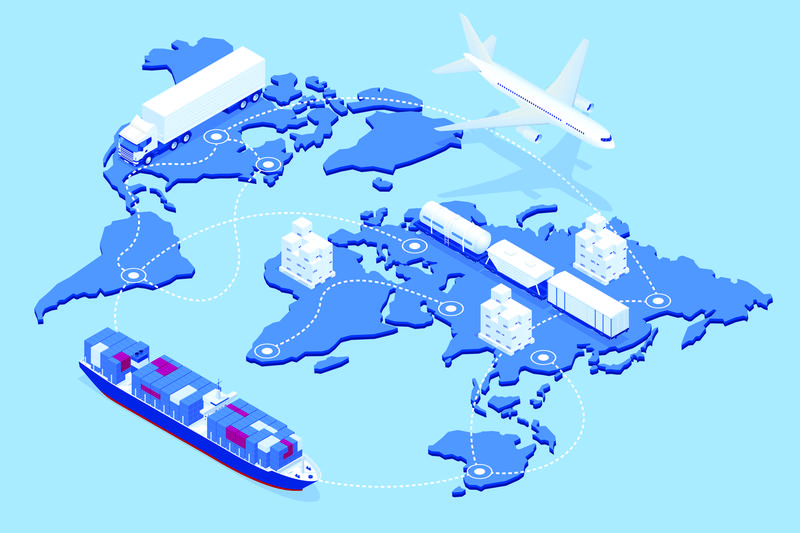
Countless companies, large and small, rely on a network of suppliers to produce and distribue products to buyers. A majority of necessary parts for products come from around the world, and the steps it takes to get a product to the customer are all part of a supply chain. Materials can make up 60%-80% of a business’ plan and budget on an annual basis, according to Martin Staples. He’s worked in supply chain operations for Emerson Electric in Racine for 25 years and now serves as an independent consultant.
He says people tend to look 12 months ahead due to long the lead time. So, what happens to a company when a plan is massively disrupted by something like the coronavirus?
Staples oversaw factories and suppliers in China when he was with Emerson Electric. He says that factories range from highly manual to highly automated operations, which impacts the dependency of a supply chain.
“Almost anywhere in China, there’s a ton of people in the manufacturing process. For the manufacturers there’s a large migrated population — about 100 million move from the inner parts of China over to the coastal cities where all the factories are,” he explains. “So with this coronavirus, that’s a bit of an issue for these people to travel around.”
“I have a big hole in my whole supply chain right now [that] I’m trying to sort through.”
While many companies are finding quotes for additional suppliers in the United States, those suppliers may also get products from China, creating a massive delay in quoting parts — up to 18 weeks, according to Staples.
“I have a big hole in my whole supply chain right now [that] I’m trying to sort through,” he says.
Immediate steps Staples recommends for businesses:
- Have multiple sources for larger volume components.
- Make sure you talk to suppliers to evaluate the risk to your supply chain: “Do they buy directly from China? Or do they know of any risk to their supply chain?”
- If you have long purchase orders, bring in more supplies than you normally would: “Raise up to 30-60 days of inventory on parts.”
- Keep your relationship with your suppliers strong: “You want to keep in touch so that you’re getting first-pass when things go bad.”
Right now, Staples says that different supply chain strategies need to be explored — for either a short-term fix at a higher cost or a lower cost long-term solution.
The most prevalent strategy companies are currently taking is similar to hoarding: “Trying to buy things and get it into their warehouse as opposed to leaving it in a distributor’s warehouse,” he notes.
However, hoarding will only go so far if businesses don’t evaluate their supply chain and communicate with their distributors. “Just keeping in contact with your suppliers is really key because then you’re known,” says Staples. “As long as you’re touching base with them, if it really comes to a tough situation, the more they know you the better they’re going to serve you.”
Circumstances like this create a “bullwhip” effect where there are spikes and drops in demand, according to Staples. Amid the ripple effects of the coronavirus, “it’s time to be creative … because you want to have the workforce there and you also need to have the capacity there,” he says.
“Try and do any restructuring you can and get yourself in a better situation so when it comes back you’re more efficient.”
Staples also recommends that businesses use this time to try to improve their process so they can come back from the impact of the coronavirus stronger. “Try and do any restructuring you can and get yourself in a better situation so when it comes back you’re more efficient,” he says.
While it’s still unknown how bad things will get, Staples says most companies will not be making any long-term bets on purchases for materials. Also, any kind of consumer confidence drop or social distancing will have a big impact on consumption.
Recent Comments