




The coronavirus (COVID-19) pandemic is not only a health crisis impacting daily life for individuals but has led to cascading supply chain disruptions, especially in Asia. Shippers and transportation providers are pressured to anticipate the impacts of the outbreak in North America with vital data changing every day. While the possible long-term impacts of the virus on supply chains are unclear, companies have to make decisions today on how to adjust to this disruption.
For now at least, Arrive Logistics’ executive vice president, Eric Lien, is counseling his customers to focus on preparation, flexibility and over-communication with trusted partners on their long-term strategy. Arrive Logistics is a third-party logistics provider headquartered in Austin, Texas, with offices in Chicago and Chattanooga, Tennessee.
The shutdown of manufacturing plants and logistics services in China coincided with a lengthy national holiday — the Lunar New Year — that Lien’s customers say was the best possible time for quarantines and work stoppages to occur.
“I was with 11 customers in LA last week; half a dozen of them were Asian-owned,” Lien said. “They were of the opinion that if there was a good time for it to happen, it was now. The bigger question is ‘does the customer have upstream suppliers that are replenishing downstream manufacturers they’re dependent on? Are those upstream manufacturers still hurt by labor shortages because of coronavirus?’ There are still many unknowns.”
Prior to Arrive Logistics, Lien spent 14 years at a Fortune 500 food shipper in distribution and supply chain operations; now he leverages that experience as a member of the Strategic Partners Division. This division is composed of executive alumni from enterprise shippers, carriers and technology providers and designed to be a resource that enriches the internal Arrive team and offers insights, networking and experience to their partners.
Lien explained that although the official holiday in China lasts approximately two weeks, “no one gets back to work at 8 a.m. on Monday.” In other words, many workers take the opportunity to change jobs, and the manufacturing sector’s return to 100% capacity is a gradual process. For that reason, shippers with operations concentrated in China build an extra two to three weeks of safety stock in their inventories, which they’ve been relying on to keep the movement of product fluid since the coronavirus hit.
So far, control measures in response to the coronavirus have shuttered much of China’s production, causing exports to plunge. Container spot rates from China to the North American West Coast are still down more than 10% year-over-year, and import shipment levels at the ports are a fraction of normal volumes. Intermodal rail volumes outbound from Los Angeles are down 36% since the beginning of February and are 22% lower than last year’s Chinese New Year-related trough.
Trucking spot rates from Los Angeles to Dallas are down 12% since Feb. 2, while rates in the opposite direction are up 24% in the same period. In other words, the trucking spot market is pricing in softness in Los Angeles, treating it like an undesirable backhaul market instead of the abundant source of freight that it usually is.
While the drop in Chinese exports has mostly affected steamship lines, drayage operators and intermodal volumes — total rail intermodal volumes outbound from Los Angeles are down 21.7% compared to last year’s CNY trough — truckload volumes have not been affected. Or, rather, they’ve been juiced by a somewhat surprising second-order effect: panic-buying.
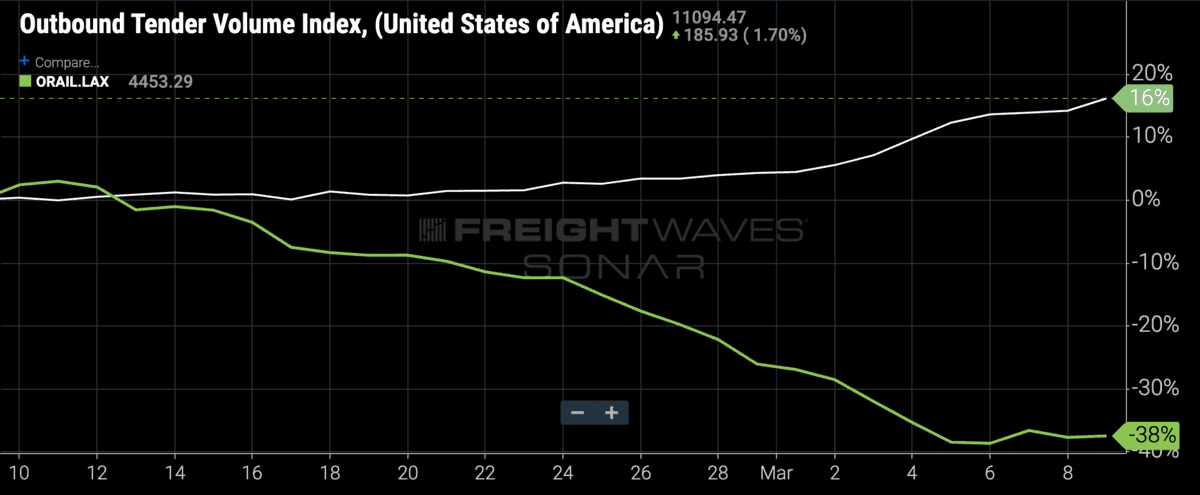
Consumers are buying dry and canned foods, bottled water, paper products, and disinfectants at higher rates than normal, pushing up truckload demand across a broad swath of freight markets in the United States. It’s unclear how long that spike will last, or whether it will be followed by a deep trough if inventories run out or quarantined people simply buy less.
Over the past two years, the total business inventories-to-sales ratio has held steady at about 1.4 months, a higher level than the previous five years. Companies tended to hold more inventory in the 1990s, then progressively became leaner as new manufacturing processes and supply chain management philosophies took hold. Recently, inventories have trended back up as the cost of capital has fallen and consumer expectations of e-commerce fulfillment have required companies to forward-position more products.
Whatever happens — intensified panic-buying, a brick-and-mortar exodus and flight to e-commerce, or generally depressed economic activity — shippers, carriers and 3PLs are bracing for volatility in both directions.
Arrive works to understand each of its customers’ priorities and particular exposures to any supply chain disruption, custom-tailoring solutions around specific requirements, Lien said.
“It’s about understanding what they value, whether it’s lead time or their customers’ experience or cost of capital,” Lien said. “There are different metrics that our customers are trying to optimize, and we want to, first, understand it, and second, support it.”
“We’ve dealt with anything and everything,” Lien said. “We’re situated as a strong contractual service provider that works with reliable carrier partners on our customers’ long-term supply chain strategies.”
Lien said that short-term supply chain stresses can spike spot demand for team capacity and opportunistic brokers can exploit those situations to widen their margins, but Arrive isn’t built to do that.
One of the largest uncertainties for supply chain decision makers is predicting customer demand. With a “natural event” such as the coronavirus, supply chain managers are in a difficult spot: consumer behavior has the potential to strain or break the systems they have in place. Some may find themselves not using previously-booked capacity, struggling to source capacity, or in the chaos failing to see the true costs of their operation.
“We’re nimble enough to provide as-needed services, whether that’s capacity or data analytics, but we’d urge shippers not to take their eyes off the ball and focus on their long-term strategies,” Lien said. “Pick your partners well, because some are opportunistic while some are interested in understanding how value can be distributed over the long run between partners.”
To learn more about the Strategic Partners division, join Arrive Logistics and FreightWaves for a one-hour webinar on April 30 at 2 p.m. Eastern time. The webinar offers insights from these seasoned logistics leaders on today’s supply chain trends and challenges. To register, please click .
Recent Comments