

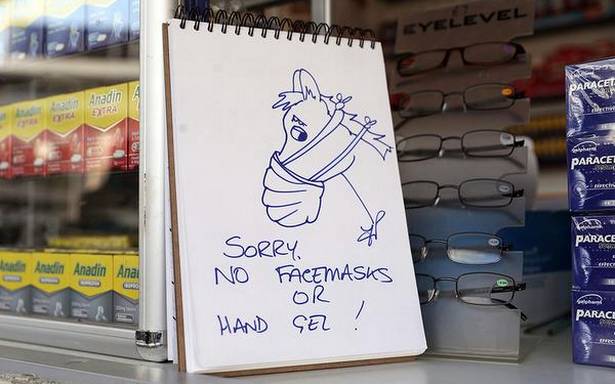

Last week, the World Health Organization warned of severe and mounting disruption to the global supply of personal protective equipment — the reason being rising demand, panic buying, hoarding and misuse. Such behaviour would put lives at risk, not just from the new coronavirus (Covid-19) but other infectious diseases as well, the WHO cautioned.
And panic buying was reported from various countries, as masks, sanitisers, etc, were wiped clean off market shelves. A similar trend was seen closer home as well. However, stock-outs in India of masks or gloves, for example, cannot be entirely blamed on anxious buying by citizens. As it turns out, the unethical price increase and profiteering has also to do with inconsistent procurement policies.
Conversations with several licensed producers of personal protective equipment (PPE) reveals that shortages and an absence of immediate capacity to supply quality products stems from a lack of clarity on procurement by Central and State governments and their obsession with “L1”, or the lowest price on offer.
Take the experience of Smita Shah, Managing Director of Mediklin Healthcare, a company that makes protective gear for many years now. All components that go into a PPE kit, from raw material to make the coveralls, shoe-covers, masks, googles, etc, are made locally, she says.
But till date, only one hospital has procured 100 kits with the right technical requirements adhering to WHO guidelines, she says, exasperated that Governments are not clear on their requirements and often end up asking for kits weak on technical standards. She contrasts this with international enquiries that are strong on technicalities, since PPE kits are critical in controlling infection among doctors and patients. Her predicament is that even if sizeable international orders come through, export of PPE kits has been disallowed. The Government does not procure kits from quality producers for local hospitals, nor does it let them export, she says, pointing out that tax-paying manufacturers like her are, in fact, earning foreign exchange for the country.
Cheap but not safe
Covid-19 has exposed the administrative framework that discourages local producers, say industry representatives. Fly-by-night operators are literally stitching together masks and gowns in non-sterile conditions and supplying them at reduced prices for large procurement orders and high prices where there is a need.
Dr Sanjeev Relhan with the Preventive Wear Manufacturer Association of India says that 80 per cent of the PPEs bought under public procurement are “of no use”. The gowns are not of the required non-woven impermeable material needed for infection control, he alleges.
There are no norms governing these products and procurement relies on the “L1 syndrome” where Government tenders procuring in bulk for hospitals go for the lowest price, he says. PPE kits are pegged at ₹320, when just the goggles (in a multi-component kit) cost ₹110. The entire kit would otherwise cost about ₹1,400, he says. Relhan claims there are enough local producers making PPEs, masks and the like. About 120 manufacturers make protective gear and can make 1,000-1,500 PPEs a day, and capacities can be upped if procurement was stable. There are about 70 makers of masks in the country, with capacity to make 1.5 lakh pieces a day.
The Government needs to standardise procurement and cap prices so products are not sold at 15 times the ex-factory price, he says. There are different types of masks, but a basic one that costs 70 to 80 paise sells anywhere between ₹15 and ₹30 per piece, if not more. Even locally made N-95 masks are sold at ₹200-300, when their original price is ₹90-odd.
Thailand, Malaysia model
Sanjay Jha, director with distribution company ColMed, observes that masks, digital and non-contact thermometers have seen a steep increase in demand. The requirement is 100 times more than a normal month — where 2,000-3,000 masks are sold in a good month. The high quality masks he imports from a couple of multinational companies are out of stock and two local companies making them have seen prices increase, partly due to increase in raw material cost, he says.
Rajiv Nath, with the Association of Indian Medical Device Industry (AiMeD), points to Thailand and Malaysia where producers are asked to keep a percentage of the product for domestic use and a portion for exports.Tossed between instructions from multiple ministries, Nath calls for one coordinating ministry to handle procurement and the needs of the country, so local producers are not chasing moving targets on quality standards and price.
Recent Comments