


The U.S. pepper market is supplied by multiple origins, but in November and December, the Israeli peppers hold the largest market share. Robin Sporn of MOR USA, the American branch of MOR International, says: “We do both conventional and organic peppers, and while the season usually starts right around the time of the PMA – so, around the second half of October – the majority of the volumes are moved in November and December.”
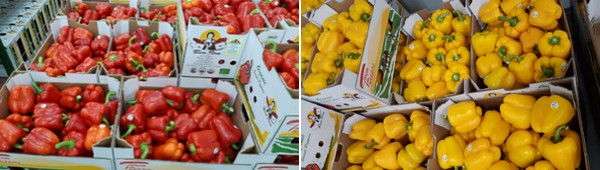
November-December: Peak season for conventional Israeli peppers
The conventional peppers are brought in by both air freight and ocean freight. Sporn shares: “The boat peppers are the same peppers as the air peppers, but they’re picked earlier and greener and treated with a natural treatment that we’ve developed in cooperation with the Volcanic Institute to help keep them fresh throughout their journey.” MOR works only with red peppers for their ocean freight because they’ve found them to be stronger than the other varieties. “We’ll bring the other colors, like yellow and orange, in by air freight during this time so that we can supply all the varieties at optimal freshness.”
The ocean freight will bring the peppers from Israel to their U.S. destination in 13 days, and the peppers ripen while on their journey. “Due to the high demand during these months, the peppers are sold very quickly and so the ocean freight is perfect for this time of year. We are also able to sell the peppers for much lower prices because our transportations costs are more than 50% lower with the ocean freight compared to the air freight,” says Sporn.
Competition with Mexico
Mexico enters the market with their peppers in January and usually the Israeli product is redirected to Europe at this time. Sporn says: “The Mexican conventional product is offered at such low prices that the Israeli product just can’t compete. So, usually we’ll turn our attention to Europe when Mexico enters the market. Sometimes, like right now, there’s an unexpected gap in the market and then we’re able to continue to supply the U.S. outside of the normal season. The volumes coming out of Mexico are very low right now, so that’s when our customers turn to us to bridge the gap.”
Since the MOR works only with greenhouse peppers, for both their conventional and organic products, they don’t compete with the U.S. domestic season.
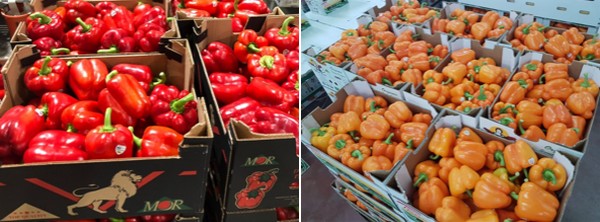
Organic peppers see good demand
While the window for the Israeli conventional peppers is quite small, the organic peppers supply the U.S. for much longer: “The organic peppers begin at the same time as the conventional peppers – though the first picks are usually from the bottoms of the plants, which results in quite small sizing that is usually kept for the Israeli domestic market. Then in the second week of November we start bringing in a steady supply of good sized organic peppers and the season will consistently run throughout March or even April. The demand for the organic peppers in the U.S. has been really consistent in the past few years,” Sporn says.
She adds: “The Israeli peppers are also sent to Europe, so they are grown to comply with the European standards for organic, which are more rigid than those of the United States. So the Israeli organic peppers are of high and reliable quality, which accounts for the consistent demand. Customers really look for the organic peppers of Israeli origins.”
This year, the company is importing slightly lower volumes than usual of the organic peppers, Sporn shares. “This year was a little tougher because for the first time we saw the Mexican organic peppers enter the market in good volumes in November already while they usually don’t start until January. This did pose a bit of a challenge, but that’s just the nature of the game.”
Good growing season
Overall, the peppers coming out of Israel this year have been of good quality, according to Sporn. “Last season, the 2018-2019 season, we had some quality issues at the beginning during the first three to four weeks because of weather issues during the planting. This year, however, the quality has been consistently good,” Sporn concludes.
For more information:
Robin Sporn
MOR USA
Tel: +1 (484) 885-6259
Email: [email protected]
Recent Comments