
Tech News, Magazine & Review WordPress Theme 2017
  • Home
  • Supply Chain Updates
  • Global News
  • Contact Us
  • Home
  • Supply Chain Updates
  • Global News
  • Contact Us
No Result
View All Result
No Result
View All Result
Home Supply Chain Updates

Cygnus cargo ship leaves International Space Station, begins new mission in orbit

usscmc by usscmc
January 31, 2020
Cygnus cargo ship leaves International Space Station, begins new mission in orbit
Share on FacebookShare on Twitter

Northrop Grumman’s Cygnus NG-12 cargo spacecraft departed the International Space Station today (Jan. 31), nearly three months after it arrived at the orbiting laboratory with about 4 tons of supplies and science experiments for the Expedition 61 crew.

The cargo vessel, named the S.S. Alan Bean after the Apollo 12 astronaut, began its journey back to Earth after ground controllers in Houston used the station’s Canadarm2 robotic arm to release it in orbit. Before the spacecraft meets its fiery demise in Earth’s atmosphere, it will spend about a month in orbit deploying various scientific payloads. 

On Feb. 29, ground controllers will initiate a deorbit maneuver, after which the cargo ship will execute “a safe, destructive reentry into Earth’s atmosphere,” NASA officials said in a statement. 

Video: See stunning Earth views as Cygnus spacecraft departs space station
Related:
Antares rocket launches Cygnus NG-12 cargo craft (photos)

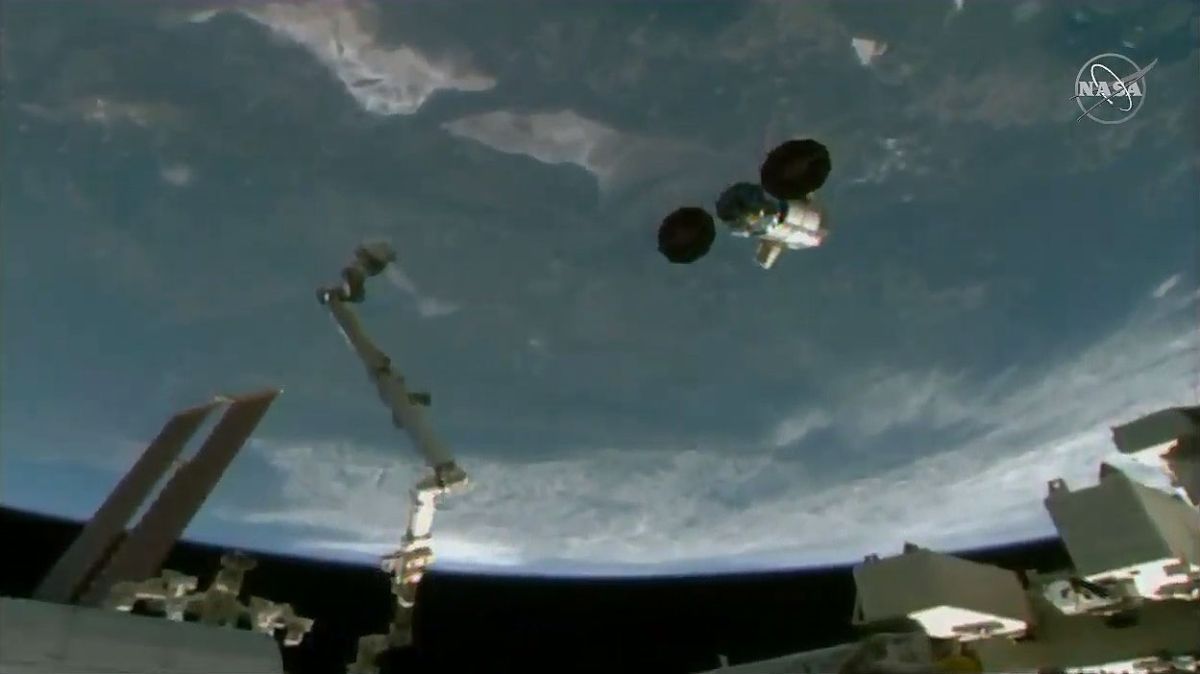
Northrop Grumman's Cygnus NG-12 cargo spacecraft moves away from the International Space Station after ground controllers in Houston used the station's Canadarm2 robotic arm to send it off. At the time of release, the station was flying about 250 miles (400 kilometers) over the South Pacific, just off the west coast of Chile.

Northrop Grumman’s Cygnus NG-12 cargo spacecraft moves away from the International Space Station after ground controllers in Houston used the station’s Canadarm2 robotic arm to send it off. At the time of release, the station was flying about 250 miles (400 kilometers) over the South Pacific, just off the west coast of Chile. (Image credit: NASA TV)

“I’d just like to say farewell to the S.S. Alan bean and thank you to the entire Cygnus NG-12 team for making Expedition 61 highly successful,” NASA astronaut and Expedition 61 flight engineer Andrew Morgan said during a live webcast of the spacecraft’s departure. He and his fellow Expedition 61 crewmember Jessica Meir provided backup support as ground controllers maneuvered the Cygnus away from the space station. 

While this isn’t the first Cygnus cargo vessel to embark on a secondary mission after leaving the space station — the NG-11 mission also took an extended detour on its way out in August — it was the first to test out a new release procedure. Typically astronauts on board the station manually operate the robotic arm to release these cargo vessels, but this time NASA tried a different method for the S.S. Alan Bean’s departure. 

“For this mission, Cygnus demonstrated a new release position for departure operations and incorporated the first ground-controlled release,” NASA officials wrote in the ISS blog. “The new orientation allowed for easier drift away from the station’s Canadarm2 robotic arm.”

The S.S. Alan bean drifts away from the International Space Station.

The S.S. Alan bean drifts away from the International Space Station. (Image credit: NASA TV)

During its remaining time in orbit, the S.S. Alan Bean “does have a secondary mission of deploying a number of small satellites to test different technologies — things like cameras, antennas, different communications technologies, solar cells, a number of different materials in the low Earth orbit environment,” NASA spokesman Dan Huot said during the webcast.

Some cubesats will deploy later this evening, with another batch deploying on Saturday (Feb. 1). Those cubesats include the University of Washington’s HuskySat-1, the University of Florida’s SwampSat II, Sonoma State University’s EdgeCube and Utah State University’s Compact Infrared Radiometer in Space (CIRiS) experiment.

Once the Cygnus capsule completes its secondary mission, it will burn up in the atmosphere along with 5,800 lbs. (2,600 kilograms) of disposable cargo, or trash, that the crew of Expedition 61 packed inside. 

The next Cygnus mission, NG-13 (also known as the S.S. Robert H. Lawrence) is scheduled to launch to the space station on Feb. 9. 

Email Hanneke Weitering at [email protected] or follow her @hannekescience. Follow us on Twitter @Spacedotcom and on Facebook.

All About Space Holiday 2019

Need more space? Subscribe to our sister title “All About Space” Magazine for the latest amazing news from the final frontier! (Image credit: All About Space)

usscmc

usscmc

No Result
View All Result

Recent Posts

  • How Hapag Lloyd captured a major market share in the Container Shipping Industry in USA
  • Why USA’s East Coast is the Favorite Destination for Manufacturing Companies
  • How Trade Relations Between the USA and UK Improved After Keir Starmer Became Prime Minister
  • Tips and Tricks for Procurement Managers to Handle Their Supplier Woes
  • The Crazy Supply Chain of Walmart Spanning Across the Globe

Recent Comments

  • Top 5 Supply Chain Certifications that are in high demand | Top 5 Certifications on Top 5 Globally Recognized Supply Chain Certifications
  • 3 Best Procurement Certifications that are most valuable | Procurement Newz on Top 5 Globally Recognized Supply Chain Certifications

Archives

  • July 2024
  • June 2024
  • May 2024
  • April 2024
  • March 2024
  • February 2024
  • January 2024
  • December 2023
  • November 2023
  • October 2023
  • September 2023
  • August 2023
  • July 2023
  • June 2023
  • May 2023
  • April 2023
  • March 2023
  • February 2023
  • January 2023
  • December 2022
  • November 2022
  • October 2022
  • September 2022
  • August 2022
  • July 2022
  • June 2022
  • May 2022
  • April 2022
  • March 2022
  • February 2022
  • January 2022
  • December 2021
  • November 2021
  • October 2021
  • September 2021
  • August 2021
  • July 2021
  • June 2021
  • May 2021
  • April 2021
  • March 2021
  • February 2021
  • January 2021
  • December 2020
  • November 2020
  • October 2020
  • September 2020
  • August 2020
  • July 2020
  • June 2020
  • May 2020
  • April 2020
  • March 2020
  • February 2020
  • January 2020
  • December 2019
  • November 2019
  • September 2019

Categories

  • Global News
  • Supply Chain Updates

Meta

  • Log in
  • Entries feed
  • Comments feed
  • WordPress.org
  • Antispam
  • Contact Us
  • Disclaimer
  • Home
  • Privacy Policy
  • Terms of Use

© 2025 www.usscmc.com

This website uses cookies to improve your experience. We'll assume you're ok with this, but you can opt-out if you wish. Cookie settingsACCEPT
Privacy & Cookies Policy

Privacy Overview

This website uses cookies to improve your experience while you navigate through the website. Out of these cookies, the cookies that are categorized as necessary are stored on your browser as they are essential for the working of basic functionalities of the website. We also use third-party cookies that help us analyze and understand how you use this website. These cookies will be stored in your browser only with your consent. You also have the option to opt-out of these cookies. But opting out of some of these cookies may have an effect on your browsing experience.
Necessary
Always Enabled
Necessary cookies are absolutely essential for the website to function properly. This category only includes cookies that ensures basic functionalities and security features of the website. These cookies do not store any personal information.
Non-necessary
Any cookies that may not be particularly necessary for the website to function and is used specifically to collect user personal data via analytics, ads, other embedded contents are termed as non-necessary cookies. It is mandatory to procure user consent prior to running these cookies on your website.
SAVE & ACCEPT
No Result
View All Result
  • Home
  • Supply Chain Updates
  • Global News
  • Contact Us

© 2025 www.usscmc.com