

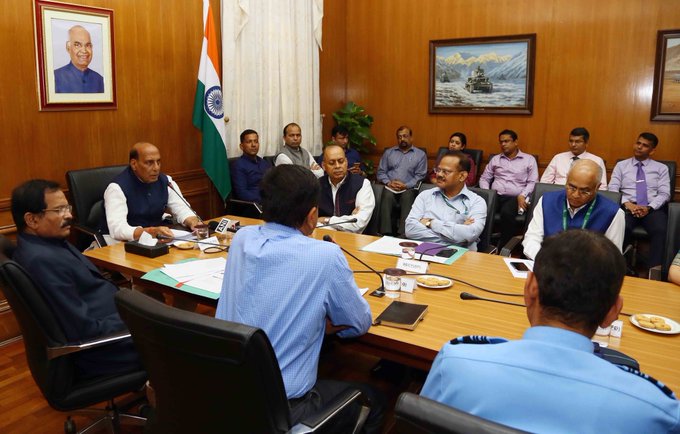


New Delhi: Raksha Mantri Rajnath Singh today unveiled the draft Defence Procurement Procedure (DPP) 2020 that aims at further increasing indigenous manufacturing and reducing timelines for procurement of defence equipment.
These and several other such innovative measures were part the Draft finalized by a high-level committee headed by DG Acquisition, Ministry of Defence that was set up in August 2019.
Boost to ‘Make in India’
Speaking on the occasion, Raksha Mantri said, “Our aim is to make India self-reliant and a global manufacturing hub. The government is constantly striving to formulate policies to empower the private industry including MSMEs in order to develop the eco-system for indigenous defence production. The defence industry of India is a strategically important sector having huge potential for growth. It needs to be the catalyst for India’s economic growth and realisation of our global ambitions.”
Shri Rajnath Singh added, “With the experience gained by the industry and the Ministry of Defence (MoD), it is now time to take further steps to strengthen ‘Make in India’ initiative, refine Life Cycle Support of procured equipment & platforms and hasten the defence acquisition process by further simplifying the procedures & reducing the overall procurement timelines.”
The major changes proposed in the new DPP are:
Indigenous Content ratio hiked
In view of the experience gained by the domestic industry, the Draft proposes increasing the Indigenous Content (IC) stipulated in various categories of procurement by about 10% to support the ‘Make in India’ initiative. A simple and realistic methodology has been incorporated for verification of indigenous content for the first time.
Use of raw materials, special alloys and software incentivised as use of indigenous raw material is a very important aspect of ‘Make in India’ and Indian Companies are world leaders in software.
Assurance of procurement on a single vendor basis from Aero Engine manufacturing unit and chips from FAB manufacturing units established in the country.
New Category Buy (Global – Manufacture in India) has been introduced with minimum 50% indigenous content on cost basis of total contract value. Only the minimum necessary will be bought from abroad while the balance quantities will be manufactured in India. This would be in preference to the ‘Buy Global’ category as manufacturing will happen in India and jobs will be created in the country.
Leasing introduced as a new category
Leasing has been introduced as a new category for acquisition in addition to existing ‘Buy’ & ‘Make’ categories to substitute huge initial capital outlays with periodical rental payments. Leasing is permitted under two categories i.e, Lease (Indian) where Lessor is an Indian entity and is the owner of the assets and Lease (Global) where Lessor is a Global entity. This will be useful for military equipment not used in actual warfare like transport fleets, trainers, simulators, etc.
A new Chapter is introduced for procurement of software and systems related projects as in such projects, obsolescence is very fast due to rapid changes in technology and flexibility in the procurement process is required to keep up with the technology.
A new Chapter is introduced for Post Contract Management to facilitate and provide clear guidelines for issues arising during the contract period as typically Defence contracts last for a long period.
Timelines for procurement reduced by reducing the process for accord of Acceptance of Necessity which would be single stage of projects less than Rs.500 crore and in case of repeat orders. Trial methodology and Quality Assurance Plan to be part of RFP.
Field Evaluation Trials to be conducted by specialised trial wings and the objective of trials will be to nurture competition rather than elimination for minor deficiencies.
A comprehensive Chapter introduced for ‘Make’ to cover procurement from manufacturers in India including start-ups and innovators and from research projects of DRDO.
Product support
The scope and options for Product Support have been widened to include contemporary concepts in vogue, namely Performance Based Logistics (PBL), Life Cycle Support Contract (LCSC), Comprehensive Maintenance Contract (CMC), etc to optimise life cycle support for equipment. The capital acquisition contract would normally also include support for five years beyond the warranty period.
The draft of DPP 2020 has been prepared by a Review Committee headed by Director General (Acquisition) based on the recommendations of all stakeholders, including private industry. In order to accrue advantage of domain specialisation of various subject matter experts, eight sub-committees headed by Lt Gen/equivalent officers were constituted to assist the review committee. These committees carried out extensive deliberations and interactions over a period of six months to formulate their respective charters. The draft has now been uploaded on the Ministry of Defence (MoD) website (https://mod.gov.in/dod/defence-procurement-procedure) for further suggestions from all stakeholders by 17th April 2020.
The first DPP was promulgated in 2002 and has since been revised a number of times to provide impetus to the growing domestic industry and achieve enhanced self-reliance in defence manufacturing.
Defence Secretary Dr Ajay Kumar and Director General (Acquisition) Shri Apurva Chandra also addressed the gathering on the salient features of Draft DPP. Raksha Rajya Mantri Shri Shripad Naik, Secretary (Defence Production) Shri Raj Kumar and other senior civil and military officials who were part of the sub-committees which drafted the Draft DPP 2020 were present on the occasion.
Modified offset guidelines proposed to give emphasis on export of products rather than components. Higher multipliers proposed for procurement from MSMEs and units established in Defence Industrial Corridors. Higher multipliers proposed for Transfer of Technology to private Companies / DPSUs / OFB and DRDO.
Recent Comments