

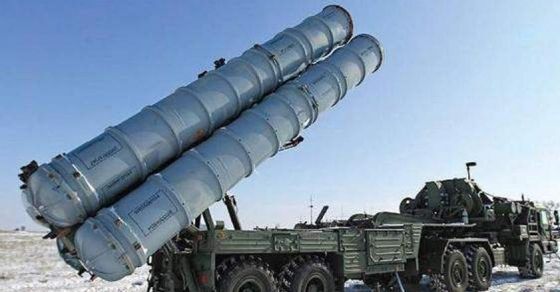

The Russian-made S-400 surface-to-air missile defence system.  |  Photo Credit: PTI
Key Highlights
- The S-400 is widely recognised as the most dangerous and sophisticated surface-to-air missile system in the world – and more advanced than the US’ Terminal High Altitude Area Defense system (THAAD)
- The ‘Countering America’s Adversaries Through Sanctions Act’ or CAATSA is specifically designed to deter the United States’ partners from engaging in significant defence-related transactions with Russia, Iran and North Korea
- Officials from the Trump administration have previously cautioned India that it could attract sanctions of its own if it proceeded with the procurement of the air defence system
India’s agreement with Russia to purchase the latter’s S-400 air defence system could “trigger US sanctions” according to a report published by the Congressional Research Service (CRS) – an independent and bipartisan research branch of the US Congress. The CRS report presented to Congress lawmakers to better inform policymaking decisions has noted that “India’s multi-billion dollar deal to purchase the Russian-made S-40 air defence system may trigger US sanctions on India under the Countering America’s Adversaries Through Sanctions Act (CAATSA).”
However, it is important to note that CRS’ reports do not amount to official US Congress reports and are not necessarily indicative of the views of US lawmakers.
In October 2018, India inked a deal with Russia to buy five units of the S-400 defence missile system following a spell of negotiations that can be traced back to 2015. Also known as the Triumf missile system, the S-400 is widely recognised as the most dangerous and sophisticated surface-to-air missile system in the world – and more advanced than the US’ Terminal High Altitude Area Defense system (THAAD).
Capable of tracking roughly 100 airborne targets simultaneously, the system can engage a variety of aerial targets including unmanned aerial vehicles (UAVs), enemy aircraft and ballistic and cruise missiles with a range of up to 400km and at altitudes of up to 30km.
What is CAATSA and how does it apply to India?
Around the same time as the Indo-Russian deal, the US also enacted a new law called ‘Countering America’s Adversaries Through Sanctions Act’ or CAATSA specifically designed to deter the United States’ partners from engaging in significant defence-related transactions with Russia, Iran and North Korea. Since then, CAATSA has already been invoked on two occasions, both, coincidentally, involving the S-400 system.
In September 2018, the US State Department and Treasury Department announced sanctions on China’s Equipment Development Department (EDD) – the arm responsible for defence procurement. Later, following the delivery of the S-400 system to Turkey, the US ejected its NATO ally from its F-35 fighter jet procurement programme while maintaining that the move may be reversed if Turkey backtracked on its deal with Russia.
Officials from the Trump administration have previously cautioned India that it could attract sanctions of its own if it proceeded with the procurement of the air defence system. However, India has repudiated these warnings with External Affairs Minister S Jaishankar saying in October 2019, “We would not like any state to tell us what to buy or not to buy from Russia any more than we would like any state to tell us what to buy or not buy from America.”
Under CAATSA, the US could impose, at least, five of twelve sanctions if the deal reached completion including export sanctions, loan cancellations from either the US or international bodies, restrictions on investment and procurement, visa and travel bans, and foreign exchange caps. However, according to some reports, there remains a possibility that the US may choose to grant a CAATSA waiver to India under a presumption that it remains a key strategic partner in the Indo-Pacific region.
New Delhi enjoys strong bilateral relations with both Washington and Moscow. Russia has also historically been India’s largest defence partner. However, while it has remained India’s top arms supplier, the period between 2010 and 2017 saw its share in India’s defence imports fall from a record high of 74 per cent (in the 2000s) to 68 per cent.
Meanwhile, India’s defence imports from the US have been steadily rising. As per SIPRI data, during the period between 2000-2009 and 2010-2017, US arms imports into India increased by a staggering 1470 per cent.
Taking cognisance of this, Russian President Vladimir Putin and Prime Minister Narendra Modi participated in a ‘reset’ summit in Sochi in May 2018. Only months later, when the Russian president visited New Delhi, the S-400 deal was announced.
Recent Comments