



ILLUSTRATION: KATTY HUERTAS
With 2020 finally behind us, we can begin to think about how the historic events that took place will be understood in years to come. To do so, we asked young scientists this question: What new word or phrase would you add to the dictionary to help scientists explain the events of 2020 to future generations? Read a selection of the best responses below. Follow NextGen Voices on Twitter with hashtag #NextGenSci. Read previous NextGen Voices survey results at https://science.sciencemag.org/collection/nextgen-voices.
2020’d (adjective)
When all of the even slightly negative events in a situation suddenly amplify in magnitude to truly horrendous proportions (e.g., police brutality, political corruption, science skepticism, conspiracy theories, political division). “We are going to need an immediate extraction—things got 2020’d over here.”
John Protzko Department of Psychological & Brain Sciences, University of California, Santa Barbara, CA 93106, USA. Twitter: @JProtzko
Algorithmic assurance (noun)
The ability of advanced algorithms to detect and reinforce a person’s beliefs in a way that encourages increasingly extremist views. “John did not start out this way, but the algorithmic assurance pushed him further and further until he denied everything from the Moon landing to the existence of the color red.”
Isaac Z. Tanner Vagelos Molecular Life Science Program, University of Pennsylvania, Philadelphia, PA 19104, USA. Email: itanner{at}sas.upenn.edu
Biopartisan (adjective)
Of or related to political bias in the interpretation of scientific matters. “In 2020, wearing a face mask to protect against COVID-19 became a biopartisan issue.”
Morgan Daly Dedyo Vagelos Molecular Life Sciences Program, University of Pennsylvania, Philadelphia, PA 19104, USA. Email: ddedyo{at}sas.upenn.edu
Chaoticatempus (noun)
A state of overwhelming, but transient, chaos. “The promising mRNA vaccine results marked the beginning of the end of the chaoticatempus, also known as the year 2020.” Origin: Doctor Chaotica (a Star Trek Voyager character bent on galactic domination and destruction) and Latin tempus (time).
JiaJia Fu Whittle School and Studios, Washington, DC 20008, USA. Email: jjnaturalist{at}gmail.com
Cryptoshock (noun)
A hidden surprise; unexpected benefits that arise from adversity. “It’s a cryptoshock that there are multiple effective SARS-CoV-2 vaccines so soon after identifying the virus.”
Bhavya Perma Vagelos Molecular Life Science Program, University of Pennsylvania, Philadelphia, PA 19104, USA. Email: bperma23{at}sas.upenn.edu
Disinforge (verb)
To create information intended to deceive (e.g., related to health, polling, or demographics). “This video looks realistic but is actually a deep fake that was disinforged by a team of experts in order to influence the election.” Origin: English disinformation and forge.
Daniel Ari Friedman Department of Entomology & Nematology, University of California, Davis, Davis, CA 95616, USA. Email: DanielAriFriedman{at}gmail.com
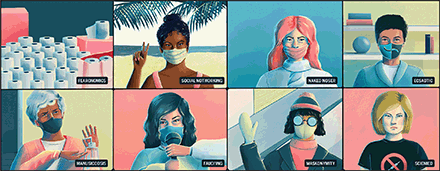
Ecsadtic (adjective)
Rushes of extreme happiness and ecstasy alternating with absolute sadness, causing emotional exhaustion. “When I think about how my family is healthy and my work goals are complete but also how people are suffering from a pandemic and savage fires are consuming our environment, I feel ecsadtic.”
Ada Gabriela Blidner Laboratory of Immunopathology, Institute of Biology and Experimental Medicine–CONICET, C1428 ADN, Buenos Aires, Argentina. Email: adablidner{at}gmail.com
Fauci’ing (verb)
To immediately amend or correct statements made by authority figures who misrepresent or overstate findings. “The graduate student was Fauci’ing at the podium, shoving aside the principal investigator to accurately explain the implications of the results they obtained.”
Juliet Tegan Johnston Department of Physical and Life Sciences, Lawrence Livermore National Lab, Livermore, CA 94550, USA. Twitter @queermsfrizzle
Fearonomics (noun)
A modern business strategy in which products and services are made available to the masses on the basis of the fears and emotions prevalent in the society. “Adopting a fearonomics business model, the company generated revenue by marketing panaceas geared toward taking advantage of the consumers’ fears of falling victim to the pandemic.”
Anant Kumar Srivastava Asia-Pacific Institute of Management, Jasola Vihar, New Delhi, Delhi 110025, India. Email: anantsrivastava74{at}gmail.com
Home-o-static slowficiency (noun)
The ability to work efficiently while attempting to maintain homeostasis under mandatory confinement at home. “In 2020, Fiona was a model of home-o-static slowficiency, publishing five papers and submitting a successful grant application despite her struggle to maintain balance amidst constant lockdowns.”
Roland Ruscher and Andreas Kupz Australian Institute of Tropical Health and Medicine, James Cook University, Cairns/Smithfield, QLD 4878, Australia. Email: roland.ruscher{at}jcu.edu.au; andreas.kupz{at}jcu.edu.au
Kyrosearch (noun)
The sudden pivot many industries, academics, and government scientists made to confront the pandemic. “Although we’d written grant applications to study broadband network signals, COVID-influenced kyrosearch changed our lab’s focus: We now develop public health interventions using mobile apps.” Origin: Greek kairos (opportunity) and English research, with spelling reminiscent of Greek kyrie eleison (a call for merciful acts).
Michael A. Tarselli TetraScience, Boston, MA 02108, USA. Email: mtarselli{at}tetrascience.com
Manusiccosis (noun)
A condition resulting from frequent hand washing and sanitizing, where the hand becomes irritated, dry, and cracked. “During the COVID pandemic, people developed manusiccosis from repeatedly washing their hands in an effort to stem the spread of the virus.” Origin: Latin manus (hands), siccum (dry), and –osis, (suffix denoting a process or condition).
Felicia Beardsley Department of Anthropology, University of La Verne, La Verne, CA 91750, USA. Email: fbeardsley{at}laverne.edu
Maskonymity (noun)
The inability to recognize the identity or emotions of other people in public places due to the obfuscation of facial features (e.g., by a mask). “Maskonymity makes some people feel isolated but gives others the freedom to pretend they don’t recognize an overly chatty neighbor.”
Mark Martin Jensen Department of Surgery, Massachusetts General Hospital, Harvard Medical School, Boston, MA 02114, USA. Twitter: @mmjensen3
Naked noser (noun)
1. A person who wears a mask but leaves their nose uncovered. 2. A person who doesn’t believe in science but is forced (by society or law) to act in accordance with scientific findings. “I wanted to take the subway, but it was full of naked nosers, so I went on foot instead.”
Nikos Konstantinides Department of Biology, New York University, New York, NY 11105, USA. Twitter: @nkonst4
Nehatha (noun)
A state of feeling drained of energy to the point of absolute numbness and apathy. “Frontline workers emerged as the nation’s heroes, but some struggled through the pandemic, their isolation and grueling work forcing them into nehatha.” Antonym: Sanskrit hatha (force).
Divyansh Agarwal Department of Genomics and Computational Biology, University of Pennsylvania Perelman School of Medicine, Philadelphia, PA 19104, USA. Twitter: @divyansh_aga
Omnidaaichism (noun)
A universal deterioration or collapse. “Instead of kicking off the new decade with productivity and prosperity, 2020 revealed itself to be an omnidaaichism of our social, political, environmental, and health domains.” Origin: Latin omnis (all) and Igbo daa iche (fall apart).
Julia Yuen Vagelos Molecular Life Science Program, University of Pennsylvania, Philadelphia, PA 19104, USA. Email: yuenj{at}sas.upenn.edu
Pragmaticalopia (noun)
An inability to see, perceive, or accept facts. “2020 was marked by an increased distrust in science as part of a universal affliction of pragmaticalopia among the denizens of Planet Earth.” Origin: Greek pragmatiká (facts), and suffix –opia (denoting a visual disorder).
Suchitra D. Gopinath Pediatric Biology Center, Translational Health Science and Technology Institute, NCR Biotech Science Cluster, Faridabad, Haryana, 121001, India. Email: sgopinath{at}thsti.res.in
Researchance (noun)
The process of raising and restoring public confidence in the scientific community, its evidence-based recommendations, and its commitment to improving humanity and the world. “During the COVID-19 pandemic, misinformation, skepticism, and fatigue related to public health measures surged, so the scientific community worked toward researchance through outreach, partnership, and education.” Homophone: resurgence.
Michael Tran Duong Perelman School of Medicine, University of Pennsylvania, Philadelphia, PA 19104, USA. Email: mduong{at}sas.upenn.edu
Scienied (adjective)
Of or related to denying scientific evidence. Pronounced, peddled, and guzzled like cyanide. Embraced by anti-maskers and anti-vaxxers. Particularly toxic when mixed with mental delusion and intentional confusion. “Scienied lies let innocents die.”
Michael Strong Center for Genes, Environment, and Health, University of Colorado, Anschutz Medical Campus, National Jewish Health, Denver, CO 80206, USA. Email: strongm{at}njhealth.org
Scifireal (adjective)
Of or related to science fiction becoming reality in an extremely short period (e.g., 1 year). “All the planes grounded, people wearing masks on the streets, people dying because of lack of medical staff and equipment, vaccines developed in just 9 months—it all felt terrifyingly scifireal.”
Matúš Soták Department of Molecular and Clinical Medicine, Wallenberg Laboratory, Börgeson Lab, Institute of Medicine, University of Gothenburg, Göteborg 41345, Sweden. Twitter: @biomatushiq

ILLUSTRATION: KATTY HUERTAS
Social notworking (verb)
When someone can’t do their job remotely but can afford to spend the pandemic traveling and posting on social media. “Ugh, don’t you hate having a cousin who has spent the entire summer social notworking when you’re trying to balance your job and homeschooling your kids?”
Katie Burnette Department of Evolution, Ecology, and Organismal Biology, University of California, Riverside, Riverside, CA 92521, USA. Email: katiec{at}ucr.edu
Tourbivalence (noun)
Uncertain and contradictory feelings about the impact of COVID-19 on a region’s tourism industry. “Throughout 2020, tourbivalence resulted in frequent debates between Venetians earning a fraction of their normal wages and those enjoying the peace and beauty of the empty Italian city.” Origin: English tourism and ambivalence.
Samuel Nathan Kirshner School of Information Systems and Technology Management, University of New South Wales, Kensington Campus, Sydney, NSW 2052, Australia. Email: s.kirshner{at}unsw.edu.au
Trustbot (noun)
A human fact-checker who works behind the scenes to protect online communities from malicious automated attacks and misleading content. “She is working fewer hours during the COVID-19 lockdown, so to make some extra money she took a part-time job as a trustbot for a popular social networking platform.”
Athanasia Nikolaou Department of Physics, Sapienza University of Rome, Rome, Italy. Email: athanasia.nikolaou{at}protonmail.com
Virutopia (noun)
A city with a population that, to prevent the spread of a deadly virus, turns to an ascetic lifestyle in which people buy only what they need, respect each other, work from home, and reduce their personal contact and entertainment activities. “Life is short in a virutopia, so people live honestly and care for each other.”
Basant A. Ali Energy Material Laboratory, The American University in Cairo, New Cairo, Egypt. Email: basantali{at}aucegypt.edu
Zeityrõ (noun)
The collective will to take action to solve a problem, precipitated by a sequence of negative events that promotes profound changes in the accepted way of life. “The extreme weather events, fires, and threats to biodiversity in 2020 led to the zeityrõ that allowed people to work together to combat climate change.” Origin: German zeitgeist (spirit of the times) and Old Tupi—an Indigenous language of South America—motyrõ (the union of efforts for the common good).
Benedito Alves de Oliveira Júnior Department of Neuroscience and Behavioral Sciences, Ribeirão Preto Medical School, University of São Paulo, Ribeirão Preto, SP 14049–900, Brazil. Email: benedito.oliveira{at}usp.br
Zoomdemic (noun)
The proliferation of online meetings via the Zoom platform during mandated work-from-home conditions. “Walking on the beach, with the phone off, I finally escape the Zoomdemic and see real people.”
Elvira Sojli School of Banking and Finance, University of New South Wales, Sydney, NSW 2052, Australia. Twitter: @esojli
Recent Comments