


-
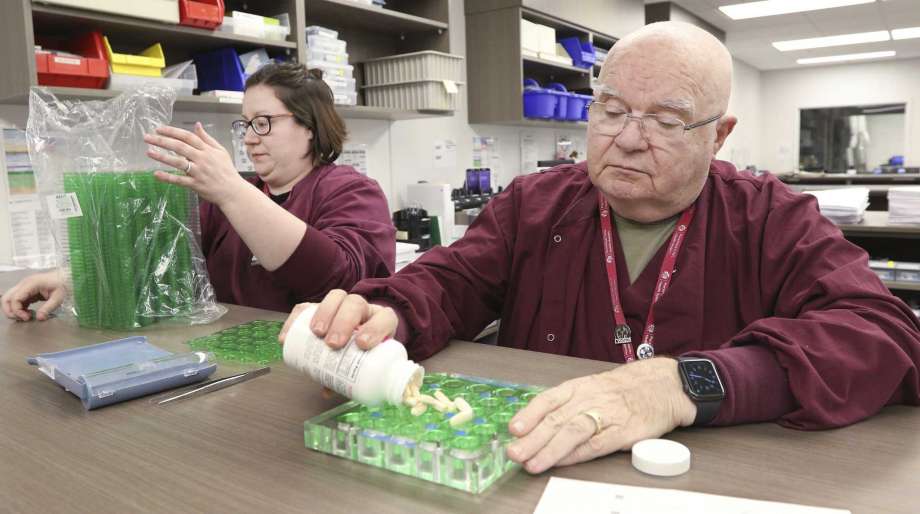 This photo taken Jan. 2, 2020, shows Marshfield Clinic Health System pharmacy technicians Bonnie Kochendorfer, 36, left, and Clark Sheerar, 76, working alongside each other to prepare medication used in the hospital and outpatient clinic on southwest side of Eau Claire, Wis. (Dan Reiland/The Eau Claire Leader-Telegram via AP) lessThis photo taken Jan. 2, 2020, shows Marshfield Clinic Health System pharmacy technicians Bonnie Kochendorfer, 36, left, and Clark Sheerar, 76, working alongside each other to prepare medication used in the … more
Photo: Dan Reiland, AP


Photo: Dan Reiland, AP
EAU CLAIRE, Wis. (AP) — Working side-by-side and wearing matching maroon scrubs, Bonnie Kochendorfer and Clark Sheerar are among the pharmacy technicians that fill prescriptions needed by patients at Marshfield Clinic Health System’s Eau Claire Center.
Though separated in age by four decades, the pair who work in the bright, immaculate room in the lower level of the area’s newest hospital have found their styles and experience complement each other.
Kochendorfer, 36, is a bit more adept at using technology in the pharmacy, but relies on Sheerar’s experience when she has questions about medications.
“I can do the computer stuff better, but that’s my guy when I need to know what something does,” Kochendorfer said.
Sheerar, 76, appreciates his co-worker’s work ethic and ability to help handle the workload when orders begin rushing in.
“She’s dependable,” Sheerar said. “If I need help, have a lot to do, she’s there and she does a good job.”
The duo are an example of an increasingly age-diverse workforce that now spans five distinct generations, a result of older workers putting off retirement to maintain their income and keep busy, the Leader-Telegram reported.
Sheerar is in the age group known as “traditionalists” or the “silent generation” — the one that preceded the baby boomers. Kochendorfer is a millennial — the group that falls between Generation X and Generation Z, the latter of which is just now entering the professional job market.
Shaped by many factors including historical events, technology and social norms of their earlier years, each generation is slightly different. Their ideas of good employee benefits and working environments also can differ in part due to their age.
“The reason why we’re talking about it now is the dependence on millennials in the workplace,” said Dan Lytle, who has delivered dozens of presentations in the Chippewa Valley on challenges of a multigenerational workforce.
Changing picture
The majority of the workforce is split between baby boomers and millennials, with the latter’s share gaining as more people in the former generation get into their mid-60s and start taking Social Security. (Between the two is Generation X, but Lytle noted those people were from decades where birth rates were lower and now make up a smaller portion of the workforce.)
Senior citizens from the “silent era” aka “traditionalists” have represented a shift in employment though they represent only about 5% of working Americans. The numbers of high school and college students working has been dropping, Lytle said, with retired people supplanting a portion of those part-time workers.
“They were there, they stepped out and because people are living longer they’re going back into the workforce again,” Lytle said of traditionalists.
For Sheerar, working as a pharmacy technician was his third career after he’d been an educator and school administrator at rural schools in western Wisconsin.
“You have to keep busy,” he said.
He entered the field in 2013 and his co-worker, Kochendorfer, became a pharmacy technician in late 2018 to switch jobs from her previous job of working at a chiropractor’s office.
Whereas Sheerar and Kochendorfer work well together, Lytle has met with other businesses where expectations between different generations have caused friction.
Different productivity ideas
Lytle, who led the Eau Claire County Job Center before his current role as CVTC’s business development manager and head of the college’s Menomonie campus, said younger workers tend to question the usual way of doing things in the workplace.
“The old mantra of ‘This is the way we’ve always done it’ — there are a lot of challenges to that now,” he said. “That’s where the majority of conflict is.”
Younger workers who want to instill and implement their own ideas for processes to reach the desired outcome can clash with the ways of tenured, long-term workers.
His suggestion to employers is to focus on the outcome and be flexible in what it takes to get there.
For example, an area hospital had trouble keeping medical assistants and sought his advice to improve employee retention. When probing the problem, Lytle found that management would chastise those workers when they’d bunch up and talk as it was viewed as social time and not productive. However, Lytle noted that despite the group chats, the medical assistants were still getting their work done.
His suggestion to management was to create time when employees would be together, such as completing shift reports in a group. That would satisfy their desire to congregate, while also completing a task.
“Challenge your perception of what productivity is and looks like,” Lytle said.
Managers in office settings may feel like employers are only hard at work when they are glued to their desks at all 40 hours of the workweek. But Lytle argues that this idea of productivity is becoming outdated as employees in many fields can do their work remotely just as effectively as they could in the office.
Adopting outcome-based metrics is a more objective way to gauge productivity so a workplace can become more flexible to meet their employees’ preferred working methods.
Different ways of communication favored by each generation can also cause conflicts.
Older employees who are in management usually place a higher value on face-to-face communication as opposed to sending emails to employees, Lytle said. Meanwhile a younger worker may opt to send emails or text messages to someone just down the hallway.
While older employees may view the electronic communication as impersonal, Lytle said younger workers see the benefit of an email or text message creating written instructions that can be revisited so there’s no confusion or need to repeat them.
“Their engagement looks different than the previous generation’s engagement and that’s where a lot of problems lie,” Lytle said.
Benefits and values
After the economy lost jobs during the Great Recession, the ensuing economy recovery and retirement of older workers has led to a worker shortage. Companies hungry to fill their ranks are now trying to become known as an “employer of choice,” but that goes beyond simply offering good wages and benefits when others are competing for the same job candidates.
“They’re more interested in how do we improve morale and culture with the overarching goal of boosting retention,” Lytle said.
The local office of hiring firm Manpower highlighted the five generations working today in a July news release and advised employers on what they need to do to attract and retain workers.
“The main thing is to listen and be open-minded and flexible,” said Kim Peterson, market principal with Manpower, leading 27 counties in Wisconsin and Minnesota from her office in Eau Claire.
Different generations will have different ways to engage and motivate them, Peterson said.
Finding millennials to enjoy diversity in their work — learning different tasks, even if it just results in a lateral move in the same company — Manpower tries to satisfy their craving for variety.
“This new generation what’s engaging them is having something different to work on — adding onto their resume or portfolio,” Peterson said.
Keeping those employees interested in their work is one way to help retain them, she added.
“It’s quite different from the baby boomers for example who were more apt to work hard in their positions so their hard work would pay off and advance,” Peterson said.
Traits exhibited by different generations can also influence what employees are interested in when it comes to their benefits packages.
“The incoming workforce has a different value system,” Lytle said.
An extra week of vacation can be more valuable to a millennial than health insurance or even a raise, Lytle said, noting the generation’s desire for experiences like travel when compared to buying material things.
Not everyone believes that employees from different generations prefer certain benefits over others.
While she initially thought benefit preferences would vary by generation, Marshfield Clinic Health system director of talent acquisition Terri Newmier said many are universal.
“Employees of any generation appreciate PTO, work/life balance and flexible schedules,” she said.
The same goes for retirement plans and health insurance, Newmier added.
“They all consider those things when looking for a job opportunity,” she said.
Age is also not the determining factor that Newmier has seen in the ways that people shop for a new job. Like many other employers, Marshfield Clinic has shifted more toward online job postings while scaling back on print advertising and job fairs.
“We find the new types of candidates who respond to these new avenues aren’t from a specific generation, it’s more across the board,” Newmier said.
The next generation
The newest arrivals to the workforce — born after 1997 and dubbed Generation Z — are defined largely by having technology including computers and the Internet around them their entire lives.
Growing up in a world where communication and information are online and instantaneous, they’re apt to want things to move quickly and be interested in companies that have invested in digital technology, Peterson said.
Younger workers are adept at using social media and other online means to communicate.
“Connecting is probably their biggest strength,” Peterson said.
Aptitude with technology has been viewed as an asset, but Lytle notes that there are questions about this latest generation’s ability to communicate in a workplace without using an electronic device.
“Their ability to engage with folks is one of the biggest areas of scrutiny we hear about,” he said. One of the alternative monikers for this age group is the “ADD generation” due to the perception they have shorter attention spans.
Seeing opportunity
Though the age-diverse workforce can challenge employers to adapt to traits seen in the different generations, local experts say that will be outweighed by the advantages having workers of many different ages.
“There are a lot of opportunities to learn,” Peterson said.
Older generations bring their years of experience, ability to adapt to changes in their years and a well-developed work ethic, Peterson said. Younger workers bring fresh approaches to workplace tasks, as well as bringing creativity and an aptitude of technology into workplaces.
Despite challenges that can be posed by five distinct generations in the workplace, Lytle also believes it creates opportunity for employers.
“It’s a challenge, but it’s going to yield great outcomes if you give it a chance,” he said.
Recent Comments