



Dry bulk shipping — the world’s largest transport market by volume — has thrown in the towel on the first half of 2020.
The focus has instead turned to the second half, when prospects for freight rates are increasingly binary: either very strong or catastrophically weak.
During Tuesday’s quarterly conference call by dry bulk owner Golden Ocean (NASDAQ: GOGL), the company’s chief commercial officer, Thomas Semino, said, “Coronavirus is causing significant disruptions in trade flows. It is too early to forecast the potential impact beyond the short term, but it is unlikely that normal business operations will quickly resume.
“Many market observers expect a quick recovery in the second half of 2020. We would, of course, welcome this, but it’s simply too soon to tell,” Semino conceded.
Golden Ocean is among the largest dry bulk owners listed on Wall Street; its largest shareholder is famed shipping tycoon John Fredriksen. But despite its stature, it declined to conduct a question-and-answer session with analysts at the end of its call, something it hasn’t done before.
The upside scenario
The upside scenario is that the virus is contained in the coming months, China builds more infrastructure to stimulate its economy, and the country imports iron ore and coal for steel production at far above normal levels.
The Arrow Shipbroking Group wrote on Monday, “While the mainstream media focused on China’s latest plans to reduce taxes and interest rates, there are signs that preparations for a sizable stimulus are taking place behind the scenes. Local government special purpose bond (SPB) issuance hit a new record in January [714.8 billion Chinese yuan]. SPBs are used to fund infrastructure projects, and a sharp rise in new bonds suggests that Beijing is gearing up for another round of infrastructure investments to boost its economy.”
Breakwave Advisors, which created the Breakwave Dry Bulk Shipping ETF (NYSE: BDRY) to mimic the Baltic Dry Index with an exchange-traded fund, opined in a report on Tuesday, “If history is a guide, expect an impressive rally later this year. Given the severity of the decline, such a potential upturn could be significant … once conditions begin to improve in China.”
During a webinar on the coronavirus presented by Capital Link on Friday, Giovanni Ravano, co-CEO of shipping brokerage IFCHOR, said, “I definitely think the short-term disruptions will be compensated for by a catch-up effect. There will be opportunities for significant price action on the underlying commodities as well as on the dry bulk [earnings] results.”
Ravano believes there will be a drawdown of commodity stockpiles during the outbreak period, and once the outbreak is contained, those stockpiles would need to be replenished. “This will create shortages and a lot of volatility, which is good for traders,” he said.
There should also be fewer Capesizes (bulkers with capacity of around 180,000 deadweight tons) competing for business in the second half.
According to Semino, current rates “are extremely untenable for owners of older vessels. There were five Capesizes demolished in January, reports of five additional Capes scrapped in February and nine sold for scrapping in the next six months. The longer the weakness persists, the greater the likelihood that more will be scrapped.”
The downside scenario
The risk, of course, is that the coronavirus outbreak could continue for an extended period, into the second half or beyond, limiting the ability of China to pursue infrastructure stimulus and capping consumption. “The [dry bulk] recovery will be very much a function of how long the crisis lasts,” Ravano acknowledged. “If they don’t find a solution [soon], that is not good for the dry bulk complex.”
U.S-listed dry bulk companies like Golden Ocean are generally in better shape to weather the storm because they’ve spent the past decade bolstering their balance sheets and modernizing their fleets. That said, most of the world’s dry bulk fleet is privately held.
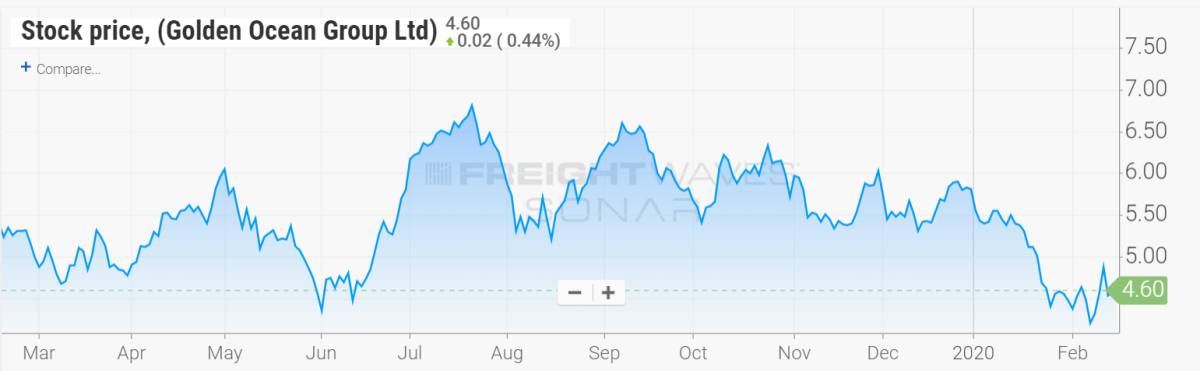
Even stronger public players like Golden Ocean face significant financial damage if the crisis continues for an extended period.
According to Clarksons Platou Securities shipping analyst Frode Mørkedal, Golden Ocean’s “cash buffer” of $163 million “will allow some breathing room for a while, but with cash breakeven at $13,800 per day for Capesizes, the market needs to pull higher during the second quarter to avoid a prolonged cash burn.”
Putting that cash burn in perspective, he estimated that based on current rates, Golden Ocean’s first-quarter EBITDA (earnings before interest, tax, depreciation and amortization) “could drop below $10 million versus interest payments of $13 million and debt repayments of $28 million.”
Not all dry bulk owners will be able to survive that kind of burn. In a client note last week, Stifel analyst Ben Nolan warned, “If the coronavirus puts continued pressure on dry bulk demand, there are some companies that may inch towards bankruptcy.”
At the Tradewinds Shipowners Forum New York event last Thursday, Scorpio Bulkers (NYSE: SALT) President Robert Bugbee said, “Very soon the game changes to: Which companies can survive?”
Golden Ocean quarterly results
Financial results announced by Golden Ocean do not reflect the current rate environment, which is near all-time lows.
Before the market open on Tuesday, Golden Ocean reported net income of $41 million for the fourth quarter of 2019 versus net income of $23.6 million in the fourth quarter of 2018. Adjusted earnings per share came in at 27 cents, better than the 23 cents per share that analysts expected.
According to Semino, “The strength of the market in the third quarter impacted our results in the fourth quarter, as a number of the strong fixtures [spot contracts] we concluded in the third quarter were for voyages that actually occurred in the fourth quarter.”
Golden Ocean achieved average rates of $21,668 per day in the fourth quarter of 2019. Clarksons Platou Securities estimates that Capesize rates are now just $2,500 per day.
Golden Ocean announced that it would be paying a cash dividend of 5 cents per share for the fourth quarter, a third of the 15-cents-per-share dividend in the third quarter but still equating a cash payout of $7.2 million.
A private owner facing the coronavirus threat might opt to preserve every cent for a cash buffer, but public companies face pressure to maintain payouts. Golden Ocean highlighted in its quarterly release that “it remains committed to returning value to its shareholders,” whereas Mørkedal noted, “Given the weak dry bulk outlook, we would not have been surprised if dividends had been cut to zero.” More FreightWaves/American Shipper articles by Greg Miller
Recent Comments