

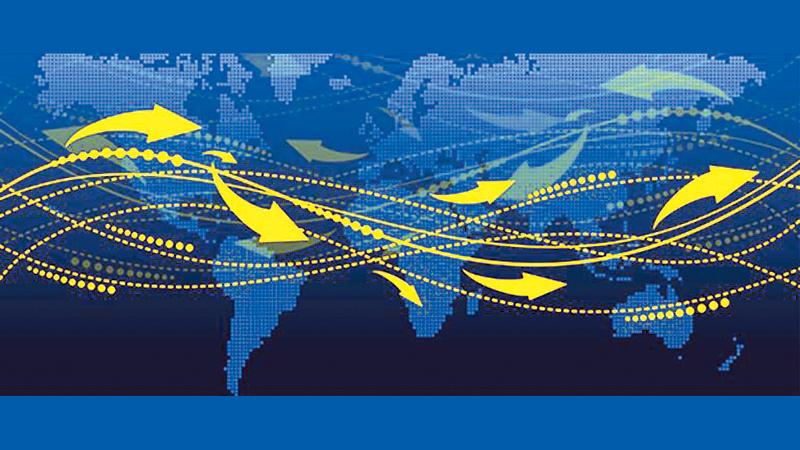

The Global Value Chain (GVC) will continue to enhance economic growth, create better job opportunities and shrink poverty in developing countries to a great extent.
In the 1990s, through international trade, global value chain benefits were experienced by poor countries and paved the path for their economic growth. Fragmentation of production was the key method in the concept, where a production process could be broken down to many subsections and could take place across other neighbouring countries.
In this process, raw material with value addition may cross the border of a country and reach another country for value addition, as semi-finished goods and be assembled as a final product for consumption. It is vital to address policy changes and enhancements by the authorities, to ensure continued participation in Global Value Chains.
Technological Developments taking place globally, containerisation and policy reforms are contributing immensely in reducing the cost of trade. Integration of China, Eastern Europe, North American Free Trade Agreement (NAFTA), setting up the World Trade Organisation in 1995 contributed enormously to develop international trade.
This situation provides great opportunities for developing economies to connect with industrial bases of developed economies, rather than trying to rebuild the entire industry from scratch.
Through the concept of product fragmentation, firms operating in developing economies, have access to foreign markets at a low cost, better productivity, improved management practices and provide better quality jobs, which would ensure fast growth in the economy.
Trade growth and global value chain formation has not reached the maximum potential since the financial crisis in 2008; the main reasons could be trading partners, such as Europe contributing one-fourth of global output and one-third of global trade, and China the second largest economy in the world could provide a better contribution to the same.
There are many ways that countries participate in the global value chain. Argentina, Ethiopia and Indonesia are engaged in simple manufacturing production chains but Algeria, Chile and Nigeria are engaged in exporting commodities and raw materials needed for production processes. India and the US produce services needed by complex production processes elsewhere, almost half of the world trade is considered to be taking place on global value chain transactions.
Few regions, some sectors, and some large multinational firms are efficaciously engaged in the global value chain. East Asia, Europe and North America are good examples and account for very large production capacities, in electronic, machinery and transport equipment manufacturing, well fragmented across countries.
These firms contribute over 80% to their total trade flows. The expansion of Value Chains is taking place regionally and globally. Europe is considered to be the most integrated region in this aspect. The North American situation is somewhat different having more global partnerships than regional. It is interesting to note that value chain partnerships are now becoming more global than regional.
Contributors to GVC development
With advanced development in Information and Communication Technology, manufacturing firms found it easy to contract out and organise much more complex activities far away, while ensuring excellence of a product. Lower transport costs, mainly declining air and sea freight costs also contributed positively to trade and Global Value Chain development.
Reliability and inexpensive cost of communication contributed vastly to develop the services sector. Trade and Investment liberalisation activities in developed and developing economies have a positive impact on reducing barriers of trade for goods and services.
Reducing non-tariff barriers also give trade a boost, but the expectations of the business community is still high, and much more needs to be done in this area. Facts such as the creation of the EU single market, China, India and Russia effectively integrating with the global economy, created huge labour and product markets.
The firms got the benefits of the Global Value Chain and addressed economies of scale issues while relocating their factories in cheap labour markets, maximising profits and finding better suppliers.
There are four ways that countries participate in the Global Value Chain: 1. Commodity production, 2. Limited manufacturing, 3. Advanced manufacturing and services, 4. Innovative activities.
As per the World Bank report, countries in the commodities group have a small share of manufacturing exports and limited backward Global Value Chain integration. Argentina, Armenia, Bosnia and Herzegovina, Cambodia, Costa Rica, Cyprus, El Salvador, Ethiopia, Indonesia, Kenya, Nepal, Serbia and South Africa had been in commodities and moved into limited manufacturing in the recent past. Jordan and Lesotho downgraded their status from limited manufacturing to commodities.
China, Estonia, India, Lithuania, Philippines, Poland, Portugal, Romania, Thailand and Turkey are in advanced manufacturing and services in Global Value chain Integration, having a high share of manufacturing and business services exports and with high backward Global Value Chain integration.
Austria, Canada, Finland, Ireland, Israel, Italy, Republic of Korea, Singapore and Spain made their moves to innovative activities. Intellectual property receipts as a percentage of GDP, Research and development concentration as a percentage of GDP are the measuring instruments of innovative activities.
As regions, East Asia, Europe and North America are engaged in advanced manufacturing and services and innovative activities, whereas Africa, Central Asia and Latin America are mostly in commodities and limited manufacturing.
Vietnam
Today, Vietnam is one of the best examples for Global Value Chain integration. Being the second largest smartphone exporter, Samsung produces 40% of its phones, and employs 35% (over 160,000) of its global staff in Vietnam. Other global players, such as LG, Canon, Panasonic, Foxconn, Intel and Microsoft also operate in Vietnam.
The geographical location of Vietnam which is an encouraging factor for Global Value Chain integration, especially being close to China, Japan, and Korea which are electronic component and parts suppliers.
 Vietnam attracted Foreign Direct Investments (FDIs), and acquired much needed capital, technology and management skills. Improvements in transport and communication infrastructure and making the logistics industry competitive leveraged it further.
Key policy level factors backing this development in Vietnam are, the World Trade Organisation’s Trade Facilitation Agreement, Agreement with the United States, Being a member of ASEAN (Southeast Asian Nations) and having many free trade agreements, EU bilateral trade agreement, making a total of 16 trade agreements.
With this background, Vietnamese exports are over 90% as a percentage of their GDP.
Bangladesh
Bangladesh can be considered as a good example of Global Value Chain participation. Apparel and footwear exports were about one percent of global demand in 1988. Since then the yearly growth they achieved was about 18 percent, and Bangladesh is the third largest exporter of apparel and footwear, having a 7 percent stake with China and Vietnam being the first and the second.
This sector contributes 89 percent of its total exports and 14 percent of GDP. This sector has 3.6 million workers of which 55 percent are women. In this background, the agriculture share of the GDP fell to 38 percent by 2018, from 70 percent in 1988. Extreme poverty levels also reduced from 44 percent to 15 percent in the period.
Through Global Value Chain participation, local firms shared technology with their business partners effectively. It is no longer necessary to master the entire production of an item. Through hyper-specialisation, countries can produce one or a few tasks of a final product, so that they could master a particular task maximising productivity and technology use. The facts confirm that within three years of linking with the Global Value Chain, an economy has the ability to increase per capita basis by 20 percent and offer better quality jobs.
Increasing market size
Domestic market size and limited local inputs are always a constraint for small countries. Negotiating trade liberalisation agreements with other economies may bring in a solution for this aspect. Import and export regulatory measures such as tariffs, quotas may limit the country’s ability to integrate with the global Value Chain at large. Cross Border activity efficiencies should be increased to the maximum level reducing the cost of import and export and time taken for such activities.
National Single Window
The National Single Window comes into the picture, in providing the facilities efficiently. The National Single Window, for foreign trade is a facility created using Information Technology and telecommunication platforms, initiated by a government to facilitate import, export and transit bureaucracies, by offering a single point for the submission of standardised information and documents, to fulfill official demands and facilitate logistics.
It handles all public and private administrative procedures in foreign trade. This single submission may be lodged through a single window for reuse across a range of government agencies, by trader organisations and even by people. The basic principles of single window are built on this single submission of data; hence, it may be reused by the system wherever required without additional data entry.
Single window attributes include a single point of payment, improved business processes in government agencies and speedier turn-around for approvals and decisions. It gives an opportunity for traders and their agents to connect with ministries of trade, agriculture, health, food security and finance and to electronically lodge licence applications and Customs declarations.
Information technology advancement and innovation has provided great benefits to international trade development. Automated Customs clearances, Port operations, import and export authority requirements completed much more effectively than before. In an increasingly globalised environment many economies needed a much more effective system than that automated Customs operations from the 1980s namely, Asycuda.
Many Single Windows were implemented in the world and “Doing Business Index”, for the first time in 2017, went to the extent of measuring effectiveness of the single window systems, through Trading Across Borders. It is considered as a system that receives trade related information and disseminates to the government authorities and many private sector stakeholders and individuals.
Taxation, challenging situation for GVC
Different tax systems in countries are creating challenging situations for Global Value Chain and product fragmentation, by adding to cost of production making the final product uncompetitive in the market. Countries are under pressure to keep corporate tax levels at a more competitive rate, and attract more Foreign Direct Investment and domestic investments, through Global Value Chain integration and fragmentation.
Lowering the cost of transportation and communication services as well as improving the quality of such services will have a positive impact on the economy. Many multinationals take serious decisions to relocate their production facilities based on these aspects. Policy consistency is also considered a sensitive factor for making business decisions.
Reference: World Bank Publications
The content of the article does not constitute any opinion of the institution / employer that the writer is connected to.
Recent Comments