


The forklift market has transformed in the last decade, but it has been far from painless. Telematics alone unleashed a torrent of data the industry is still trying to manage. Modern’s Lift Truck survey last year indicated one in five respondents felt their company’s adoption of fleet management software was “not very” or “not at all” successful, and more than half said it was merely “somewhat” successful. Coupled with competition and a tight labor market, the pressure to improve fleet efficiency has skyrocketed.
Forklift manufacturers used to turn within to innovate and develop new technologies, but there’s a growing trend of collaboration between forklift original equipment manufacturers (OEMs) and tech companies that’s creating faster and less expensive forklift innovation.
The continuing emergence of disruptive technologies, including automation borrowed from the automotive and automatic guided vehicle (AGV) sectors, has the potential to reshape how forklift operators work. Over time, technology has turned the lift truck into a sort of mini-computer, a technology-based unit in itself, says Steven LaFevers, vice president of emerging technology for Hyster.
“There’s also a speed-to-market element, like a technology arms race, as more start-up companies enter the market, some have proven to be a perfect fit for materials handling and forklifts,” LaFevers says. “Customers want us to be very quick to offer solutions around things like object detection and Big Data, which has ushered in a new age of increased diversity of internal development, partnerships and acquisitions.”
New forklift fundamentals
Amid the turmoil, a more sustainable vision for the role of forklifts has emerged. Enter the forklift platform as a service (PaaS). The concept involves designing lift trucks to easily interface with all sorts of hardware and software—including some that might not yet exist.
“Lift trucks are manufactured to last seven to 10 years; and in the tech space, that’s an eternity,” says John Rosenberger, director of iWarehouse Gateway and global telematics for The Raymond Corp. “If we make all interconnects look outward, not inward, then the lift truck can accept many different devices. Even though it may be only halfway through its life, it can quickly adopt new capabilities.”
For example, if the price drops for a higher-fidelity object detection sensor, just plug it in and go. Vincent Halma, president and CEO of KION North America, says cameras and the 3D processing technologies that use camera data are “a huge development,” but you can bet the best camera today will be obsolete in a year. It should therefore be simple to swap and upgrade going forward. Forklift manufacturers are even proactively embedding these types of sensors and componentry, which a customer might or might not ever use.
“We’ll be introducing a line of automation-ready products with sensors and hardware ready to be connected at some point to an open-platform interface,” Halma says. “This will help users leverage the latest technology today and make sure they’re ready to automate later, but not lock them into anything either.”
Rosenberger highlights similar efforts at his company. “That’s why it’s a platform as a service. You only pay for what you need,” Rosenberger says. “If an OEM can incorporate those elements so the base vehicle is not overpriced, the customer can turn on additional functionality at a later time, potentially even over the air.”
Rosenberger says suppliers of forklifts and suppliers of technologies that might apply to the forklift are concentrating on quicker and easier integration. This includes makers of battery chargers as well as fledgling automation specialists. The shared focus supports small companies’ desire to grow and forklift OEMs’ desire to respond to customers.
In addition to improved performance, upgradable forklifts could bolster efforts to attract and retain operators. Enhancing safety, ergonomics and productivity are always top priorities, but the labor crunch has added a new level of urgency.
“The intensity of the demand for new forklift technology is growing,” says Mick McCormick, director of robotics and automation for Yale Materials Handling Corp. “It’s not just historically low unemployment rates, it’s the ridiculously high turnover.”
McCormick cites a recent report from The Bureau of Labor Statistics showing that the 12-month turnover rate in the warehouse is 44%—and that’s the average. Manufacturing is a bit more stable, but still 32%. What’s more, the average cost to place a new employee is $4,200 (median $2,000), according to a Society for Human Resource Management report.
“Customers are highly motivated to move staff they have into high-value opportunities, and any time they can take easy tasks out and automate, they’re looking for it,” McCormick says.
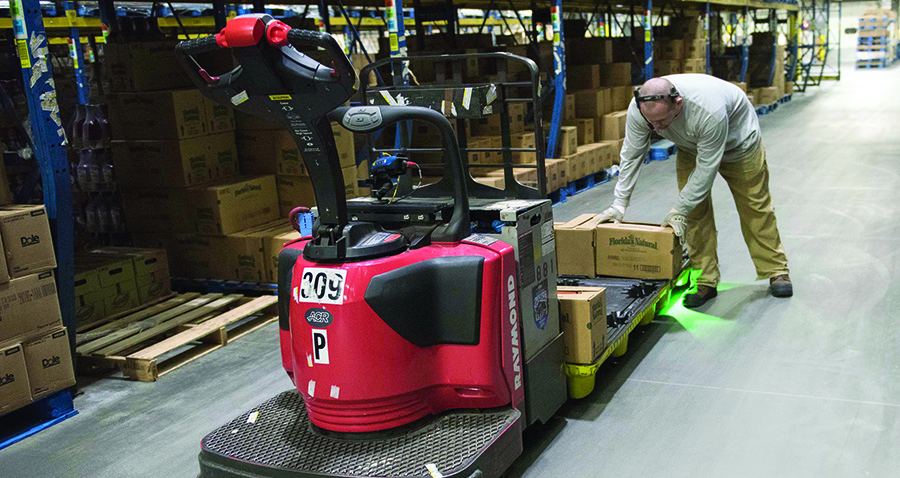
Many of the most promising automation technologies center around operator assistance, not replacement. Location tools can keep equipment in or out of a zone, change top speeds and acceleration in specific areas, or prevent accidents in a height-restricted aisle.
“However, the important thing is not those marginal improvements. It’s the ability to do the work without the operator being chained to the truck,” McCormick says. “That might mean fully robotic or a sort of a co-botic application where operators can dispatch equipment to another area once their job is completed.”
Success is not automatic
The spectrum of forklift automation ranges from fully autonomous pantograph reach trucks to simple fork-embedded lights that direct a picker to place items on the correct pallet. Somewhere in the middle are a collection of features like automatic emergency braking, real-time location systems (RTLS), remote control, and dual-mode equipment that can transition on the fly from autonomous to manual operation. Assuming some sort of telematics is used, McCormick says a pilot of any forklift automation can help a customer quickly identify the first few use cases.
“The lift truck fleet is a customer’s mobile data collection device and gives a 360-degree view of what’s happening in a facility. All other sensors are in one location and fixed in place,” McCormick says. “Unless for some reason they haven’t invested in telematics, merging that info with the totality of operational data will really allow them to isolate the best initial use cases for automating.”
As they go through the learning process, establish the needed infrastructure and continue to drive efficiencies, he says, the expansion of automation becomes easier and faster. Users can expand without experts from out of town flying in to do it. Obsolescence from hardware is almost nonexistent, McCormick adds, and any software obsolescence can be overcome.
Halma says data integration is a key objective. Right now, data tends to be separated by brand, he says, with isolated systems that don’t leverage all the data available. Customers want more data, Halma notes, and they want it presented in a way that’s more manageable. As a result, KION offers an asset management software product that can pull in data from different telematics systems—including non-forklift assets—and provide a central overview.
“Fast forward to how we will operate factories in the future. Forklift and material movement will be completely integrated,” Halma says. “Merging of data and control systems is the biggest efficiency improvement going forward. To create those products and services we will either partner with or acquire other providers. The materials handling piece that used to be a stand-alone part of the system will be integrated.”
KION’s enterprise asset management software solution can work with a customer’s enterprise resource planning (ERP) system to provide holistic visibility while empowering customers to make the best use of available data. Previously, OEMs’ fleet management and telematics portals tended to present insight based only on that OEM’s service data.
“By instead interfacing with the customer’s ERP and using the customer’s own data, it avoids questions of who owns the data and who can access it,” Halma says. “They can use their data and work with a third party if they want. The customer will not be bound to specific brands or whatever system they are already using.”
LaFevers also emphasizes the critical value of data, which he’s watched steadily evolve in two decades in the industry. “I remember being fascinated at the beginning when they told me a lift truck could collect 4,400 data points, and now it’s far more,” he says. This has resulted in an “incredible amount of focus” around application programming interfaces (APIs) to capture data and then make it useful to users. The easier and nimbler the API, the better the access to actionable information.
“It’s about thinking beyond raw sensor data to create insights that make sense and deliver a message,” LaFevers says. “We want that data to somehow be imbued with the 100 years of experience we’ve had with lift trucks.”
For example, if the system detects a power spike, historical knowledge can help quickly determine whether it’s an issue with a contactor tip or an issue with the battery.
“This is a fundamental change over the last decade or so,” LaFevers adds. “Everything was done through the lens of how a forklift can accomplish a job. Now, it’s how to also get the data to empower predictive decisions, ensure parts are on the shelves or in the van, and optimize productivity levels.”
This also fundamentally impacts the role of the dealer technician. McCormick cites widespread initiatives to leverage a base of thousands of technicians to, for example, accelerate the commissioning portion of a robotic system.
 “This elevates their job so they’re not viewed as just someone who keeps the fleet running, but someone in a mechatronics role capable of programming and commissioning,” McCormick says. “This has been a highly skilled, intensive role in the automatic guided vehicle and mobile robot industry, but with continued advances in artificial intelligence and self-learning algorithms, technicians can deal with unique, complex, unexpected environments rapidly and efficiently.”
For those customers overwhelmed at the prospect of applying recent evolutions in the materials handling industry, LaFevers offers some guidance.
“These solutions have to be directly aligned with your goals,” he says. “Some of these new solutions are fundamentally game-changing, so to traverse all these potential options you don’t just look at shiny options. Look at the back-end pieces, the support, the ability to change over time, and the risks of new technology. We’re going to have lots of these conversations, but the right questions are needed for comprehensive solutions.”
Recent Comments