

Two big announcements were made in the US political media this week, and the outcome of one will likely have a profound effect on the 2020 election. The New York Times announced the process and date for revealing which candidate it will endorse on the very crowded Democratic ticket, and Facebook reiterated its policies (or maybe lack of them) on political advertising.
Many things have happened since the 2016 election to both the press and technology companies, in terms of examining their respective roles in democracy. And while there have been plenty of laments that too little has changed in the intervening four years, the truth is that one thing – control of the media – has changed significantly.
If you want to find out what one of the house journals of the Democratic establishment thinks of the party’s candidates, mark your calendars for 19 January. The New York Times has been putting a thumb on the electoral scale since 1860, but this time its opinion desk is moving if not towards radical transparency, then at least towards a little reader-driven openness, by publishing transcripts of candidate interviews and offering some insight into its deliberations.
The antediluvian practice of a news organisation declaring for a candidate and party is a necessary ritual, not least for the news organisations themselves, and it has the benefit of stoking public conversation around the democratic process. Insofar as influence goes, though, it is more akin to a vicar saying daily prayers in an empty church. News organisation endorsements are not what win elections. What do win them are narrowly targeted ad campaigns, according to people who sell narrowly targeted ad campaigns.
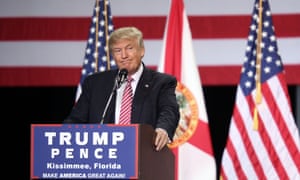
If one is to believe the internal communication to Facebook colleagues from executive Andrew Bosworth, which surfaced last week, the 2016 election was won not by the interference of Russian troll factories, or by the psychometric salesmen at Cambridge Analytica, but because Trump, in Bosworth’s words “ran the single best digital ad campaign I’ve ever seen from any advertiser”.
Given the Trump campaign spent heavily on Facebook and benefited from teams of Facebook employees embedded within the campaign, Bosworth might have substituted “he” for “we”. The rambling memo, which included a mishmash of insights from Lord of the Rings and the philosopher John Rawls, was a rather effective way of informally signalling how Facebook management was thinking about its role in elections ahead of 2020.
Bosworth started his missive by explaining why Facebook would not use its own tools and practices to decide the outcome of the next election, even if that meant the election of a lying candidate. Facebook will, it seems, only put its thumb on the scale for a candidate or campaign when paid to do so, as a vehicle for targeted advertising.
Bosworth’s memo provided an early smokescreen for an announcement later in the week that Facebook was holding fast to its policy of not fact-checking or removing untruthful statements in political advertising. For those concerned about the fairness of elections, this was a disappointing response. Even a very low bar for claims would be better than no bar and, much more importantly, an agreement to stop using the targeting methods which segment voters on an individual level would limit the vast opportunities to run dishonest campaigns.
It has always made commercial sense for Facebook to refuse to be the regulator for political advertising, for two key reasons. First, it doesn’t actually have the human capacity or skill to reliably check and remove untruthful campaign material.
And second, because some of its biggest and most powerful clients – political parties and governments – don’t want it to. On a broader principle, media companies should be setting their own standards for what is acceptable and ethical – but they should not be setting the rules for the rest of society.
In 2016, the Trump campaign ran 5.9m different advertisements in six months, compared with Hillary Clinton’s negligible 66,000, each one a subtle variant which can be created, tested and targeted. It is a system that cannot be effectively policed without either a change of business model or more stringent external regulation. The persuasion of societies happens through multivariate testing of different messages, whether buying bed sheets or elections.
We know a great deal more about the dynamics of how information and misinformation is deployed during elections than we did in 2016. Media gatekeepers, which are now principally companies like Facebook, Google, Twitter and Apple, are still struggling to develop both methods and organisational cultures that meet the role.
Those that have been losing control of gatekeeping over two decades, the news organisations, have bigger problems. In the past four years the media in the US and UK have learned what other parts of the world woke up to some time ago: namely, that politicians can be elected without ever engaging with the news media.
Presidents and prime ministers can succeed by telling lies and avoiding any accountability in terms of public scrutiny. This is a global phenomenon – Narendra Modi, India’s charismatic authoritarian leader, has never held a press conference. The White House press secretary has not held a briefing for half a year – not even in the last week, when the US has teetered on the brink of a war.
Politicians across the spectrum understand that there is little to be gained by subjecting themselves even to good faith questioning. When the Conservative government is reportedly considering no longer participating in a serious programme such as Newsnight because its new policy editor, Lewis Goodall, was active in student politics a long time ago, it is hoping to read the last rites over any type of difficult public questioning. Who would seek out this kind of scrutiny when they could just stick to their own accounts on social media?
What comes with it – the trolling, disinformation, virtual and real threats – only serve to remove the more fair-minded. Set against this trajectory, Facebook’s policy of applying less scrutiny to political advertising than other types looks more reckless than reasonable.
Even with the impossibility of policing, the reduction in revenue and likely evasion of any rules, it would be good to know that the new gatekeepers understand the importance of demonstrating their own values. If running the best dishonest digital campaign is the way to win, those responsible for enabling it are as much at fault as those who commission it.
Recent Comments