


Companies offering early-bird contracts at an all-inclusive rate
Early-bird contracts prices at nearly double last year’s
Some shippers putting contracts on hold, waiting for spot rates to fall
New Delhi —
After a year of soaring container rates and plunging availability, shippers are now trying to find the right strategy to approach long-term contract negotiations. Some are opting to go for early deals while others wait to see if spot rates cool off, leaving them in a better position to negotiate.
Not registered?
Receive daily email alerts, subscriber notes & personalize your experience.
Some carriers are even offering early-bird contracts, which may be signed at a higher price but will be inclusive of general rate increases (GRIs), peak season surcharges (PSSs) and space and equipment guaranteed, according to Peter Sundara, vice president of global freight management at LF Logistics.
Most of the early-bird contracts are being signed for shorter periods than usual.
“Some BCOs [beneficial cargo owners] have finalized their contracts with the carriers at $3,700/FEU for Los Angeles. This is nearly double last year. But this is not a yearly contract, this may be valid for only a quarter, not a year,” Dave Li, Chongqing branch manager at THI Logistics, said.
Locking in space and having stable rates is going to be key this year, according to Michael Gaulin, national sales manager at Laufer Group International.
“The rate level is secondary to these factors because over the past year the carriers fulfilled the MQC [minimum quantity commitment] early in the year and then carriers consequently started micromanaging the volume provided; and they more or less shifted to bi-monthly market rates; and later adding per shipment booking premiums for providing access to space and equipment. So, amid the volatility, every shipment is negotiated, even if the rates are set twice a month,” Gaulin said.
While those going for early-bird contracts expect container rates to remain elevated throughout 2021, there are some that believe rates may have peaked and are waiting to see if they come back down.
“Today we are at peak rate. If you are at the peak rate, in most market places, it’s not wise to sign a long-term commitment, typically,” said Michael Van Hagen, VP for sales and marketing at Laufer Group International. “And it’s not clear yet what carriers are willing to commit to in terms of allocations. So in my opinion, those who wait about four to six weeks, they wait until late March or early April, and wait until the Chinese New Year passes and we get a sense of how bad the supply demand imbalance really is, they may benefit because of that clarity.”
HOW PROMISING ARE TERM CONTRACTS?
Shippers may be trying to strike a perfect deal but the reliance on long-term deals is widely questioned.
The skepticism stems from the developments in 2020 where MQCs were not fulfilled and all the contracts were only on paper, sources said.
“No matter what contract is signed with the forwarder, carriers cannot live up to that contract. Because the market is such where terms and conditions will apply to a certain extent but when the situation changes, the contract is no longer valid,” a freight-forwarder based in Singapore said.
When nobody knows what’s going to happen in the market next, signing a contract, irrespective of the timing, is going to be worthless, the forwarder added.
SPOT RATES AT RECORD HIGHS
Container rates on Asia-Europe and Asia-North America trade lanes touched new highs this year amid acute container shortage, congestion at transshipment ports and widespread lock-downs.
Intra-Asia rates have also increased nearly four-fold since November, sources said.
On Feb. 23, Platts Container Rate 11 (PCR 11) — North Asia to UK — was assessed at $9,750 per forty foot equivalent unit (FEU), up from $2,000/FEU in October last year. PCR 5 — North Asia to East Coast North America — was at $5,300/FEU on Feb. 23, up from $4,650/FEU in September.
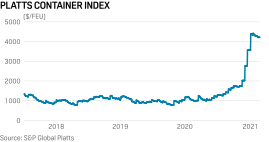
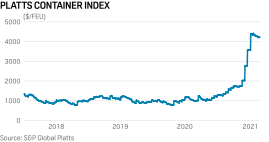
As of Feb. 23, Platts Container Index was at $4,226.32/FEU, up 154.2% from October.
US PORTS CRUCIAL TO SUPPLY CHAIN RECOVERY
With equipment shortages the primary factor behind the steep rise in prices, getting empties back into Asia remains a key factor in determining supply chain recovery.
“It will also be interesting to watch what’s going on in Southern California LA Long Beach, there’s about 35 ships still at anchor — that story is really a microcosm of what we’re seeing here in the United States. There are staff issues at the ports because of COVID,” Hagen said.
Whether dockworkers are prioritized for vaccinations, can they work through the congestion, does Chinese New Year really offer a respite in the trade so that we can kind of take a deep breath and get back to normal, these factors will really be crucial to watch-out for, he added.
Recent Comments