



FedEx (FDX) is a well-known name and the company has been written about extensively in the financial press, so I won’t dwell too much on the company’s description. The thesis is simple:
Due to its “operate independently” mantra, FedEx has a bloated and underutilized domestic Express network. Recent actions suggest that FedEx is in the early innings of integrating this network with its robust Ground infrastructure. Based on my estimates, this could drive 300-500 bps in margin improvement, equivalent to >$4bn in annual savings. This can double the company’s stock; a multiple re-rate provides even further upside.
By way of introduction, FedEx operates three segments: FedEx Express ($40bn revenues, 5.5% operating margin), FedEx Ground ($21bn in revenues, 13% operating margin) and FedEx Freight ($8bn in revenue, 8% operating margin). FedEx Express deals with domestic and international “Express”, or time-definite shipping, FedEx Ground deals with domestic/Canadian “day-definite” shipping and Freight is the largest less-than-truckload (NYSEARCA:LTL) freight forwarder in the U.S.
Why Two Networks?
To answer this question, we must travel back to 1998 when FedEx purchased Caliber Systems. Prior to the acquisition, Federal “Express” was pure-play in the fast-growing United States Express business. Caliber Systems represented its entry into the FedEx Ground and Freight businesses. UPS (UPS), on the other hand, grew its Ground and Freight businesses separately, and this is a key difference between the two companies. Whereas FedEx elected to keep its two networks separate, UPS chased economies of scale by integrating its operations into one “UPS Domestic” segment. Practically, this means that if you send two packages to an address to be delivered on the same day – one through Express and one through Ground – two FedEx trucks will arrive at the recipient’s address on delivery day (albeit two half-full trucks).
Given the scale advantages inherent in the logistics industry that I need not spend time mulling over, why didn’t FedEx integrate? Surely, it wasn’t incompetent leadership: Frederick Smith is well-revered and was CEO of the year in 2004. Perhaps the nature of the two operations are different: FedEx executives will tell you that the time-sensitive nature of Express packages requires a dedicated, separate network to service (Source: Author’s calls). However, this doesn’t explain how UPS is able to offer a similar quality service with integrated networks. Nor does it explain the fact that FedEx integrated its European Express operations with TNT Express, a recent acquisition that has an extensive Ground network in continental Europe. If it can be done in Europe, why not in the U.S.?
This leaves culture and union concerns. Smith’s disposition is very geared towards Express, and actually wrote a college term paper on Express shipping. On the other hand, he was a pilot during the Vietnam War, earning a Silver Star for his service. Former executives also indicate that the Express and “Ground guys” usually don’t mix (Source: author’s calls). In addition, the industry was still scarred from a huge Union strike at UPS. For reasons I will discuss shortly, having separate networks mitigates the power of Unions.
Valid reasoning in 1998, but I argue it isn’t valid today. For one, UPS hasn’t experienced a significant strike since the 1997 Teamsters strike. In addition, the number of work stoppages has decreased dramatically since the 1980’s (187 in 1980 vs. 11 in 2010). Moreover, FedEx Freight is a unionized freight forwarder, but hasn’t experienced any debilitating strikes over the past decade.
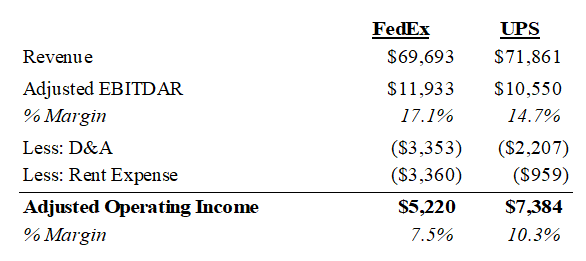
This financial ramifications of having two separate networks, however, are severe. Despite enjoying financial advantages of having a non-union workforce, FedEx throws away this advantage and some in the form of a bloated infrastructure:
 (Source: Company filings)
This has been the case since the early 2000s, and along with it a ~3-turn valuation difference with UPS. The long-term effects are even more mind-boggling: UPS generated more FCF in 2018 than FDX has cumulatively generated over the last 12 years.
From an operational point-of-view, this financial under-performance stems from a severe efficiency differential to UPS on virtually every operational metric:
 (Source: Company Filings, Air Traffic Statistics, Author’s Estimates)
FedEx enjoys a 2.1% EBITDAR advantage due to having a non-unionized workforce (Source: author’s calculations). However, this is more-than-offset by a 4.7% margin disadvantage due to a bloated asset-base (Source: author’s calculations).
The Union Issue
Unions can potentially come into play when you combine Express and Ground segments, and my conversations with industry executives indicate that this is the prime reason Smith has opposed a full-scale integration. According to the IRS:
The general rule is that an individual is an independent contractor if the payer has the right to control or direct only the result of the work, not what will be done and how it will be done… A worker is an employee when the business has the right to direct and control the work performed by the worker, even if that right is not exercised. (Emphasis added)
Specifically, the “degree of control” matters:
Degree of Instruction means that the more detailed the instructions, the more control the business exercises over the worker. More detailed instructions indicate that the worker is an employee. Less detailed instructions reflect less control, indicating that the worker is more likely an independent contractor. (Emphasis added)
Over the past several years, pockets of Ground drivers across the country have been pursuing litigation against FedEx arguing this very reason: FedEx exerts significant control over their work, and they should therefore be classified as employees. FedEx has prevailed in these litigations thus far. However, if the Ground and Express networks were combined, drivers who previously had some leeway in determining their work schedule for Ground shipments must now handle Express shipments that need to be delivered by a certain time. If there’s an 8am delivery in that truck, then the driver needs to get up in the morning even if every other package is a Ground package that can be delivered at any point in the day. Given this, a stronger legal argument can be made that FedEx will be exerting “significant influence” and a much higher “degree of control” over the IC’s work schedules, and FedEx might have to yield and classify IC’s as employees.
A similar situation exists for Express workers. Due to the nature of time-sensitive shipments, work stoppages and strikes can yield havoc for Express businesses. This was a big deal in the early 1900’s in the case of railroads, leading the government to enact the Railway Labor Act of 1926 (RLA). This law essentially laid out a set process for employees to work out grievances with the parent company; in other words, it make it more difficult for employees to stop the operations of an Express business, go on strike or otherwise disrupt the daily package flow of an Express carrier. The key here is that this classification only applied to employees of railroads and other “Express carriers”:
The term ‘‘carrier’’ includes any railroad subject to the jurisdiction of the Surface Transportation Board, any express company that would have been subject to subtitle IV of title 49, United States Code, as of December 31, 1995, 1 and any company which is directly or indirectly owned or controlled by or under common control with any carrier by railroad… All disputes between a carrier or carriers and its or their employees shall be considered, and, if possible, decided, with all expedition, in conference between representatives designated and authorized so to confer, respectively, by the carrier or carriers and by the employees thereof interested in the dispute.
Currently, FedEx Express is designated as an Express carrier under the RLA. However, if the company were to merge its Ground and Express networks, it may lose this classification, giving employees free reign to strike or join a national union (as is with the case of UPS).
I’ve illustrated that union woes don’t justify a ~500 bps margin drag, but can FedEx potentially side-step this? Operationally, perhaps the best workaround for the union situation would be the way FedEx assigns workers to certain deliveries. Express AM deliveries (time-sensitive morning deliveries) are the most time-sensitive, Express PM can be delivered in the afternoon and Ground deliveries are the least time-sensitive. Therefore, FedEx can assign current Express/Ground employees to Express AM deliveries while assigning Express PM/Ground deliveries to employees and independent contractors. This may preserve the RLA status for Express employees without exerting “significant control” over independent contractors.
Financial Implications of Integration
FedEx has an opportunity to increase margins by over 400 bps by integrating its domestic Express and Ground operations. We can estimate this by using UPS as a proxy.
If you were to combine FedEx’s domestic Express and Ground businesses, you essentially have a U.S. delivery business with the following characteristics: about 90,000 drivers and 1,300 facilities handing ~12m daily packages. The comparable UPS domestic company has about 75,000 drivers and 1,000 facilities handling ~17.5m daily packages. On a per driver basis, therefore, FedEx handles about 133 packages and UPS handles 233 packages; on a per facility basis, FedEx handles 9,231 packages and UPS handles 17,500 packages. If we can close each of these gaps by 50%, this would imply eliminating 90k-12m/183=24,000 drivers and 1,300-12m/13,366=400 facilities. We know drivers cost $40k/driver/year for FedEx, so the savings from the 24k reduction would be on the order of $960m. Facilities can cost anywhere from $5m-10m/year depending on the side, and this would give us potential savings of $2-4bn. Finally, FedEx currently spends double per air package relative to UPS, and airlines are highly underutilized, evidenced by a 450bps differential between payload factor vs. UPS (Source: Air Traffic Statistics). By reducing domestic airline capacity, FedEx can realize ~$800m in incremental savings (40% of gap to UPS closed).
This corroborates nicely with our margin picture: taking the low end of ~$4bn in total savings is about 5.7%, which would bump FedEx’s margin from 7.5% to 13.2% vs. UPS’s margin of ~10%. These estimates corroborate with my industry calls. In addition, industry experts agree that logistically, this isn’t an extremely difficult result to accomplish.
Up until now, this was a theoretical possibility. In addition, Smith seems to have a personal vendetta against an integration. According to Q4 2019 Earnings call:
Analyst: “Why not a more radical look at the business I think someone suggested to look at integrating portions of Express or Ground or maybe even going more aggressively just on the overall footprint of the business?”
Fred Smith: “We don’t look at the business as a single segment, we’ve said that over and over again… if we don’t resume any kind of international growth we would change our approach to the business.”
However, this all changed last week: FedEx Express will now begin contracting with FedEx Ground to deliver residential packages. The driving force of this change, Raj Subramaniam, came onto the board of directors about a month ago. Executive turnover over the last year within FedEx’s C-suite also indicates a change in mood and potentially a slate of people ready to look at the business radically. A combination of these factors makes realizing a portion of these potential cost savings a real possibility.
Valuation
FedEx is a sleeping giant- while this opportunity has existed for over a decade and has in fact intensified in recent years as the company has invested heavily in its duplicative Express infrastructure. There is precedent for an integration strategy working, however. Back in 2013, Third Point got involved in the company championing some of these same issues I’ve raised in this article, but exited by way of greenmail.
Using the low range of our estimates, FedEx can achieve ~$4bn in incremental pre-tax savings through a full integration of FedEx Ground and Express. These numbers are based on only 20-40% reduction in the “efficiency gap” between the domestic Express and Ground networks. Interestingly, international Express is doing fine with margins far greater than that of domestic Express (Source: Author’s estimates based on conversations with industry experts).
On top of this, FedEx has historically traded at a ~6-7x EBITDA multiple, relative to UPS’s ~10-11x multiple. This is most likely a result of FedEx’s lower cash conversion, higher capex requirements and lower margins (despite it having a superior Ground business that is non-unionized). An integration will directly improve on all these metrics and we can expect to see a multiple re-rate along the lines of UPS given the success of this strategy.
Its important not to overstate the what is happening, however. Specifically, FedEx has publicly stated that this change isn’t a full integration; rather, it is structured as a contract between the two segments and will only deal with residential deliveries. However, this does signal a shift in management’s view on the business and indicates that we are in the early innings of a thorough internal review of the company’s asset efficiency. Previously, no internal studies had been conducted in FedEx to explore the potential monetary savings of an integration strategy (Source: Author’s calls with industry experts). Here is the potential savings we are looking at with such a strategy:
 (Source: Company filings, Author’s Estimates)
Others have argued that value can be recognized in several other ways- specifically a spinoff of FedEx Ground. While this is a good idea in theory, it is logistically difficult given the overlap in customers between the two businesses. In addition, it would be difficult to justify the valuation of FedEx Express as a standalone entity, which is chronically FCF negative given its current footprint and package volume. FedEx realizes this and therefore they haven’t divested/spun-off any business in the past several decades, another testament to the importance of scale in this industry.
Conclusion and Other Issues
There are other pertinent issues that are relevant to FedEx, namely:
- The politics surrounding the USPS and last-mile delivery. Few talk about it but the USPS is critical to the last-mile delivery segment of the industry but is chronically unprofitable.
- The elephant in the room, Amazon and its recent skirmish with FedEx (background) as well as UPS’s reliance on a melting ice cube. Amazon is quietly buying an airline fleet and has entered into off-balance sheet warrant contracts with Atlas Air (AAWW), Air Transport Services Group (ATSG) and StarTek (SRT), among others.
- FedEx in Europe and the havoc reaped by NotPetya on TNT Express as well as UPS’s desire to maintain a stranglehold on the region.
- DHL Express as a real-life example of what can be accomplished through capacity consolidation (10x operating profit over 10 years in Express).
These issues, while important, will undoubtedly make this article unbearably long. I mention them in passing to give a sense of some of the peripheral issues one should consider when deciding to invest in FedEx.
As Smith says, the economy has a say and the competitors have a say. The recent developments between Express and Ground seem to indicate we are in the early innings of a managerial review of the company’s disparate operations, and perhaps a step towards integration. While one should follow these developments closely and how they evolve, one also needs to look no further than UPS to determine how FedEx can look/operate with a more integrated business. I would also recommend getting familiar with BTS data to get operational information and indications of improvement at Express (both domestic and international).
Even a portion of the savings I outlined here (>$4bn on the table) along with a multiple re-rate for the stock can allow investors to realize significant upside from investing in FedEx. All in all, there is a clear path to $300/share if this optimization continues.
Disclosure: I am/we are long FDX. I wrote this article myself, and it expresses my own opinions. I am not receiving compensation for it (other than from Seeking Alpha). I have no business relationship with any company whose stock is mentioned in this article.
Recent Comments