

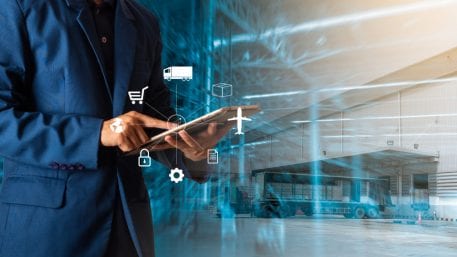
Supply chain management is increasingly more strategic than operational, enabling businesses around the world to improve their bottom lines while meeting the intensifying demands of end customers: quick and convenient ordering, faster and cheaper delivery, greater product choice and more.
In recent years, Industry 4.0 has opened up the opportunity for supply chains to not only digitize, but modernize. Internet of Things (IoT), robotics process automation (RPA) and autonomous vehicles are just some of the cutting-edge solutions offering positive disruption. According to research from JDA Software and KPMG, the C-Suite is eager to invest in these technologies to ramp up their supply chain management strategies.
Supply chain technology offers a level of automation, error mitigation and efficiencies that humans, in many cases, cannot provide. Indeed, supply chains are in the midst of a technological revolution, according to George W. Prest, CEO of logistics and supply chain association MHI.
Yet, while there are many areas of opportunity for digitization to help businesses meet the ever-increasing market demands, Prest told PYMNTS in a recent interview about the human capital challenge facing supply chains everywhere.
A Technology Combination
“Today’s supply chains do much more than just physically move materials and product from place to place,” Prest explained. “Customer service expectations are through the roof, and putting supply chains under more stress than ever before.”
Indeed, those demands for speed, efficiency, choice, affordability and beyond have introduced a high volume of friction and challenges for supply chain managers. Just a few of the tallest hurdles of a modern supply chain include enabling visibility and transparency as goods move from Point A to Point B, ensuring that those movements are accurately tracked and recorded, allowing digital communication between players throughout a supply chain and digitizing the flow of funds between businesses based on this information.
Yet, these challenges also present an opportunity for supply chain managers to wield a more strategic position within their enterprises, as technology arms these professionals with the capability to overcome these challenges.
There are many tools out there today vying for their chance to improve supply chain operations. Prest highlighted several, including blockchain, autonomous vehicles, cloud computing, IoT, predictive analytics and others — though not one single technology is going to emerge as a silver bullet to supply chain friction.
“These technologies work together to create next-generation supply chains that can meet new supply chain challenges,” he said.
Artificial Intelligence
One of the most heavily touted technologies in this arena is artificial intelligence (AI), which Prest pointed to as a key tool for positive change. Citing MHI’s own research, he said that while AI adoption in supply chains now stands at about 13 percent, it is expected to rise to 62 percent over the next five years.
However, perhaps the biggest role for AI, he added, is in data.
“AI will help firms make sense of the flood of digital information being generated by IoT and other technologies, to gain actionable insights about their operations,” Prest said, pointing to the “flexibility, reliability and speed” that AI can offer in its analytics capabilities.
Like any technology, AI will “not be the ‘be all, end all’” tool to elevate supply chains to the level necessary to meet today’s market demands, but the technology is particularly promising — considering its ability to ingest and make use of data in a way that humans alone cannot do.
The Human Capital Challenge
Technology is undoubtedly a necessity for today’s supply chains working to meet what Prest described as “the continued mindset of ‘faster-better-cheaper’” that the market requires. While there are several tools that can address an array of challenges, Prest emphasized that one of the largest points of friction in supply chains is of another nature.
“One of the main challenges facing our industry continues to be the shortage of skilled workers who can implement next-gen technologies, including managing and gaining insights from the onslaught of data coming from digital supply chains,” he said.
In other words, while technologies can generate, aggregate and analyze data for the purpose of faster, more efficient supply chains, there must be humans to make use of the insights that these technologies create.
Indeed, MHI’s 2019 Annual Industry Report found hiring qualified workers to be the biggest supply chain challenge for survey respondents, and Prest said he expects a similar outcome in the 2020 report. Talent will also be one of several key topics at MHI’s MODEX industry conference in Atlanta this coming March, the company said in a recent press release. It’s an important focus for an industry currently consumed with the demand to integrate cutting-edge technology, he noted.
“A critical component in the success of these digital supply chains is the ability to hire and retain the talent to run them,” he said. “One of the largest challenges — and opportunities — moving forward for supply chain advancement is to improve the digital literacy of the workforce.”


Recent Comments