


News of study comes as MUA’s VICT action threatens Sydney-like congestion
|
|
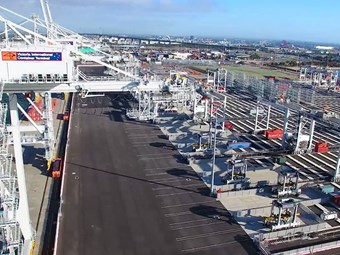
VICT in the port of Melbourne
|
State government body Freight Victoria is to look into empty container management capacity and supply chain issues in Melbourne.
The move comes as the system faces a period of industrial relations disruption at Victoria International Container Terminal (VICT), with the possibility of a new layer of disruption on an already heavily stretched system.
It is understood Freight Victoria has engaged consultancy firm NineSquared to conduct the study, which follows the commitment of the state government to ensure that its proposed Voluntary Performance Monitoring Framework for container trade through the Port of Melbourne covers all parts of the Melbourne container supply chain.
Road haulage body Container Transport Alliance Australia (CTAA) welcomes the move.
“CTAA has worked closely with NineSquared and its principal Phil Bullock in the conduct of a similar study in NSW, the NSW Empty Container Study,” CTAA director Neil Chambers says.
“This has also extended to collaborative work between industry and the NSW Government to try to address the study’s recommendations for improvement.”
“The NSW study estimated that current empty container management inefficiencies in NSW result in an additional cost of $49 million per year, which could blow out to approximately $100 million if not addressed. And, that estimate was made before the current severe empty container congestion in Port Botany, which is ongoing.”
“CTAA anticipates that the Victorian study will discover similar added costs in Melbourne caused by inefficiencies and congestion.”
“Tight physical and slot capacity in many parts of the Melbourne empty container chain leads to:
- Supply chain delays and added container handling
- Increased empty redirections to alternative de-hire facilities;
- Added truck kilometres travelled and futile truck trips;
- Difficulties in obtaining suitable empty containers for export packing; and
Fractious arguments between shipping lines, importers and transport providers about container detention fee demands when containers aren’t de-hired within detention free timeframes.
“Transport operators now have to hold swags of empty containers in their yards before they can gain a slot for de-hire, which could be as much as two days hence at some empty parks.”
“CTAA also receives numerous examples of export container stock being either physically unavailable or transport operators not being able to obtain sufficient slots to pick up the required empties from nominated empty parks for the export customer.
“This can have a devastating cost impact on agricultural export supply chains where profit margins per tonne of commodity are thinner.”
“And even though we are well into the 21st century, some shipping lines still don’t provide any accompanying electronic data to verify delivery order instructions for empty import container de-hire. This holds back the transport sector from achieving paperless gate entry procedures and increasing truck turnaround velocity at empty container parks.”
“Instead, copies of delivery orders need to be emailed through to empty yards, or the driver needs to present paper verification at an operational window. That archaic behaviour must stop, and it’s not Covid-safe.”
“CTAA looks forward to working closely with NineSquared and Freight Victoria to ensure that key stakeholders in Melbourne’s landside container logistics chain can input into the study.”
Meanwhile, the Maritime Union of Australia (MUA) squeeze on Victoria International Container Terminal (VICT) is to begin in earnest on Friday and freight industry bodies are again registering their concern.
The union action is to include:
A stop-work for a full 12-hour shift on Friday, starting 6pm.
- Further 12-hour shift bans for Sunday, at 6am, following immediately by a 24-hour ban commencing at 6pm – therefore incurring a 36-hour concurrent stoppage of all VICT’s operations and equipment maintenance
- From Monday VICT’s control room will be banned from operating cranes unless the operations of each crane is manned by a dedicated quayside supervisor.
- An indefinite ban on overtime, various restrictions on communications phone use and bans on interaction with anyone outside Australia.
“VICT accounts for a third of Victoria’s container freight,” VICT CEO Tim Vancampen says.
“The union is directly attacking VICT’s unique way of working as a modern, automated terminal.
“They want to take us back to the past, no matter the cost or the ill-considered timing in the context of the lockdown.
“This campaign won’t produce the extra jobs, massive pay rises and fewer hours the Union has promised our employees.
“All it will do is undermine VICT’s competitiveness and threaten the benefits of port automation for Victoria and for the Port of Melbourne.
“If the MUA was serious about representing VICT employees’ interests it would seek to protect their modern jobs, not jeopardise them.”
Read about MUA and other comments on the dispute, here
CTAA notes that, as VICT handles larger ships that will struggle to be handled at Swanson Dock, the action will likely have an impact on ship schedules in other Australian container ports.
“It’s interesting that the other two unions with coverage under the VICT enterprise agreement – the Australian Maritime Officers Union [AMOU] and the Electrical Trades Union [ETU] – are being relatively quiet about the MUA actions,” CTAA says.
“However, CTAA notes that the AMOU, MUA and ETU have formed a ‘Union Single Bargaining Unit’ to negotiate with VICT on the new enterprise agreement.
“How the MUA might deliver on its ‘promise’ of exempting medicines, medical supplies and refrigerated containers is unknown if road receival and delivery activities are suspended due to work stoppages.
CTAA reiterates the view that if faced with an intractable difference between the parties, VICT should take the matter directly to the industrial umpire at the Fair Work Commission [FWC], and the federal government should support a quick resolution to the dispute via arbitration, as the Federal Government was prepared to do in the similar EA disputes at DP World and Patrick last year.
The Victorian Transport Association (VTA) is also reiterates it alarm and frustration at the MUA’s moves.
“The MUA should be ashamed of this opportunistic and irresponsible industrial action, which comes at a pivotal juncture in Victoria’s recovery from the Covid pandemic, and with supply chains already under significant additional pressures because of the recent snap lockdown in place throughout the state,” VTA CEO Peter Anderson says.
“The VTA encourages the union to rethink their unrealistic and unworkable demands, which introduces unnecessary competitive pressures that could easily see freight customers send and receive goods via other ports, to the detriment of road, rail, and sea freight operators in Victoria.”
Shipowner body Shipping Australian Ltd (SAL) rejects any MUA ameliorating statements on cargo exemptions and expresses its sympathy for those taking collateral damage, including traders and transporters.
“Shipping Australia also would like to express sympathy to importers and exporters of cargo at this difficult time, made even more difficult by this selfish industrial action,” it says.
“At a time when businesses are reeling from the twin Covid and the Covid-induced economic crisis, it is outrageous that businesses should be deliberately hit by uncaring and reckless industrial action.
“Shipping Australia also would like to express sympathy to the trucking industry.
“A substantial volume of trucking is driven by imports and exports and so the trucking industry’s work will be substantially disrupted.
“Meanwhile, the problems faced by trucking operators in dealing with empty container management can only get worse if these strikes go ahead.”
It estimates daily delay costs at $67,042 for 2,500 teu capacity ships $79,788 for 4,000 teu ships and $124,279 for 8,500 ships and warns that, as with Sydney last year, container lines may see their ships skipping strike-bound and congested ports.
“It really is time for the federal government to recognise the vital importance of the international container trade,” SAL CEO Melwyn Noronha says
“Shipping Australia calls for the federal government to intervene and to protect Australians from this reckless industrial action.”
More information on the Freight Victoria study is awaited.
NSW Empty Container Study details can be found here.
You can also follow our updates by joining our or liking us on Facebook.
Trucks For Hire | Forklifts For Hire | Cranes For Hire | Generators For Hire | Transportable Buildings For Hire
Recent Comments