

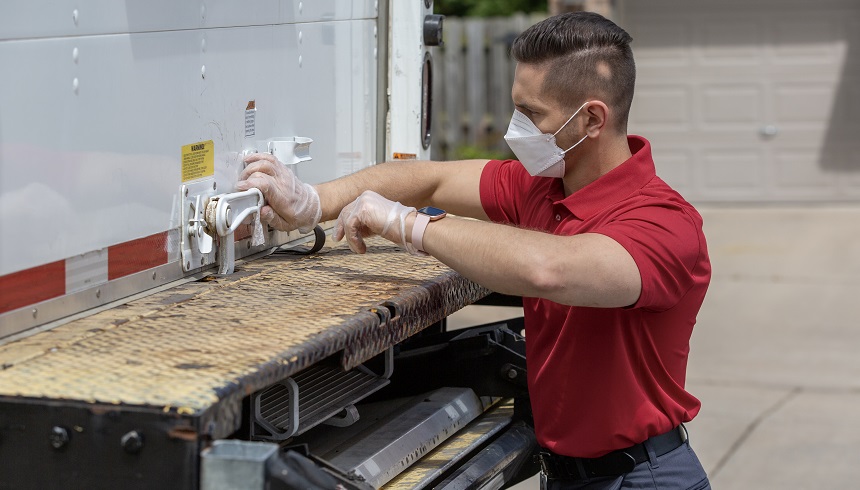

J.B. Hunt says it makes sure consumer know about safety protocols and delivery options.
By Larry Thomas, special to Furniture Today
HIGH POINT — Unprecedented sales volumes, delayed shipments and spot shortages of key supplies have become a way of life for those who buy and sell furniture in the age of COVID-19, and those same issues, plus a handful of other roadblocks, have migrated to another key segment of the business: those who deliver furniture to retail warehouses and consumers’ homes.
The issues are especially serious for companies that specialize in last-mile deliveries, but they are affecting furniture haulers of all types. And just like their counterparts in manufacturing and retailing, they don’t foresee that changing anytime soon.
“Business is stronger that it has ever been, and we anticipate it will continue to get stronger,” said Josh DeLay, vice president of final mile business development for J.B. Hunt. “People have been spending a lot of time at home thinking about how the house looks, and that bodes well for those who build and sell furniture, as well as those of us who make sure that merchandise gets delivered to the customer.”
DeLay and other delivery executives say their delivery teams, warehouse workers and support staffs have gone above and beyond the call of duty to make sure deliveries keep pace with orders, but the pandemic has presented enormous challenges ranging from the implementation of protocols to keep employees and customers safe to the unprecedented spike in orders to fill.
“For quite a while, the (furniture) companies just didn’t have the inventory available to get everything to the consumer. But as that has begun to rectify itself: The flood of delivery orders has started to arrive, and that has put pressure on the local delivery network,” said Christopher Randell, vice president of revenue at Freight Club.
Safety first
But delivery executives emphasized that, regardless of the sales volume, they won’t compromise the safety of their employees or the consumers who receive the furniture.
Besides the usual protocols of using masks, gloves and hand sanitizer, most have policies requiring vehicles to be wiped down before and after making deliveries, and delivery teams and warehouse workers go out of their way to adhere to the social distancing guidelines published by the Centers for Disease Control. Plus, most have their temperatures taken before starting the workday.
“We built these protocols by thinking about everybody who is involved in a delivery and keeping everyone’s safety in mind throughout the process,” said DeLay. “And we are also collaborating with our (retail) clients. There are a lot of (regulations) that are very specific to certain markets.”
But the biggest change has been the types of delivery the last-mile carriers are now offering.
While most focused on white-glove delivery almost exclusively prior to the pandemic, other options such as threshold delivery have jumped in popularity in recent months. Even though such non-white glove deliveries require the consumer to unpack the furniture, move it to the desired location in the house and dispose of the packing materials, many are choosing this option to reduce or eliminate contact with delivery teams.
“There’s no questions that threshold deliveries have gone way up,” said Geoff Chasin, senior vice president of Cardinal Logistics. “I know of one retailer who went from zero to about 35% threshold deliveries almost overnight.”
Chasin said the delivery choice often boils down to whether the consumer is comfortable having delivery people in her home for what could be an extended period of time.
“It’s very client specific,” he said. “Higher-end retailers have fewer threshold deliveries because of the type of product they’re selling. If you’re buying a $10,000 sofa, you don’t want your brother-in-law shoving it through the front door.”
Randell said Freight Club has seen threshold deliveries increase by more than 40% in recent months, and he said consumers have the option of downgrading a white glove delivery at the last minute if they are not comfortable with the health and safety aspects of the project.
“While a consumer may have booked a delivery as white glove, his/her comfort level can change, depending on what’s going on around them,” he explained. “We just have to maintain some flexibility.”
Randell acknowledged that such changes have the potential to throw off delivery schedules, but that hasn’t been a major issue thus far.
“The sheer volume of orders has created delays, but the safety protocols themselves have not,” he said, noting that threshold deliveries take less time that white glove projects. “The increase is threshold deliveries has kind of evened things out.”
But regardless of the type of delivery the customer chooses, executives said good communication with the customer is more important than ever. Delivery teams may utilize text messaging, email and even old-fashioned phone calls to keep all parties up to date.
“There has to be continuous communication,” said Chasin. “Many of our clients want the drivers to call the customer and go over a check list … so that everyone is comfortable. But however we communicate, we have to be rigorous and do it every day, every stop, with every customer.”
DeLay said his team makes sure consumers clearly understand the company’s safety protocols and the available delivery options. Plus, it allows the company to make sure the delivery team will be safe, as well.
“We want to make sure the consumer has the delivery experience that makes them the most comfortable, given the uncertainties of the pandemic,” DeLay said, “It leads to more interaction between our scheduling team and the consumer.”
And how have drivers responded to all these additional protocols?
“One good way to look at it is that our attendance from employee drivers is at an all-time high,” said DeLay. “The type of teamwork we’ve seen has been refreshing.”
Serving retailers
Such interaction is not limited final mile delivery entities. Carriers who haul goods from manufacturers’ warehouses to retail distribution centers also must be in constant communication, since each retailer has its own set of safety protocols for deliveries, said Jack Hawn, president of Zenith Freight Lines.
Hawn said many retailers have limited the number of loading dock doors that are in use — often opting to use every other door to make it easier to maintain social distancing — while some require drivers to call ahead to let them know the approximate time if their arrival.
“Some are very strict about their safety protocols, but I think our drivers appreciate that. They feel secure going in there,” Hawn said. “I’m pretty proud of how our drivers have responded to COVID-19. We haven’t had a single CDL driver get sick with the virus.”
He said Zenith’s long-distance drivers, who primarily deliver goods to 13 Zenith hubs around the country, have been encouraged to take food with them on the road to avoid eating in restaurants and to use a credit card to pay for fuel at the pump so they won’t have to go inside the truck stop.
Perhaps surprisingly, one of the biggest pandemic issues currently facing CDL drivers is the difficulty renewing their driver’s license.
The U.S. Department of Transportation gave CDL drivers with expired licenses until Feb. 28 to get a new one, but Hawn said most states are offering license renewals on a very limited basis by appointment only, and it can take weeks or months to get an appointment.
Hawn believes the deadline will be extended by at least a couple of months, but there’s no assurance of that.
“One of my drivers moved from North Carolina to Texas in October, and he couldn’t get an appointment with DMV there until May. If that deadline isn’t extended and his North Carolina license expires, we can’t use him,” he said.
Recent Comments