

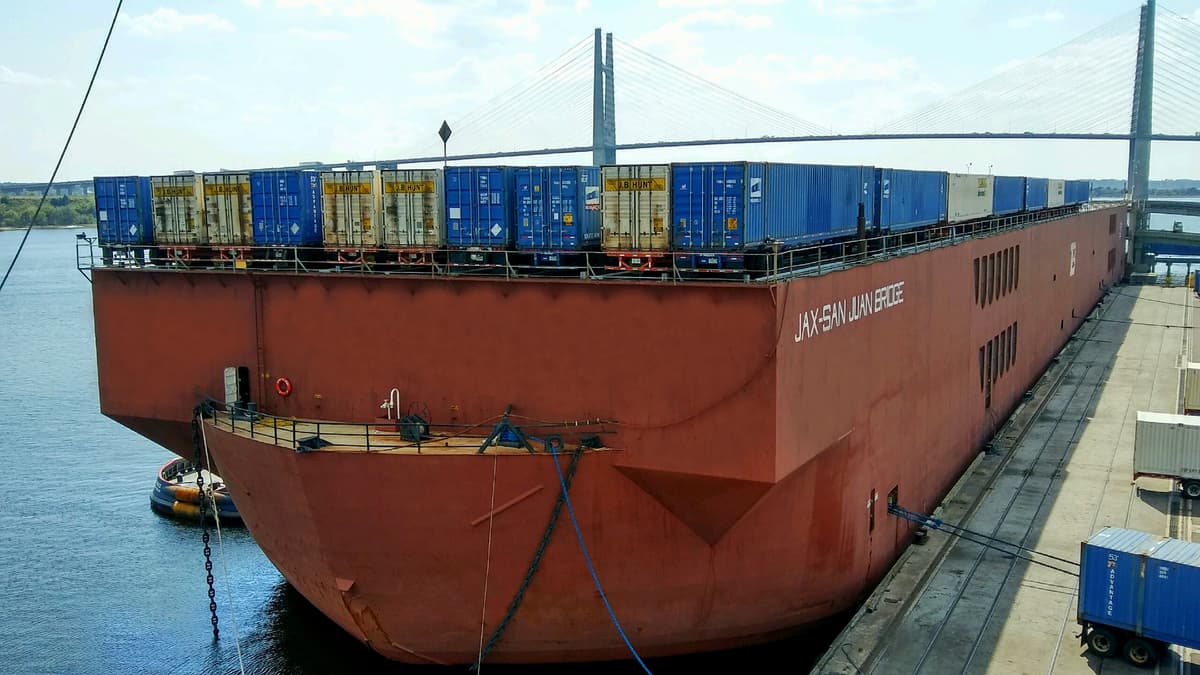

Moving trucks off the I-95 corridor north and south of New York and putting their cargo on the water instead will be a goal of the North Atlantic Marine Highway Alliance, or NAMHA, which is armed with grant money to study how to best implement that traffic shift.
NAMHA first came together in 2018 with a cross-section of governments and other interested institutions that see the open waters of the ocean as a way to move traffic up and down the Middle Atlantic and New England, with the highway-clogged New York area as sort of a ground zero for that traffic. Members of NAMHA, with the New York City Economic Development Corp. (NYCEDC), recently visited Washington as an unofficial launch of the study, powered by a federal grant given from the Federal Maritime Commission to the NYCEDC.
“There’s a lot of alignment among the maritime industry that this is a good thing,” Andrew Genn, senior vice president for transportation at the EDC, said of the study and the goals of NAMHA in general. “The focus of the study is to understand what is the low-hanging fruit in the freight world in the NAMHA region for moving international containers and domestic trailers by marine highway.”
The meetings in Washington, he said, were to speak with members of the relevant Congressional staff “so that there was heightened awareness that we’re undertaking this effort.”
All the areas represented by NAMHA are interrelated. For example, as Genn noted, a truck moving up from the mid-Atlantic to New England may not be picking up or dropping off freight in the New York area but is still impacting the volume of traffic on the road in New York City as well as contributing to air pollution.
“NAMHA members are truly looking at building a system that will get trucks off I-95,” Genn said. From the New York perspective, there’s also a goal to move more cargo up the Hudson to the port of Albany. It would have the benefit of taking trucks off the New York Thruway, also known as I-87.
In 2018 the EDC launched FreightNYC, an effort to use New York’s waterways and train infrastructure to get freight off of trucks – and the roads – and instead move freight using water and rail infrastructure. Genn said some of the things learned from FreightNYC led the EDC to conclude that the types of freight that are best for transitioning away from trucks and on to water or rail would be “heavier cargoes that are less time-sensitive.” Beverages and household supplies were cited by Genn as examples that would fit that definition.
There is an existing “marine highway” hauling dry bulk cargoes and aggregates, “but beneficial cargo owners have never really seen those kinds of services for higher value goods,” Genn said.
And changing attitudes will be a key goal of NAMHA. As Genn said, since the dawn of the interstate highway system, “we’ve developed the ability of shippers to rely on trucking for door-to-door moves. People developed supply chain models that just haven’t changed.”
“And a lot of logistics managers just don’t know any other way,” he added. “It’s the most tried and true way.”
So what will NAMHA do to change that?
Adam Lomasney, a colleague of Genn’s at NYCEDC, said the study’s engagement with shippers and cargo owners will be to provide information on the “end to end costs” of a marine highway service, “and what does that entail.” “We’re already speaking with a lot of companies that have an interest in this, to understand their supply chain better, to understand their operations and what are their cost centers,” he said.
The end result, Lomasney said, should be the ability to say to a cargo owner or shipper that “other companies have gone through this exercise with us,” and that moving some cargo on a marine highway “is not going to break your cost model.”
The goal will be to “drill down to the true costs of the system,” Lomasney said. That includes a knowledge base of labor and other regulations that might need to be modified to make a marine highway work for a greater number of shippers.
The study is expected to take six to seven months to complete. “The breakthrough we’re seeking is for logistics managers, probably of bigger fleets, to see that the economies of scale for shipping by water just makes a lot more sense than having truckers stuck in the Bronx,” Genn said.
And driving through New York City by truck is likely to get worse. There’s the necessary overhaul of a key portion of the Brooklyn Queens Expressway and a possible crackdown on trucks and truck weights that might go along with that. Congestion pricing in Manhattan is coming; and more tolls to finance highways are under consideration in states like Connecticut and Rhode Island.
“All these things are putting pressure on the freight market,” Genn said. “It’s been interesting to see people who have not been receptive to this idea in the past are more receptive than they have been. Even a few years ago we would have heard crickets if we called them about it.”
Recent Comments