

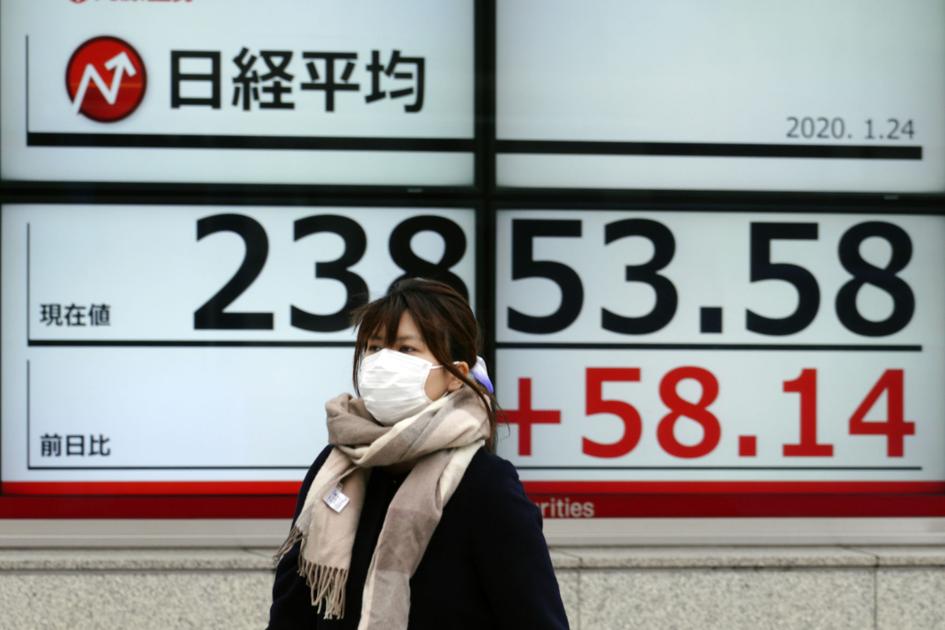

Wall Street stumbled at the end of the week amid fears that efforts to curtail a lethal virus in China could further disrupt the global economy.
The Dow fell nearly 200 points Thursday before recovering to close at 29,160.09, down 26 points for the day, after China’s decision to expand its quarantine beyond Wuhan, where the virus first appeared. Oil prices also dipped as traders anticipated global slowing.
The pain continued Friday as health care companies led a broad slide in U.S. stocks. The S&P 500 was on track for its worst day since early October. The benchmark index was also on course to snap a two-week winning streak.
Friday’s selloff came after news that a Chicago woman had become the second U.S. patient diagnosed with the new virus from China. Health authorities worldwide have been taking measures to contain and monitor the coronavirus outbreak.
A day earlier, the unprecedented lockdown of a provincial capital of 11 million people and several other cities showed that Chinese authorities are belatedly ramping up efforts to head off a potential pandemic. The virus has killed dozens and sickened nearly a thousand in China.
Reported cases in Singapore and Vietnam show that the illness, which causes flulike symptoms, has jumped national borders.
Trading screens Thursday and Friday glowed red as losses spread to European markets and the United States.
“This disruption comes at a time when Chinese economic growth already looks fragile, and it will unfortunately undo some of the boost in consumer and business sentiment from the China-U.S. trade deal,” said economist Eswar Prasad, former head of the International Monetary Fund’s China unit. “A broader spread of this disease has the potential to disrupt travel, trade and supply chains throughout Asia, with knock-on effects on the world economy, since Asia is now a key driver of global growth.”
Worst time
The Wuhan coronavirus appeared on the eve of the Chinese Lunar New Year, an annual festival that sees hundreds of millions of people travel to their hometowns for family celebrations.
The quarantines already announced — and those that may follow — are certain to dent spending on airlines, railways, hotels, restaurants and other parts of the consumer sector that Chinese officials have been seeking to develop.
“This couldn’t have come at a worse time,” said Jorge Guajardo, former Mexican ambassador to China.
On the Yangtze River, Wuhan is a key transport hub for goods moving from China’s interior to the coast, as well as for north-south commercial traffic.
The city reflects China’s role at the center of pan-Asian supply chains for electronics, pharmaceuticals and automobiles.
Manufacturers in recent days were rushing to get shipments out before the New Year festivities. Government officials will use the annual break to control the outbreak while factories are idle during the roughly three-week holiday.
“Any serious transportation shutdown has the potential to interrupt supply chains,” said Phil Levy, chief economist for Flexport, a freight forwarder. “(But) it will make a big difference to economic impact how long this virus threat lasts.”
The flulike ailment adds to worries over the global economy. Earlier this month, the IMF trimmed its 2020 growth forecast to 2.9% from 3%, citing weakness in key emerging markets such as India.
‘Major distraction’
Chinese officials, meanwhile, must battle the unexpected health crisis and implement the terms of a new U.S.-China trade deal. The accord requires China to increase its spending on American goods and services by $200 billion over the next two years and begin opening its financial services market by April 1.
“That could be a major distraction,” said Scott Kennedy, a China specialist at the Center for Strategic and International Studies. “Meeting targets in the trade deal would fade in comparison to managing the domestic politics and economics of this crisis.”
Previous health scares offer reasons for investor concern, at least in the short run. In 2014, an Ebola outbreak in West Africa knocked U.S. markets off course as investors worried about a chilling effect on consumer spending. The Dow fell nearly 7% between mid-September and mid-October that year.
Likewise, in 2003 as Chinese authorities struggled to curb the fatal severe acute respiratory syndrome (SARS) virus, the MSCI China Index plunged by more than 10%. SARS ultimately was responsible for the deaths of 774 individuals worldwide, according to the U.S. Centers for Disease Control and Prevention.
The economic hit from SARS was more lasting, according to a study by economists Jong-Wha Lee of Korea University and Warwick McKibbin of the Australian National University. In a 2004 paper, they found that the fast-moving virus carved more than 1% from China’s economic output and 2.6% from that of Hong Kong.
Fallout from the disease continued to dampen activity and marginally depress investment in China and Hong Kong for the next decade, the study concluded.
But markets rebounded swiftly as SARS was brought under control, indicating that in most such cases any financial damage is short-lived, Oliver Jones, senior markets economist with Capital Economics in London, wrote in a note to clients Wednesday.
China’s burdens
Still, China already is burdened by soaring government debt, meaning officials are less able to offset any economic damage with tax cuts or increased spending.
China also accounts for twice as great a share of the global economy as it did in 2003, “meaning there is greater scope for events there to set the tone in global markets,” Jones added.
Official measures to blunt the disease also are likely to be heavy-handed and disruptive, according to Guajardo, who was Mexico’s ambassador to China during a 2009 outbreak of swine flu.
In that case, Chinese authorities concluded that the virus had originated in Mexico and responded with a draconian crackdown on all Mexican citizens whether or not they had recently visited their homeland, Guajardo said. Individuals, including a Mexican consular official visiting from Cambodia, were arbitrarily quarantined for a week.
“It was awful. None of it was done scientifically,” Guajardo said.
Investors drew solace from a meeting of the World Health Organization (WHO) emergency committee, which decided, for now, not to declare the Wuhan episode a public health emergency of international concern.
On Twitter, Patrick Chovanec, a China specialist and chief strategist at Silvercrest Asset Management, offered a chilling reminder of the worst-case risks.
“Behind everything WHO does is the specter of the 1918 global influenza epidemic, which killed an estimated 50-100 million people,” he wrote. “That’s the nightmare they’re always thinking about.”
Recent Comments