

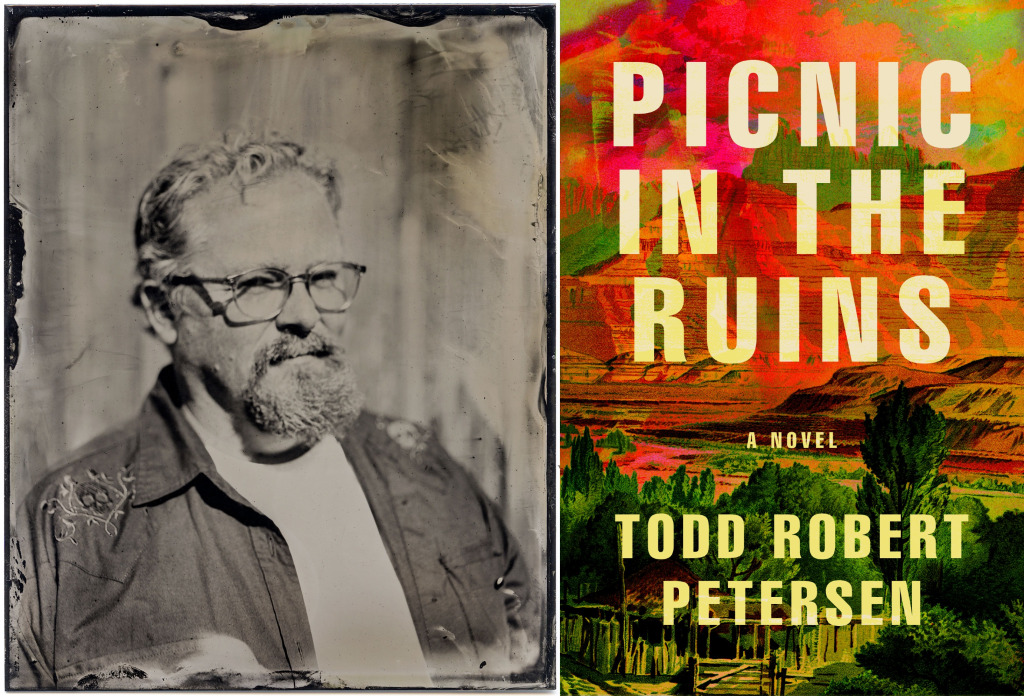

“I wanted to try something I hadn’t seen before, but more than anything I just wanted people to read a crime novel they can have fun with,” says Todd Robert Petersen, referring to his new book, “Picnic in the Ruins” out now from Counterpoint Press.
The book is a romp populated with a cast of eccentric characters and marked by extreme moments of dark humor, delicious irony and bizarre scenes. It all takes place in the surreal red-rock backcountry and small towns of Utah and Arizona, and in national parks and national monuments.
But there are also revelatory themes that run through the story, which is centered around the archaeological sites and cultural artifacts created by the Indigenous people who once lived in the territory. Big issue questions arise: Who owns the artifacts? Who owns the land? Who owns history, after all? As one character puts it, “The artifacts on their own are meaningless. They need a story of the people who made them and used them.”
Petersen, 51, is a professor at Southern Utah University, where he teaches creative writing and film theory. He is also the author of “It Needs to Look Like We Tried,” “After Dark” and “Rift.”
He teaches his creative writing students partly by example, counseling them, “If you’re afraid of making mistakes, then you’re going to be afraid of putting something new out there. Push into new territory.”
This conversation has been edited for length and clarity.
Q: You gathered material for the book partly by talking with locals during the 20 years you’ve lived in Utah, right?
A: Initially, I didn’t know that’s what I was doing. Sometimes writers get themselves tuned to a frequency and stuff starts coming our way. I’ve had hundreds of conversations with park rangers and superintendents, American Indians, special-collections archivists, mapmakers, archaeologists, geologists. Enough of these conversations cohered in a way that I felt I wanted to tell the story.
Q: You’ve been up close and personal with the backcountry.
A: There was a long period of time when I was out there, sun-baked, with boots on the ground. Punctured tires are common in those areas, so I’ve sort of semi-destroyed vehicles while I was exploring. That’s where a lot of the book’s details come from.
Q: Did you find artifacts?
A: I did, under the guidance of National Park Service archaeologists and after agreeing not to talk about where this stuff is. I don’t think I found anything that had never been found before, though. We walked through one place where points (arrowheads and spears) were once made, and there were a few dwellings and long petroglyph panels. You’re moving through this space and you look up and, ‘Whoa!’ The petroglyphs took my breath away. I got to help do an inventory of petroglyph panels.
Q: One school of thought says artifacts should be left where they’re found and not taken at all. Another promotes removing them from collections and returning them to where they were originally found.
A: Leaving things in place may be consigning them to destruction because of energy development. But now that there’s some possibility of having some of the sites restored, maybe there’s some hope for leaving artifacts where they are. I feel like there’s a combination of things that might best be done via technological solutions. Like using technological tools to look down into the ground for insight recordings, without having to disturb everything.
Q: What about human curiosity? People were able to find their way to that 12-foot-tall metal monolith/art installation discovered in the Utah desert last November.
A: And the impacts on that area were pretty severe. We have such an interest in things like artifacts and cultural sites, or just beautiful landscapes in the wilderness, that we forget our presence has tremendous and maybe irreversible impact on that thing we love so much. Once we think about everything we’ve done in our attempts to save something, maybe we didn’t save it after all.
Q: “Picnic” also looks at the degradation of cultural sites at national parks and monuments, due to tourism.
A: I don’t want to throw shade on the National Park Service — nothing could be further from that — but there are key sites where the impact has been so great that the question has become, “Have we worked backwards? Have we tried to preserve cultural sites with protections, which attract attention, and a vicious circle gets going and we end up loving these places to death?” There are places like Zion and Bryce Canyon national parks where there are so many people that it’s no longer delightful to go there. One doesn’t want to pull up the drawbridge, but every now and then that’s what you want to do.
Q: The National Park Service seems to be in a Catch-22.
A: With the mandates the parks have for maintaining and preserving them for the future, they’re faced with an almost impossible task. That is, given the idea they’re trying to maintain, which is: These places are amazing and we should be doing something to make sure that people have access to them, and also that they’re protected from other kinds of commercial endeavors that might turn them into something else. There’s not a solution to all of this. The more I think about it, the more the complexity of the situation is revealed.
Q: “Picnic” was thought-provoking and funny. What can we look forward to next?
A: I thought I would play around with another madcap crime story, about some people on the run in an Airstream trailer. We oftentimes have these high-speed chases in crime novels, and I thought, “What would it be like if there was a low-speed chase in an Airstream?” Also, Area 51 and the Extraterrestrial Highway are going to play a part, too. I’ve got my will all worked out, so if I disappear….
Recent Comments